Sunday, February 28, 2016

Utricularia roundup, February 2016

Everyone knows that Drosera is my favorite genus of carnivorous plants. I mean, it's in the name. The number 2 spot goes back and forth – sometimes it's Pinguicula, but lately I think it's been Utricularia. It's funny, because when I was first first starting out I didn't get Utricularia at all. I had no idea why anyone would bother growing such weird, dumb little plants. Incidentally, I still feel that way about the aquatic species (but don't tell anyone).

Why Utricularia? Well, as with sundews it's a big, sprawling, cosmopolitan genus. There's a huge variety out there to explore, and several different cultivation styles to master. And of course, the flowers are a real treat, whether it's cute little spray from the easy terrestrials, or a more impressive display from larger/touchier species. Of course, the fact that very few people seem to specialize in Utricularia just makes them that much more attractive.

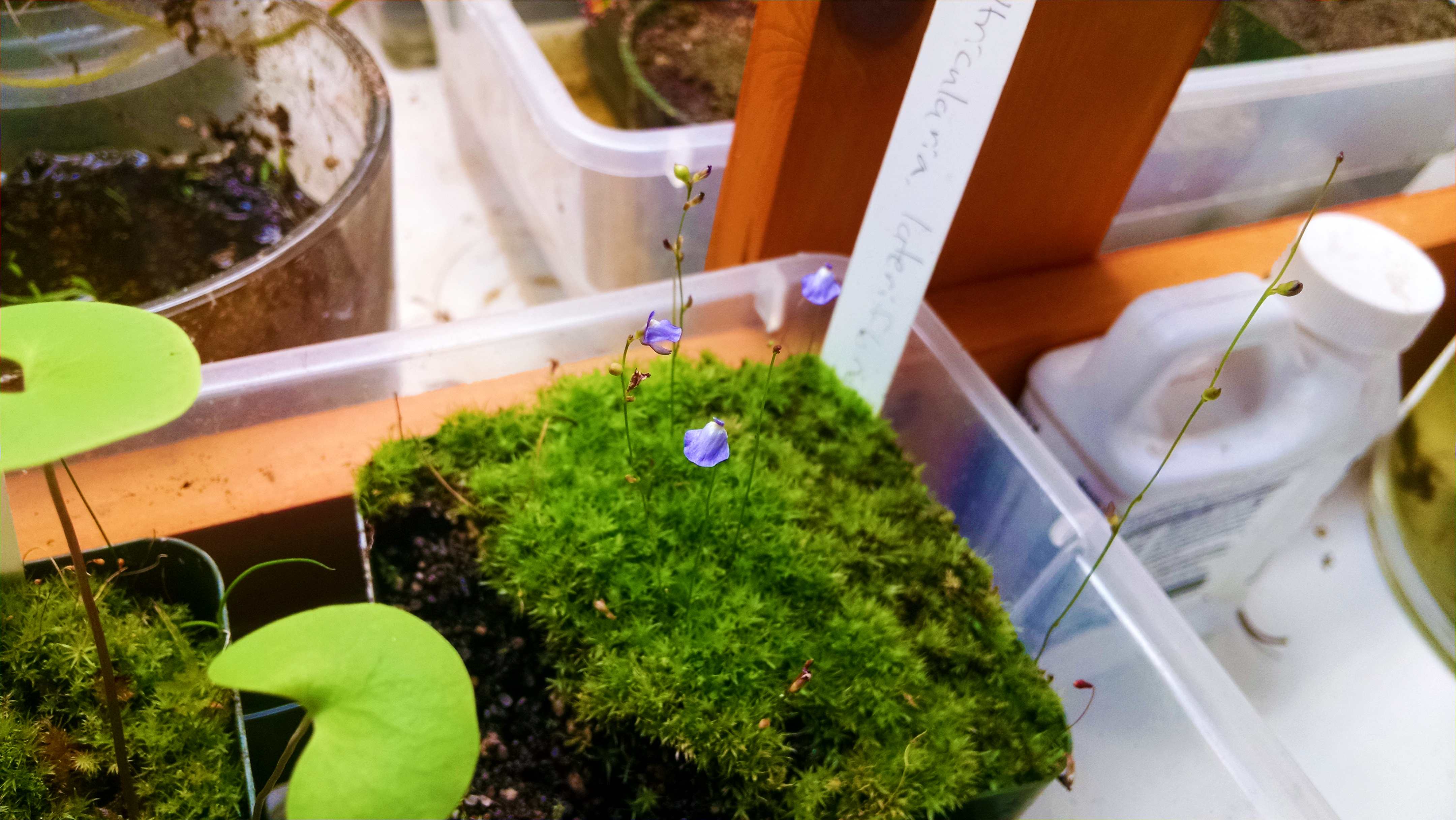
In any case, I decided to check in on my collection today. This collection of Utricularia lateriflora flowers got me started with the pictures.
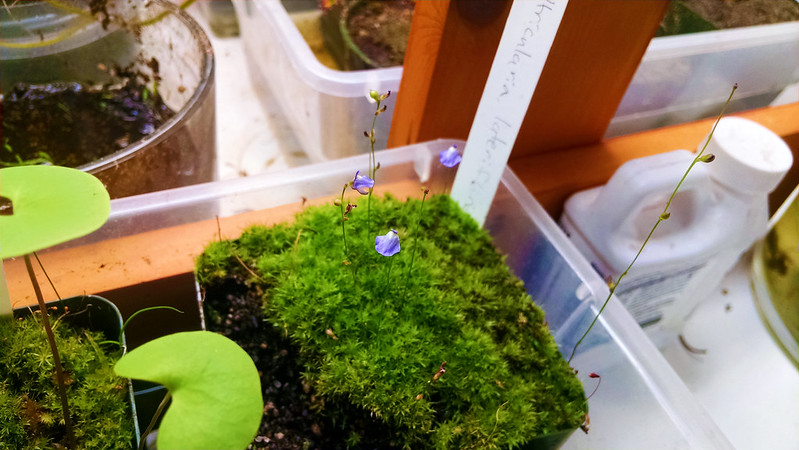
Utricularia lateriflora.
Such delightful purple flowers.
This is one of my favorite species right now. It flowers pretty freely, and the flowers are adorable – dark purple with a white splotch.

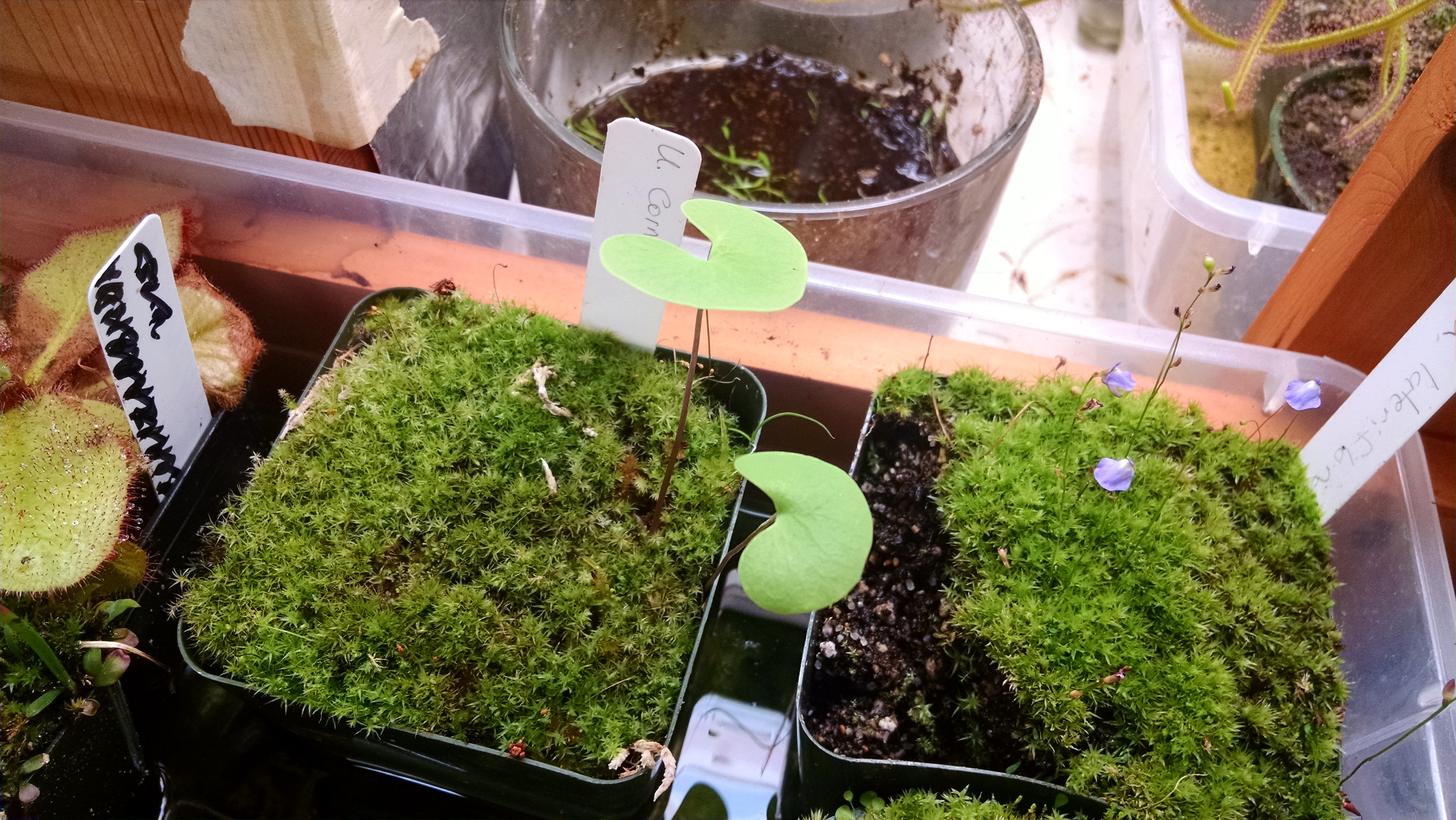
Next door, my Utricularia cornigera is doing very well.
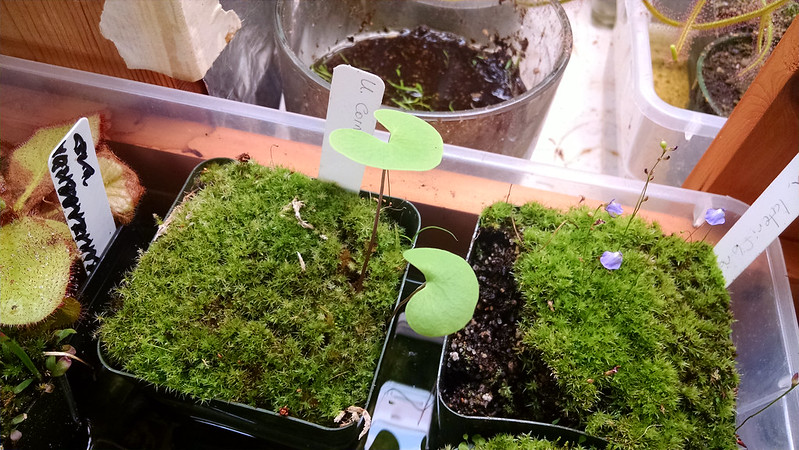
Utricularia cornigera.
Those are some nice-looking leaves.
I'm glad these have recovered from dying back a few months ago. Based on how I've seen new leaves come up on this one, I feel like it would favor an airy LFS planting in a net pot. Maybe I'll do that once it gets a chance to grow in a bit more.

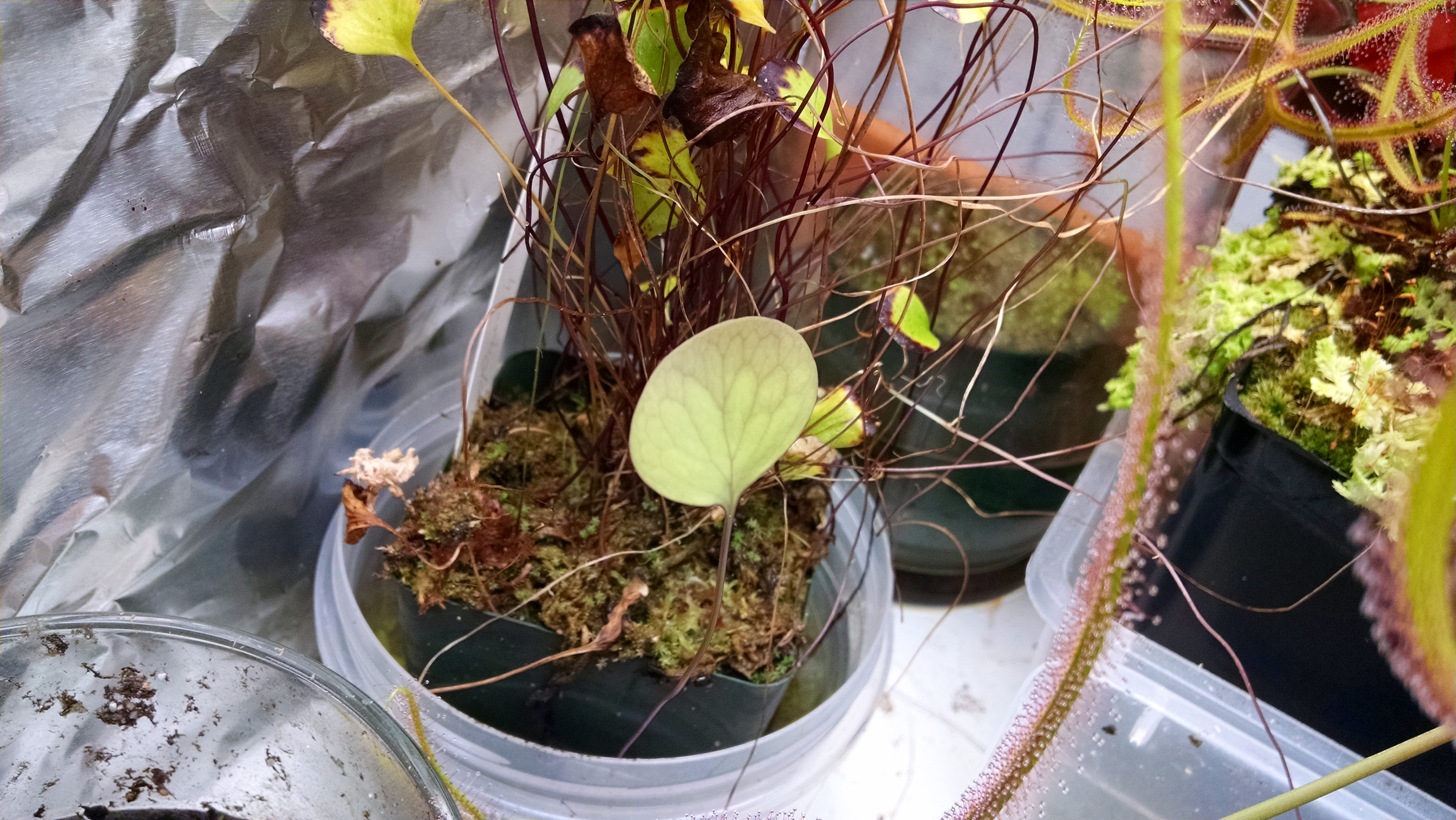
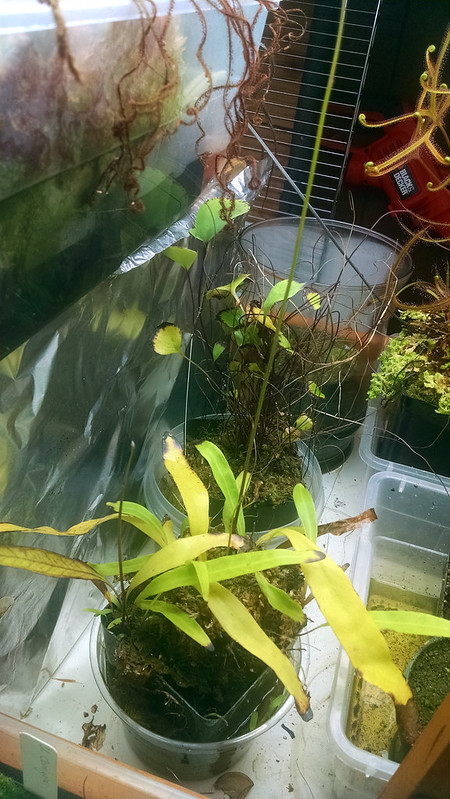
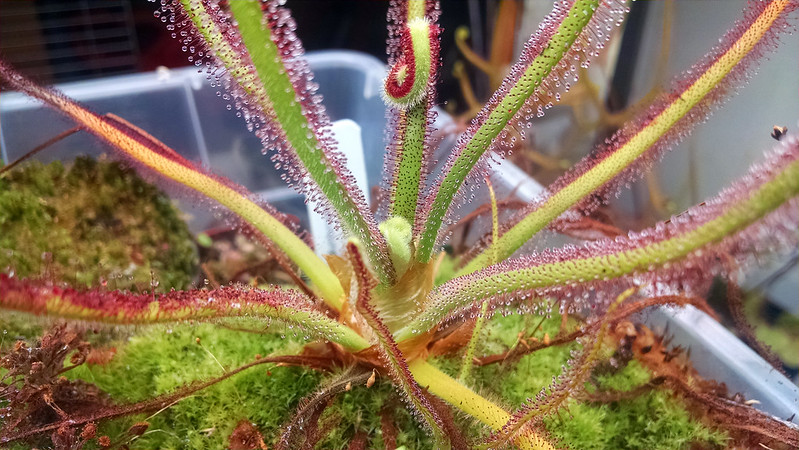
My other plant from section Orchidioides, Utricularia humboldtii, has put out a new leaf.
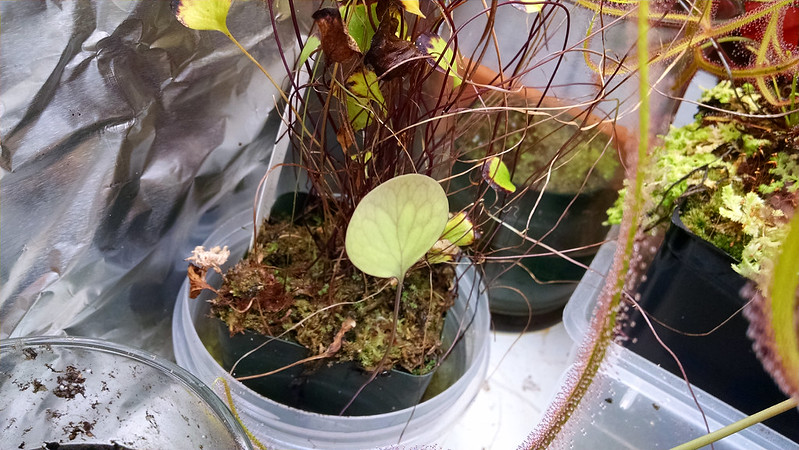
Utricularia humboldtii.
I like the venation on those leaves.
This one is pretty slow to make new leaves, but I understand that's pretty normal. I should trim all the dead growth and messy stolons to get a better picture of what it looks like. By the way, this plant has been found at elevations of more than 8000 feet (2500 meters). That's really high!

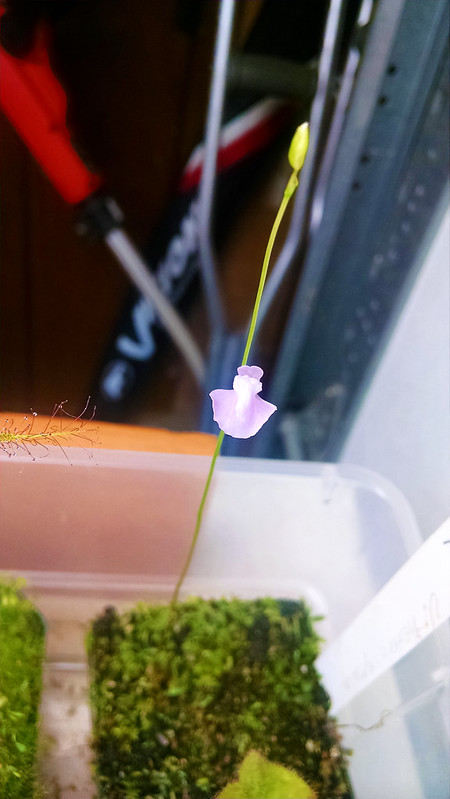
Nearby, the Utricularia heterosepala flower stalk fell over after I jostled it recently.
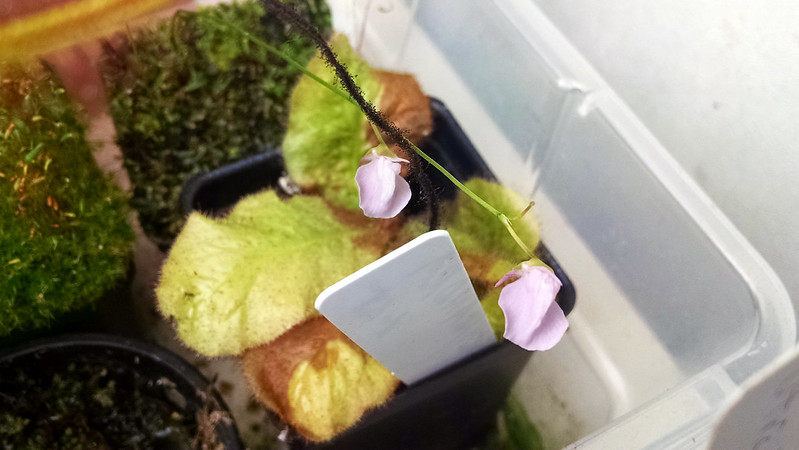
Utricularia heterosepala.
Man, it would be awesome if another flower popped too.
I'm seriously impressed with this plant. It's been holding both of the flowers for a while now, and there's no sign of giving up. Really fantastic grower, looking forward to getting more blooms from it.

Utricularia calycifida has a somewhat similar flower, although the bloom stalks typically support only one at a time.
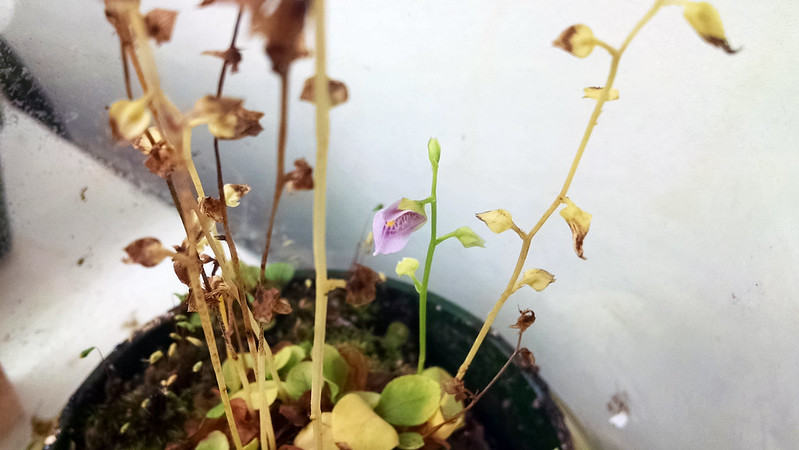
Utricularia calycifida.
This flower has awesome patterning on it.
This is the first time it's rebloomed since the last big show. I really feel like I should repot this plant into pure LFS. It's been so hard to find time to do serious plant stuff like that lately! Alas.

One of the plants that I've never been able to flower is Utricularia praelonga.
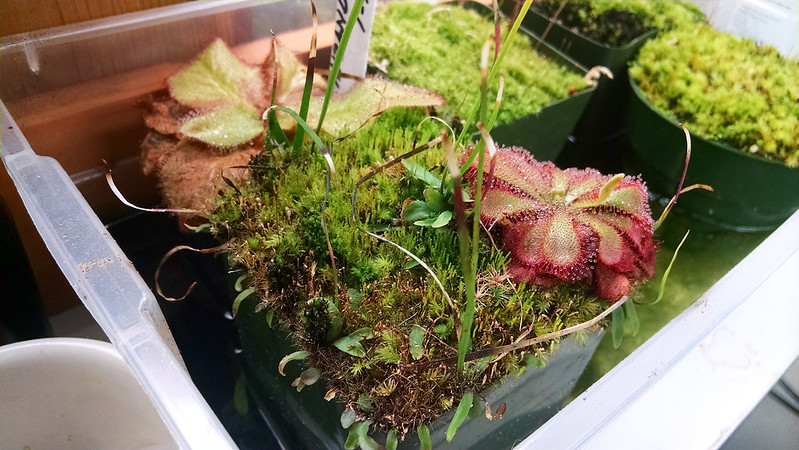
Utricularia praelonga.
This is one of those plants just just hangs out, waiting to do something.
This oddball utric grows two different kinds of leaves, and is notoriously difficult to flower. I've seen some in bloom in cultivation though, and I'm trying to get some tips. The flowers are supposed to be large and yellow.

Utricularia sandersonii is one that flowers for me, but very weakly. This first pot has had like 2 flowers, and is covered in a really robust moss of some sort that I do not like.
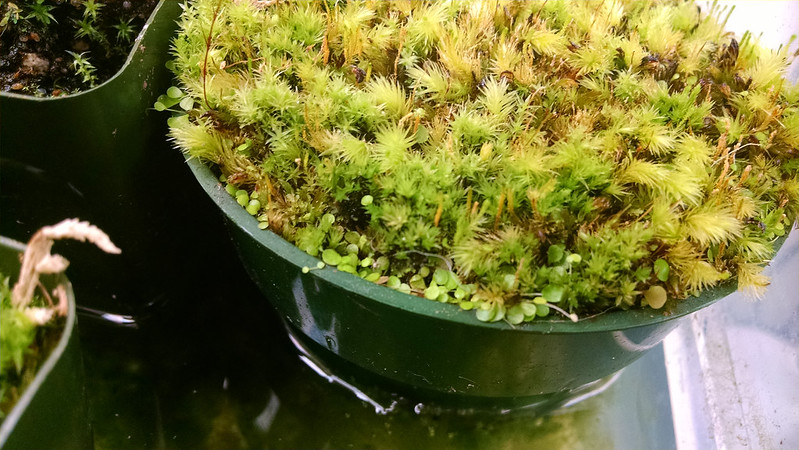
Utricularia sandersonii.
Seriously overgrown pot.
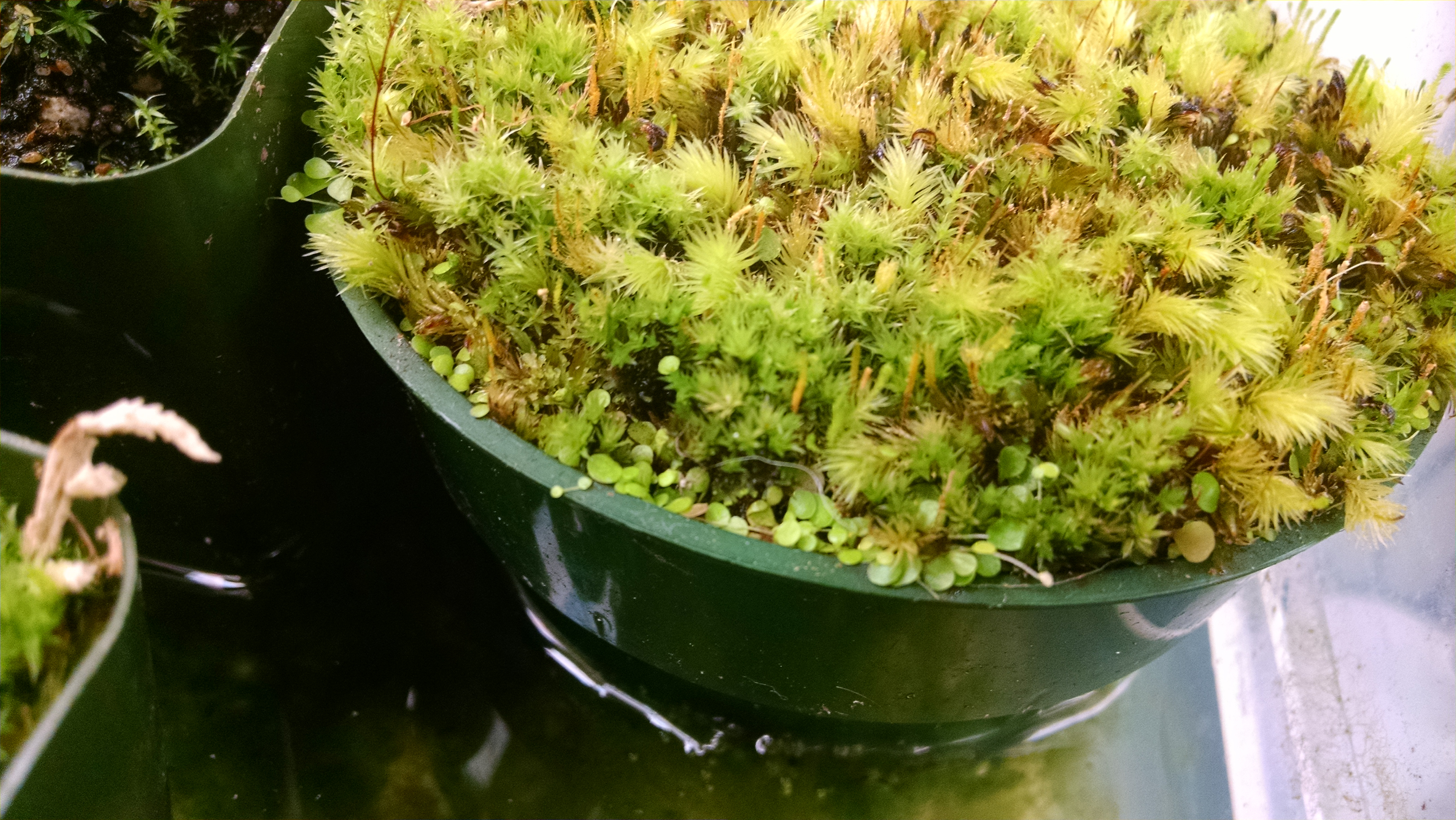
Whereas in this next pot, it's definitely losing the fight to Utricularia subulata.
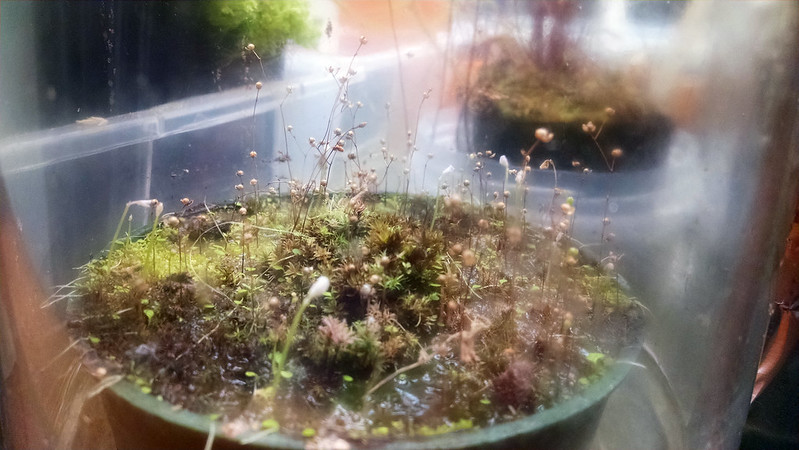
Utricularia sandersonii.
REALLY seriously overgrown pot.
Not sure what the problem is with this one for me. I know people who can't help but get a big carpet of bunnies. Maybe I should try some in a windowsill.

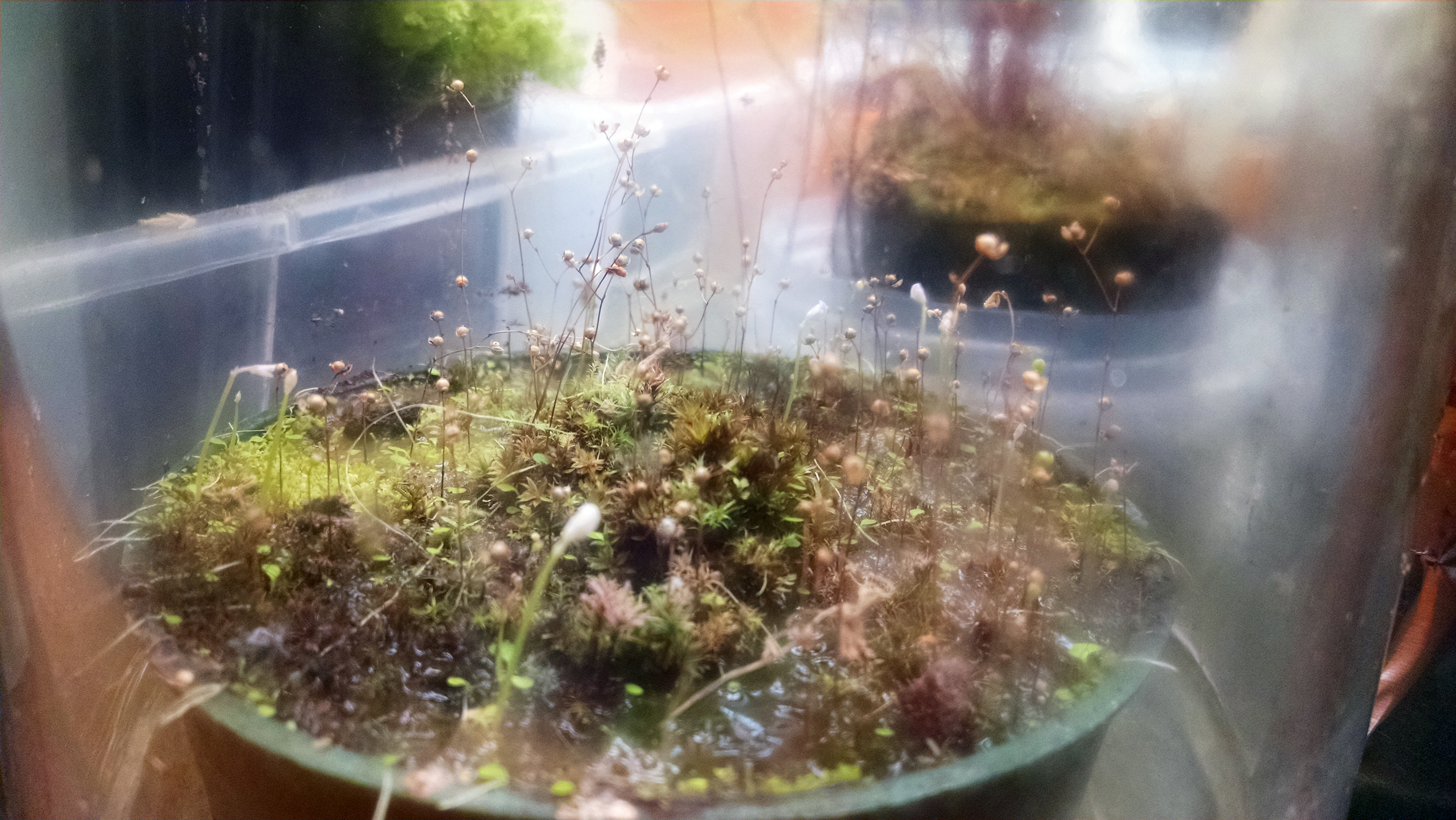
Speaking of U. subulata, my big, proper bloom is looking so good right now.
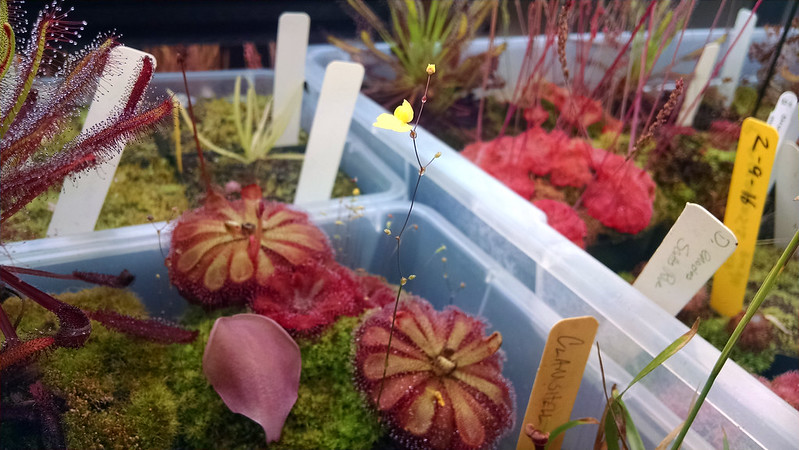
Utricularia subulata.
U. subulata always breaks your heart.
I wish wish wish it would do this all the time. This is a fantastic flower! Ah well. Maybe the fleeting quality of it makes it more special.

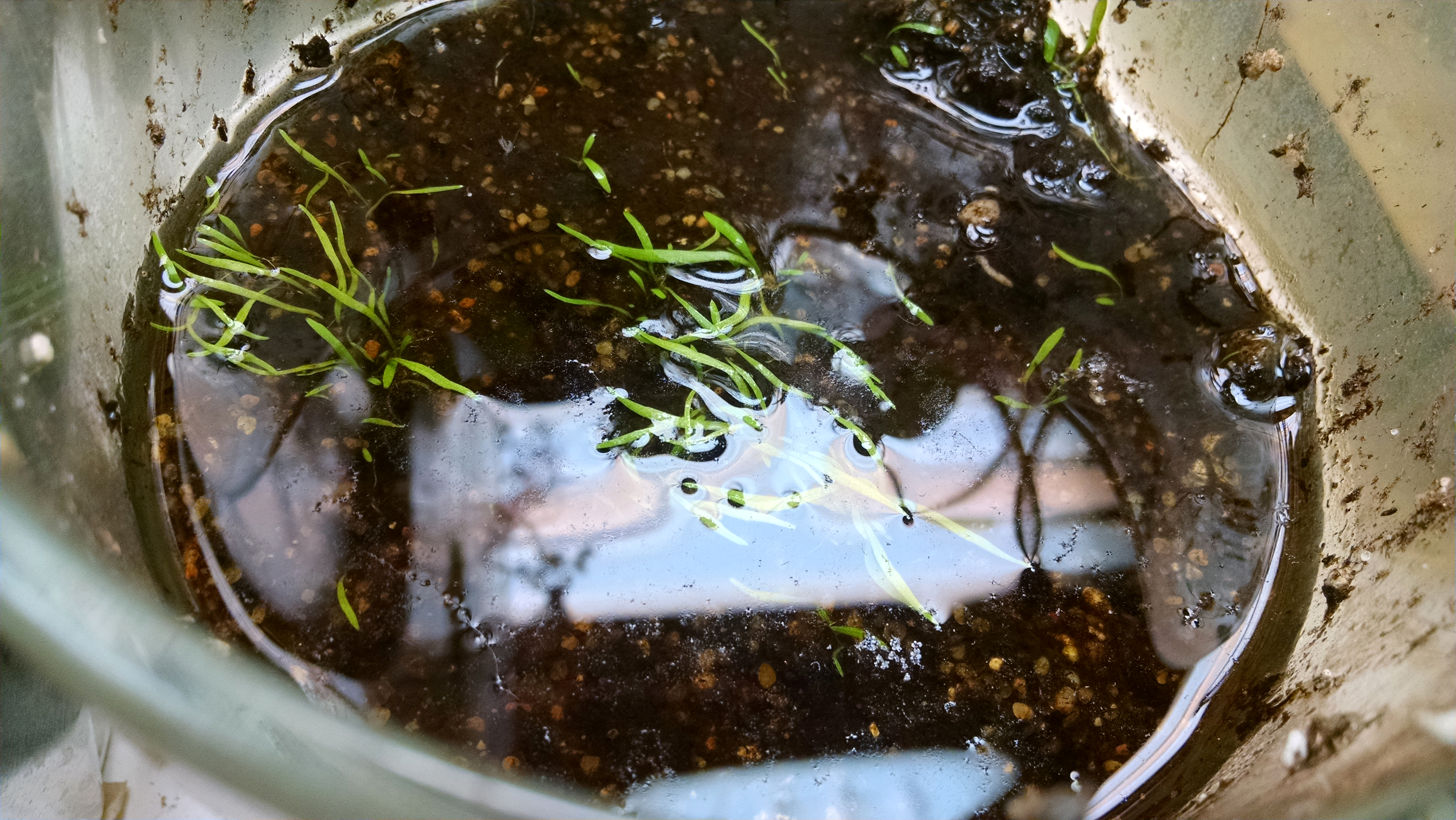
One thing I did recently was break up a few of my well-established plants to share around and propagate. Here's my Utricularia gramnifolia getting started again.
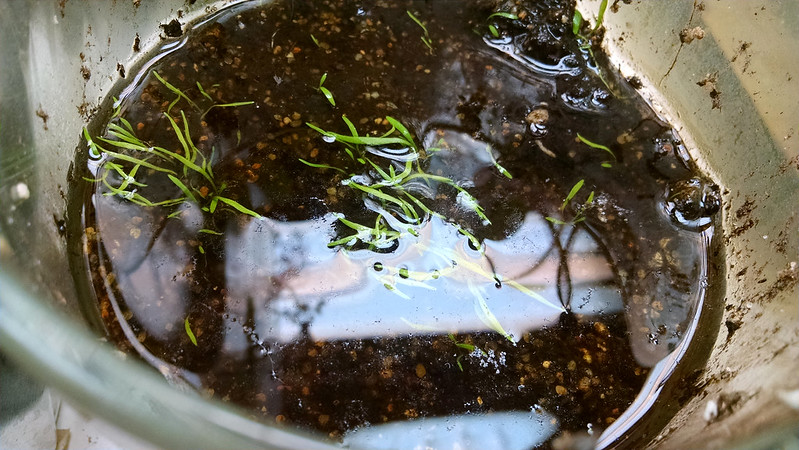
Utricularia gramnifolia.
Looking forward to this filling in and blooming again.
The submerged aquatic setup in an undrained pot seems to work pretty well for this plant. I suspect a lot of the terrestrials would like this treatment, actually. Might be fun to try them in teacups, like the Carnivore Girl.

This tray has starts from some of the pots I broke up, as well as a couple new specimens I'm just getting started.
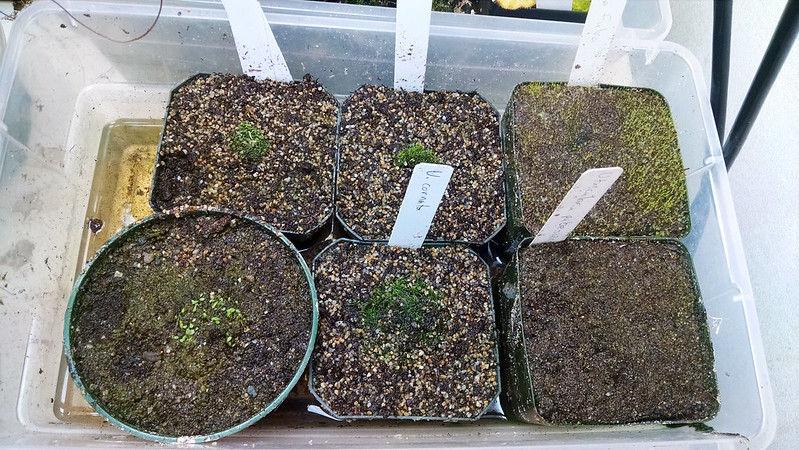
Utricularia tray.
So much promise in these pots!
Clockwise from top left: Utricularia 'Betty's Bay' (a large-flowered form U. bisquamata), Utricularia blanchetii, Utricularia fulva, Utricularia pubescens, Utricularia cornuta, Utricularia livida. I've been flooding this tray to try and jump-start these guys.

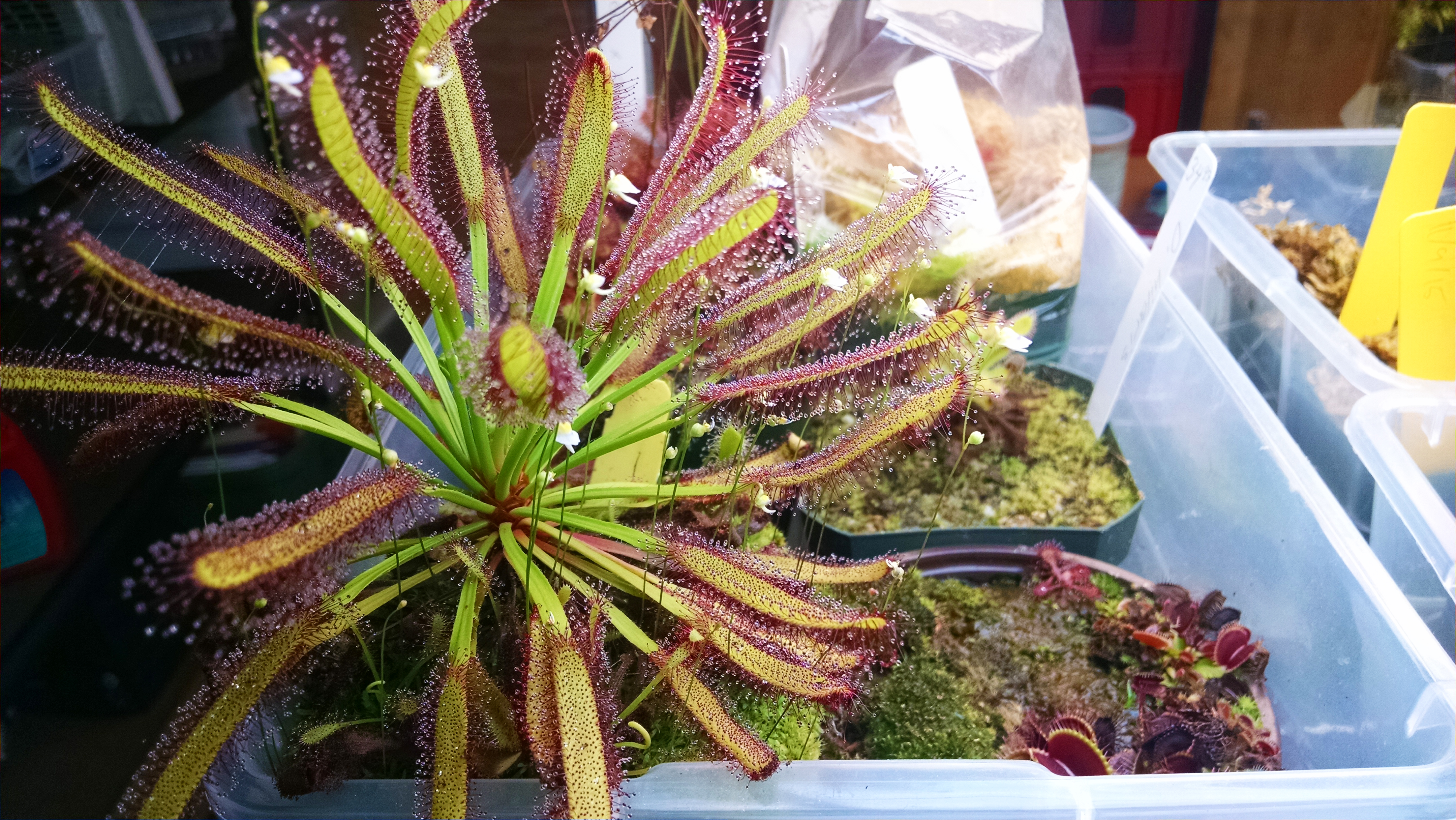
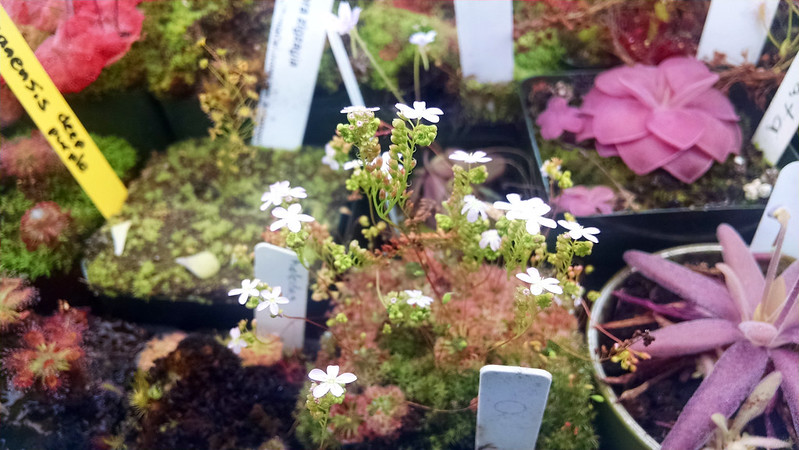
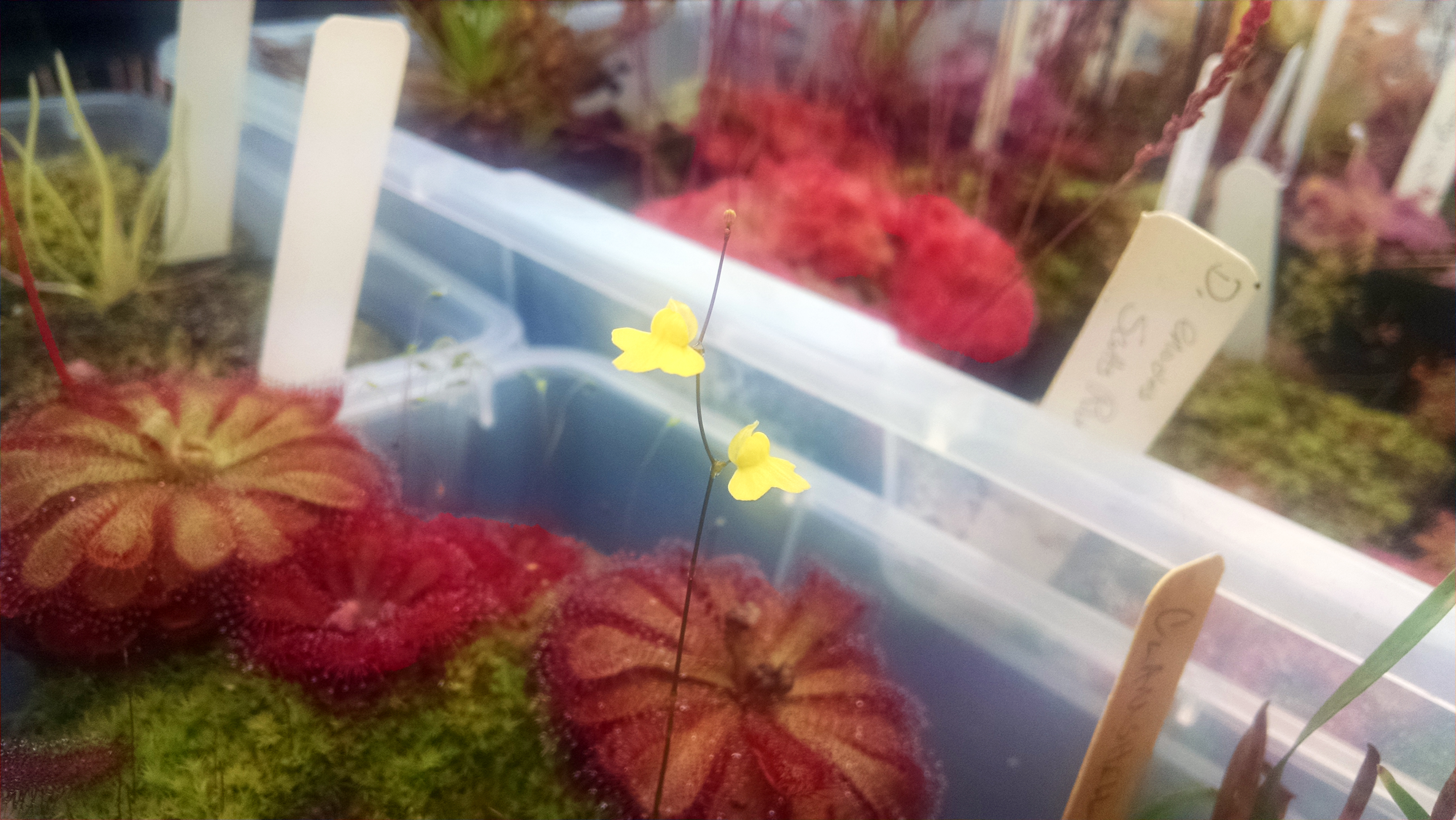
Finally, I took a picture of some U. bisquamata among my wide-leaf Drosera capensis.
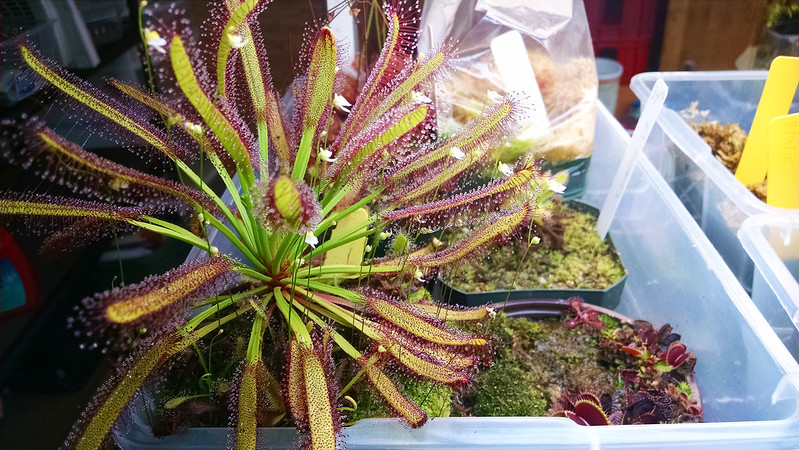
Utricularia bisquamata among the Drosera capensis wide leaf.
I love how the flowers all face towards the lights.
It's just too cute. Even though it's a weed, it's a wonderful plant. That's true of both of them, actually. No respect at all!

Incidentally, my Utricularia longifolia is blooming. It's not in my collection right now because I brought it for display at the Pacific Orchid Expo. I'll feature that one later.
Saturday, February 20, 2016

Some plants just struggle

Not every plant can be a Drosera spiralis. There are a handful of plants in my collection that always seem like they're in a slump. Drosera collinsiae is definitely like that.

Drosera collinsiae.
On the plus side, that utric looks great.
This is a very handsome plant when it's happy, but it just seems to get deflated by everything. Heat for sure, and Pyrethrin, but also the Bayer 3-in-1, which didn't seem to affect any other plant in the collection. I can't remember the last time this one had more than 3 dewy leaves.

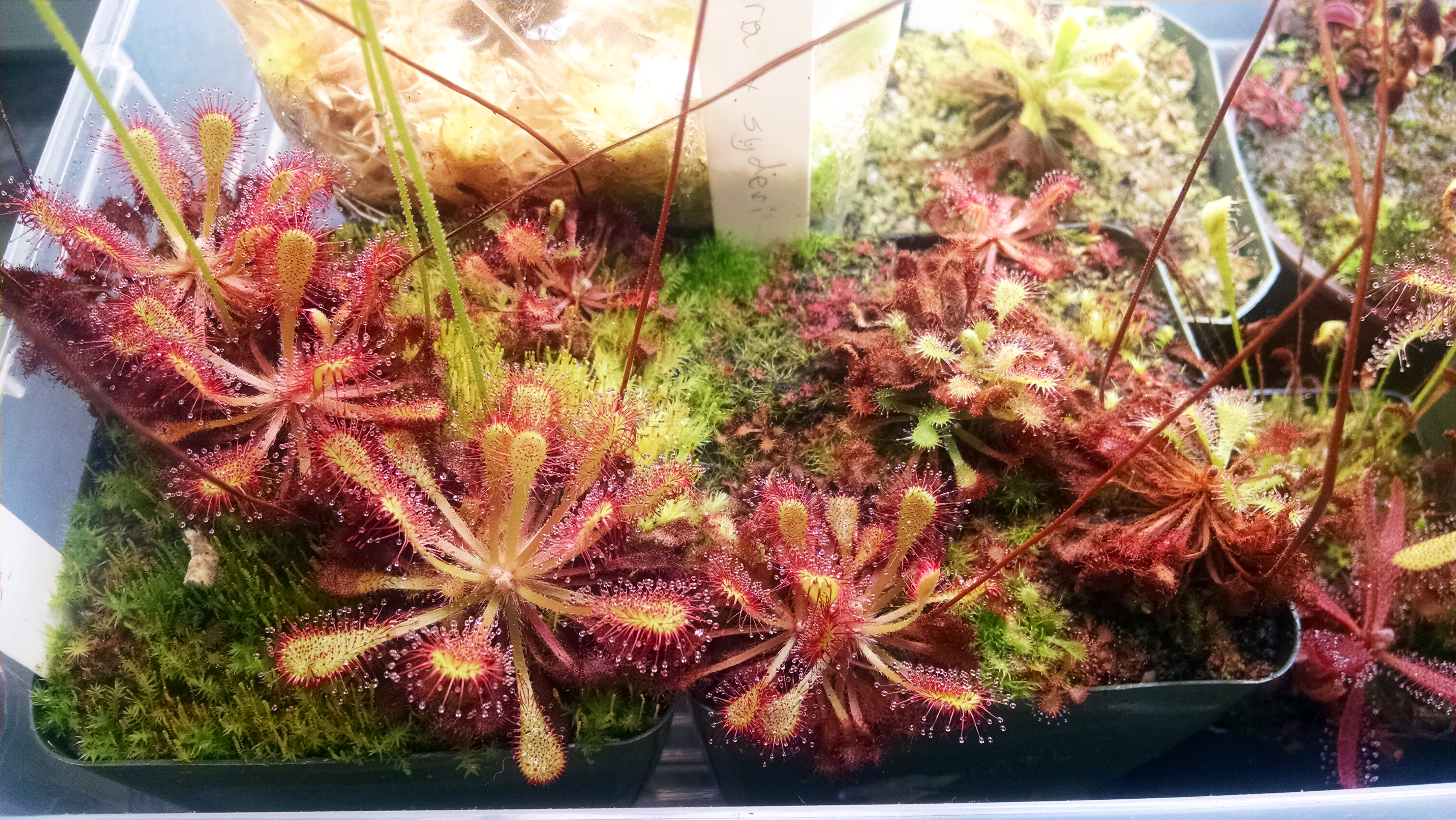
Another consistently wimpy plant is Drosera ×snyderi, which is D. dielsiana × nidiformis.

Drosera ×snyderi.
They actually look pretty decent right now.
There were originally 5 plants in each pot. The one on the right clearly had a bit of a crash recently, but all of them look super set back whenever I have to spray for bugs or whatever. Funny plant.

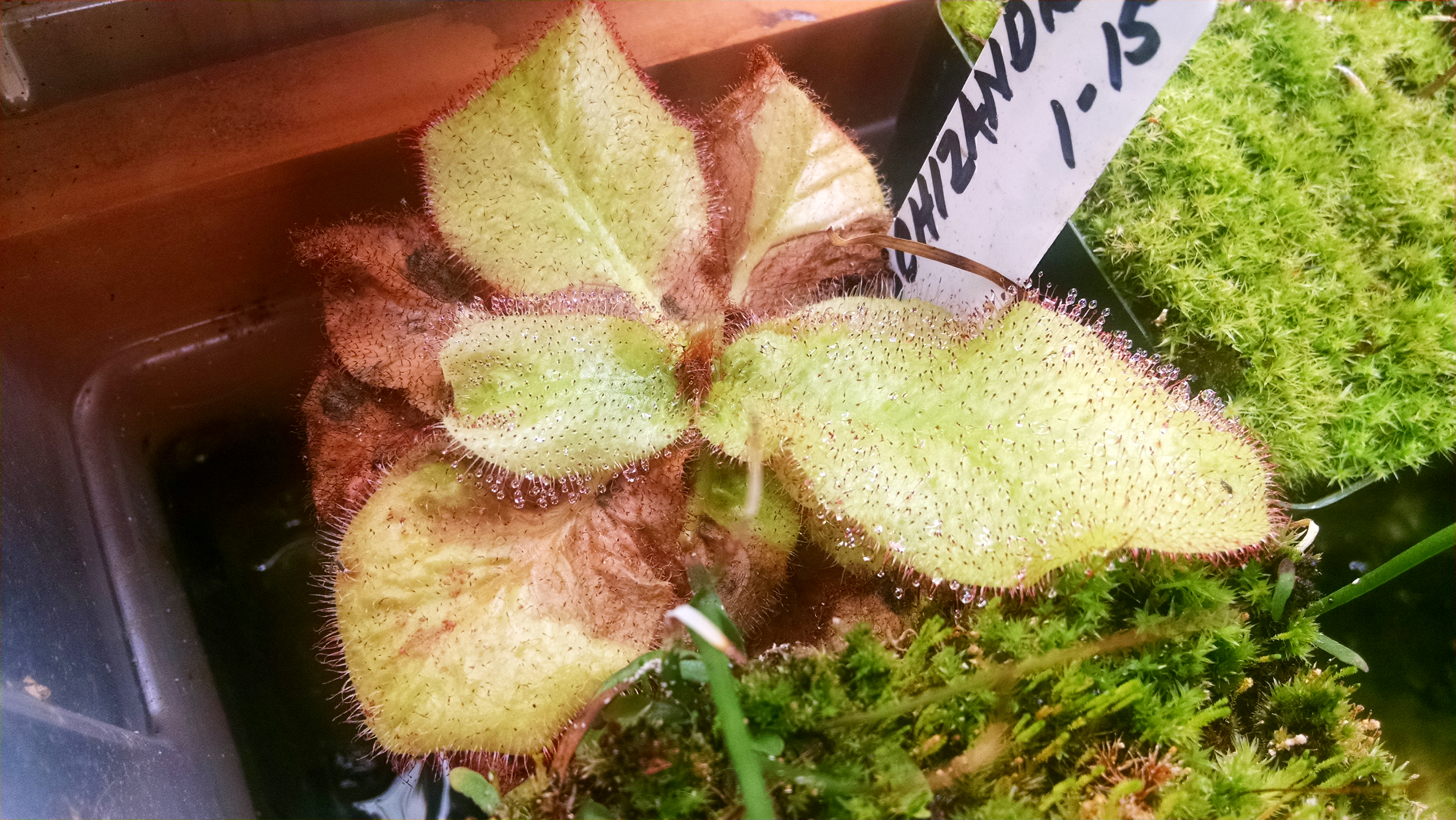
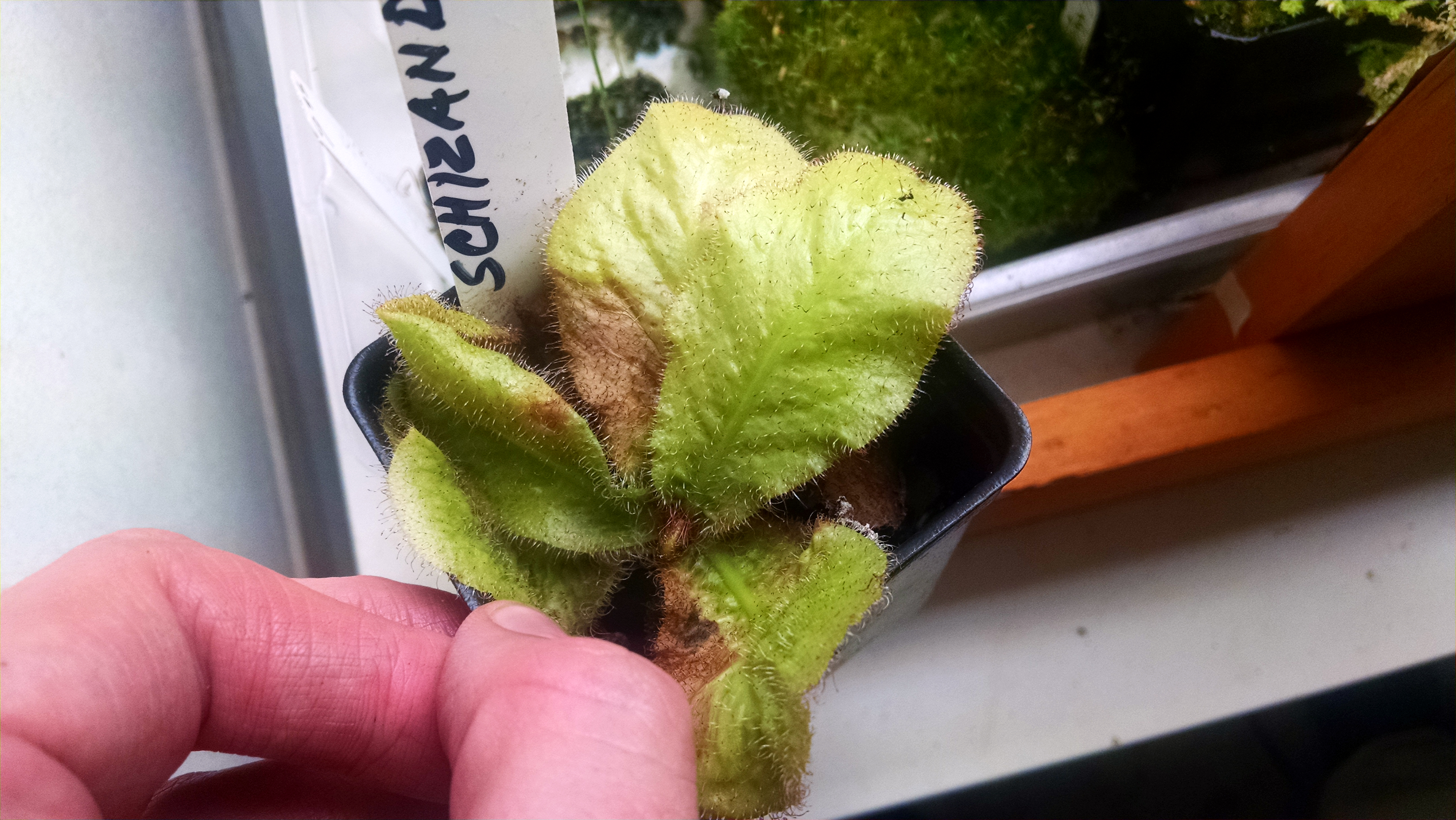
A very funny case is Drosera schizandra. I've got two pots, and they're looking pretty different right now.

Drosera schizandra.
Spinach anyone?
Drosera schizandra.
There's a little pup in the bottom of the pot actually.
They're also looking pretty different than they looked back in January. I don't think there's been enough heat to cause a crash like this, and nothing else weird has happened. Who knows? This is a famously temperamental species, after all.


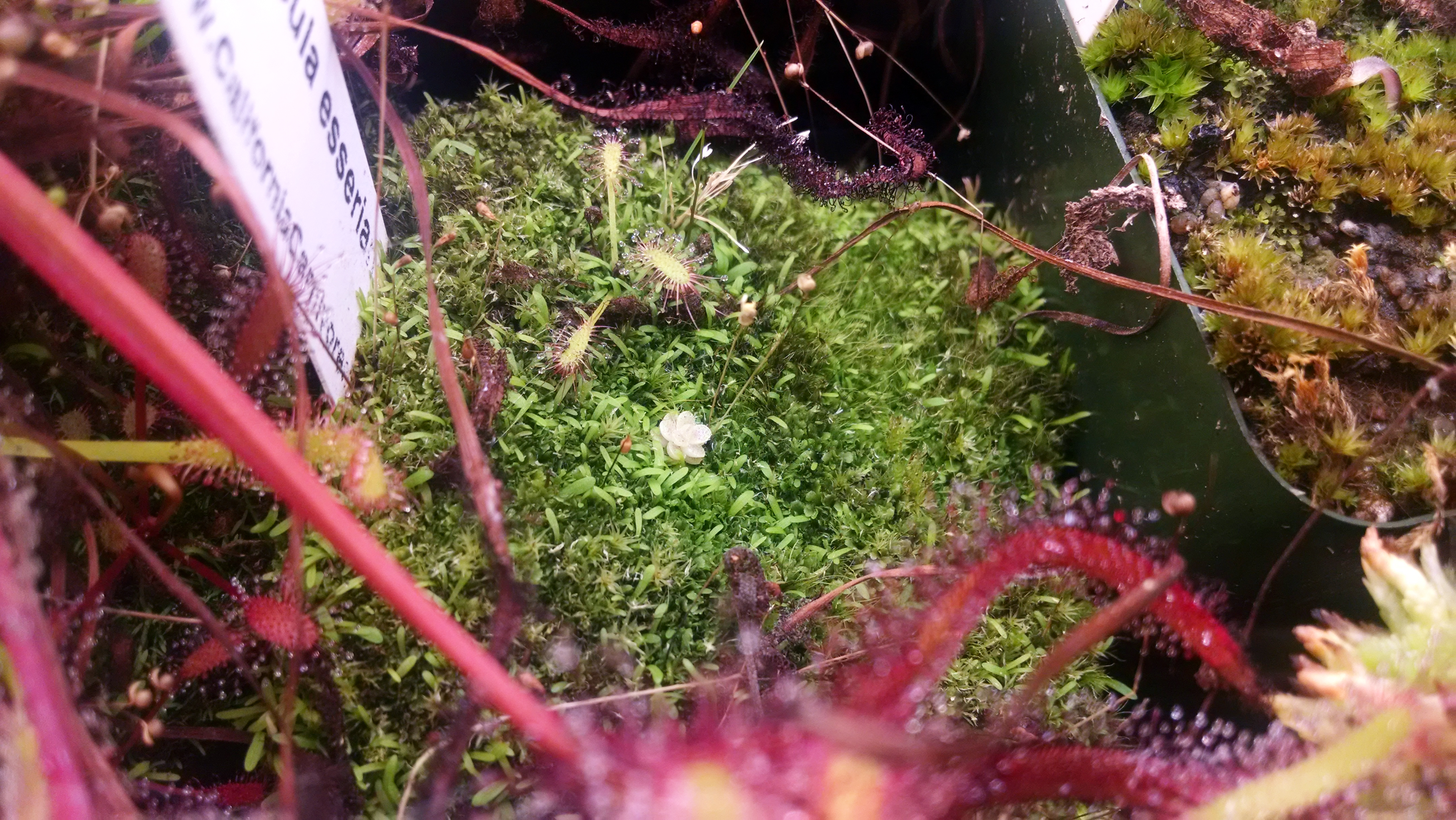
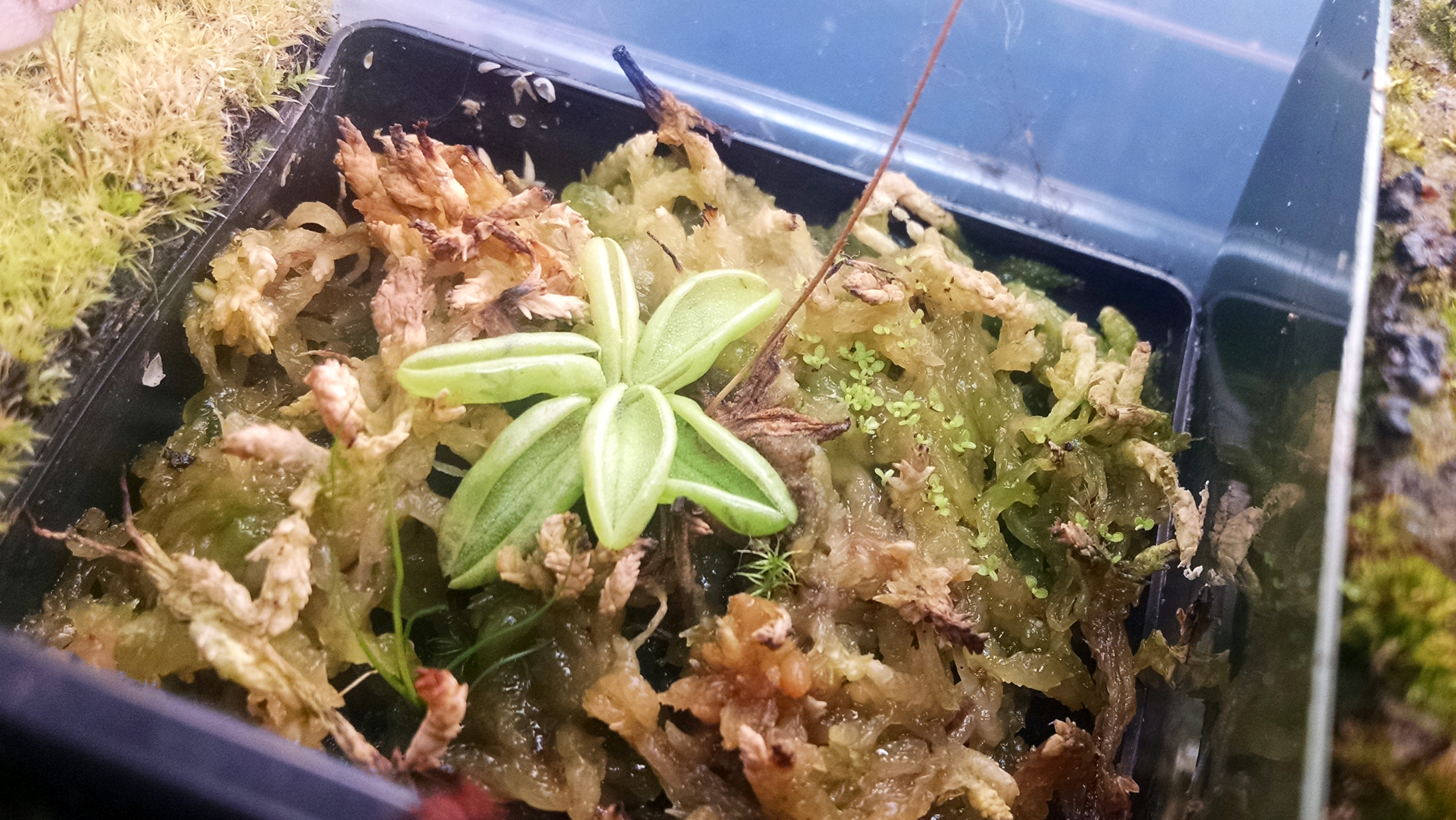
This next is a funny one. I got this Pinguicula esseriana from California Carnivores a year ago. It certainly hasn't grown, and looks to have shrunk back a bit in fact.

Pinguicula esseriana.
Little guy is lost down in there!
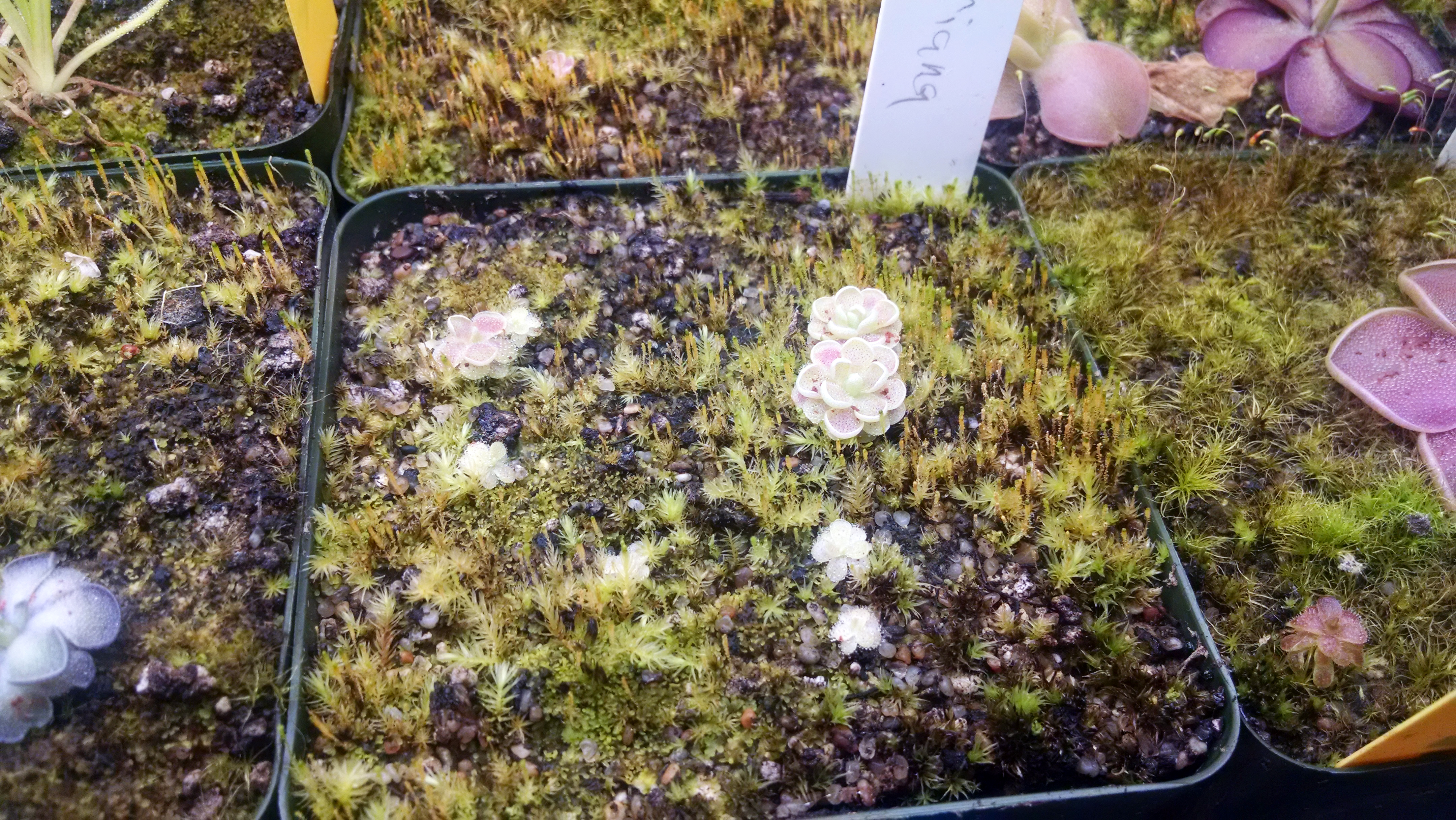
I don't know why that would be the case, because a bit later I received some small P. esseriana starts, and those are doing much better.

Pinguicula esseriana.
Look at all the little babies.
I should really just scoop out that first one and put it in the second pot to free up some space in the tray. I wish it would put on some size!

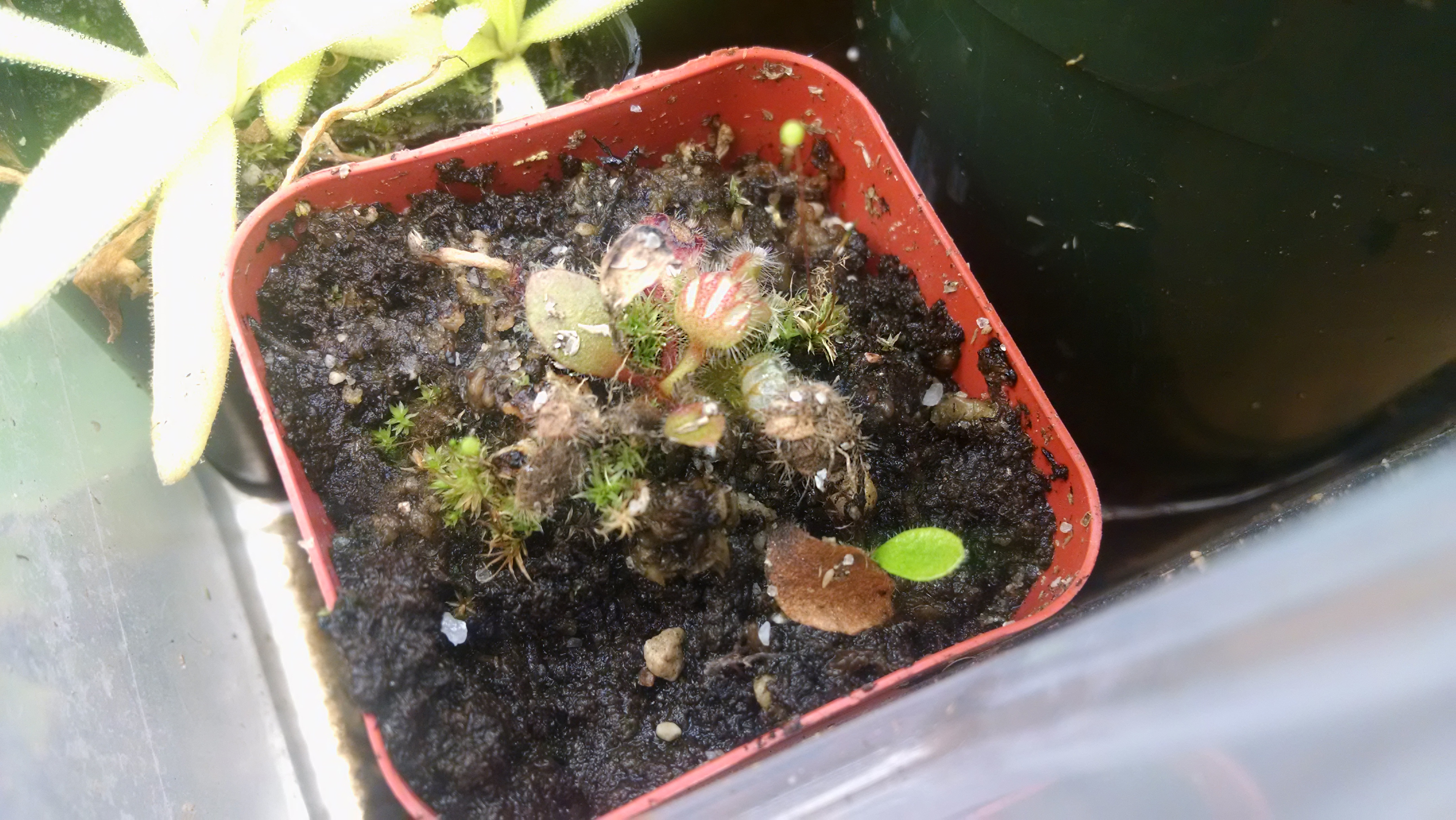
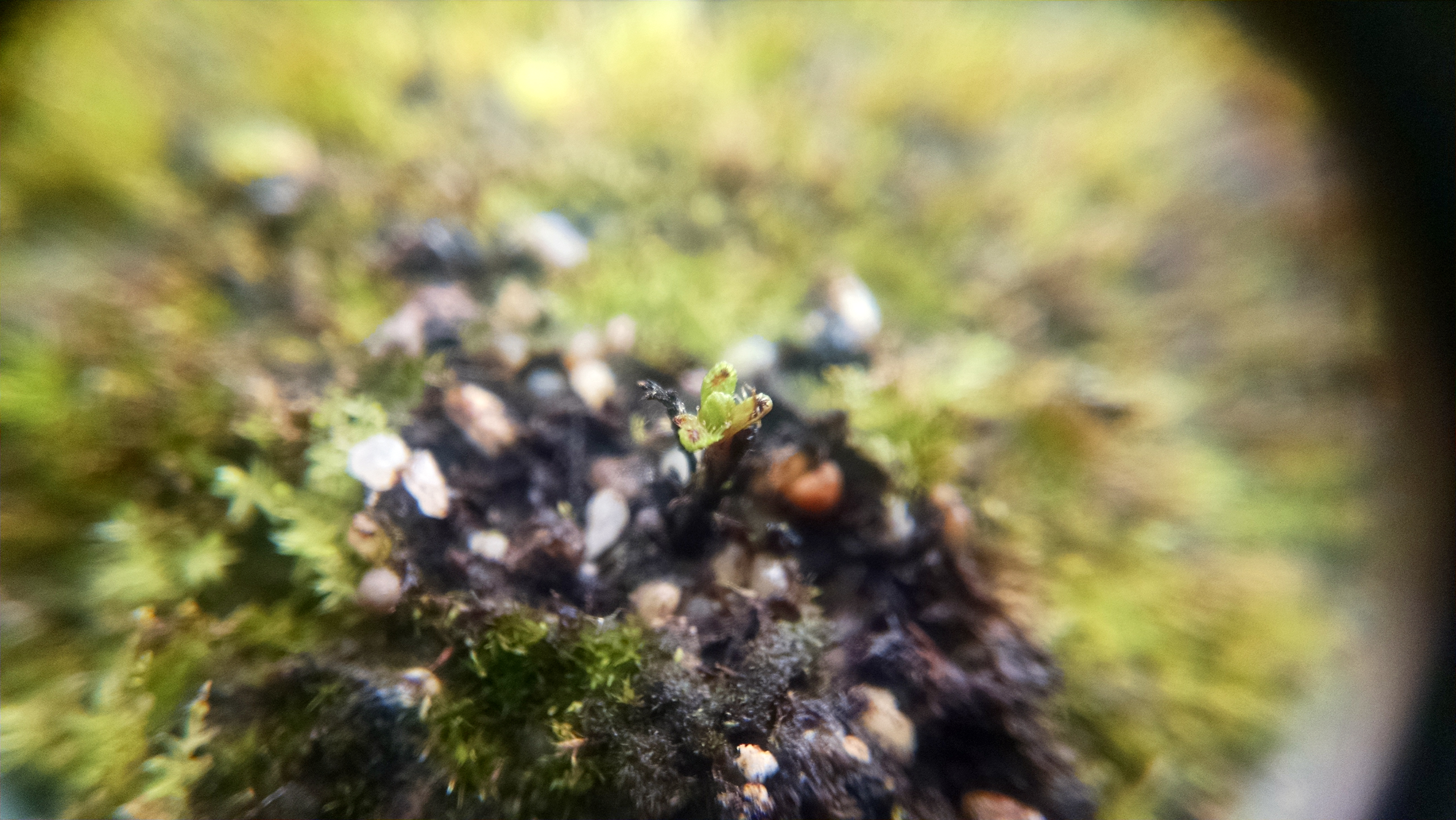
On a more hopeful note, the itty bitty Cephalotus follicularis I got in a trade a bit ago seems to be settling in rather than dying off.

Cephalotus follicularis.
We've got a long road to go, but we're off to a good start!
I believe that's a new pitcher on the upper right, and it's certainly a new leaf on the lower right. Progress!

The Drosera hamiltonii are a funny case. These look absolutely terrible, right?

Drosera hamiltonii.
Sooooo ugly right now.
The thing is, they're just fine. I fed a bunch of plants (including these) a week ago or so, and D. hamiltonii take forever to look good after feeding. The thing is, when they look good they look really good. Weird little sundews.

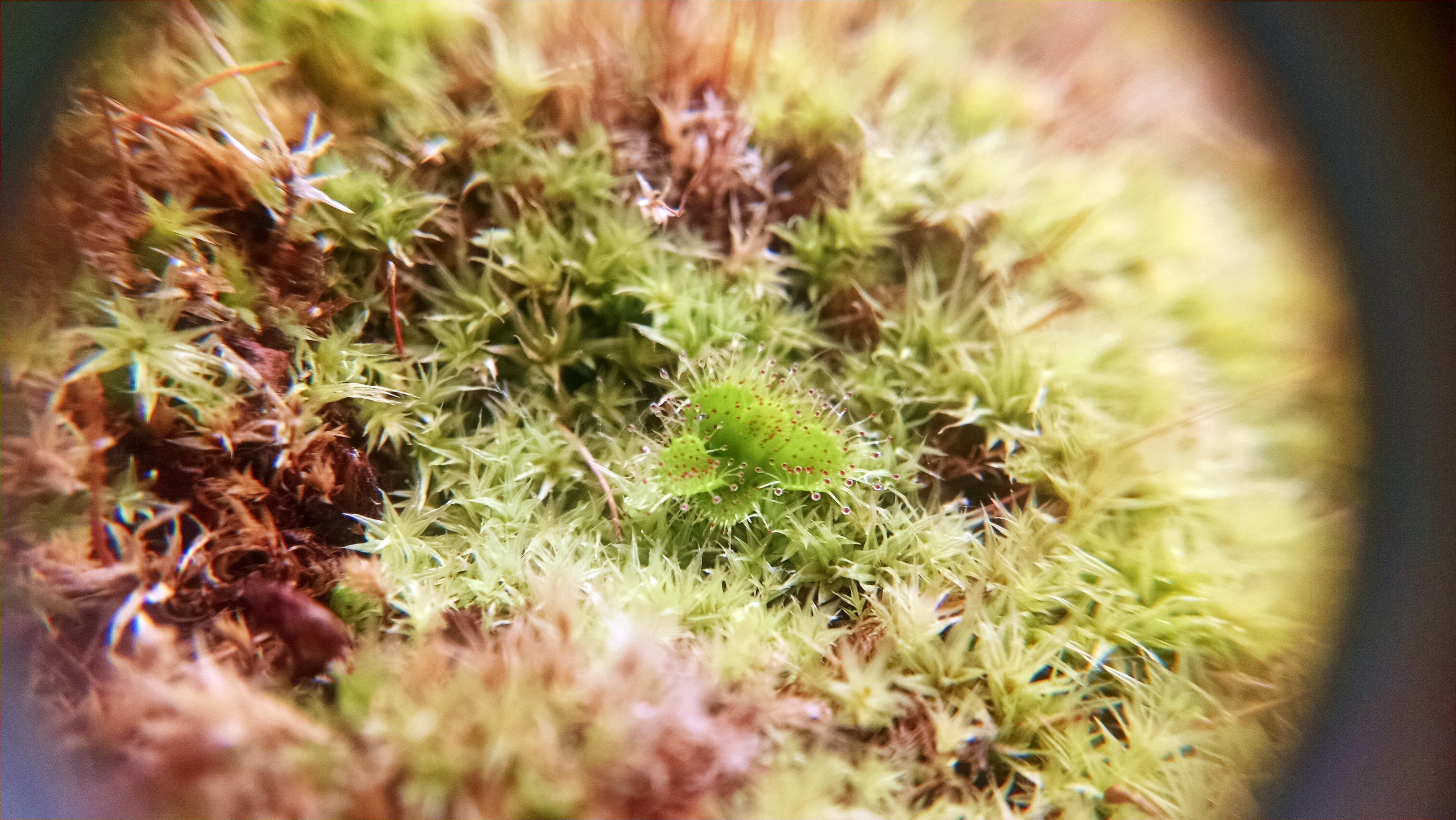
Finally, a pygmy that seems to have no idea whether or not it likes me.

Drosera spilos pygmy sundew.
I love all pygmies, even the fussy ones.
Drosera spilos is the only pygmy I've got that seems to go dormant at all in my conditions, and as you can see there are a couple of them that are dormant right now, in the middle of winter. Amusingly, this is as good as this pot has ever looked. No idea why. Sorry you don't like it here as much little guy!

Plants are weird.

Sunday, February 14, 2016

Flowers and pygmies

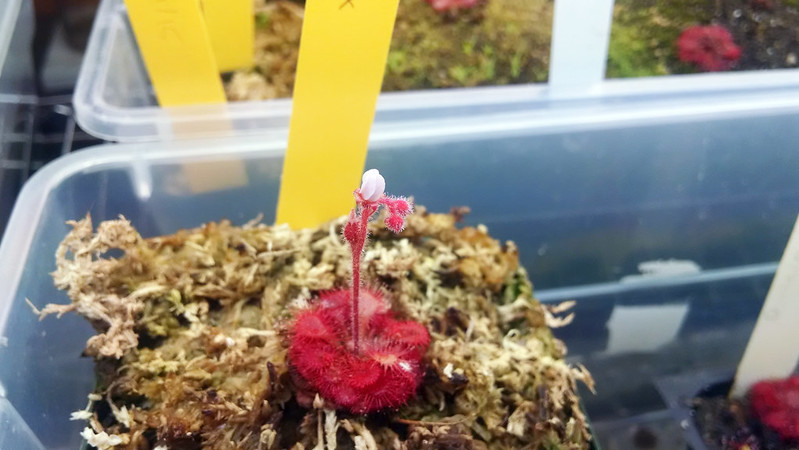
A new flower has popped up in the collection. This is Utricularia heterosepala, a new utric I picked up from California Carnivores recently.

Utricularia heterosepala flower.
Such a lovely flower.
It's a pretty good-sized flower, around the size of Utricularia calycifida. It's pale pink and white, and quite handsome. I love getting new utrics.

In other flower news, there are 4 flower stalks coming up on my Utricularia longifolia.

Utricularia longifolia.
U. longifolia is the best.
It's a bit hard to see, but this is going to be quite a bloom show. The tallest stalk is almost ready to pop, while the others have a bit more growing in to do. I love this plant! Once the flowers are done I think I'm gonna break it up a bit – keep a small pot inside, and then stick something very large outside, like in a 2 gallon pot or something silly like that.

I've got a pot of Drosera helodes × pulchella that is absolutely losing its mind with flowers right now.

Drosera helodes × pulchella flowers.
I don't know what to do when they get like this.
Pygmy crosses are nuts. This is too much.

A funny thing is going on with my one Drosera grievei that produced gemmae.

Drosera grievei.
Very cute plant!
It looks a bit crested. You occasionally see fasciation in carnivorous plants, and I feel like I've heard about it in pygmies, but this is the first I've seen (if that is what's going on). Glad to have gemmae at least!

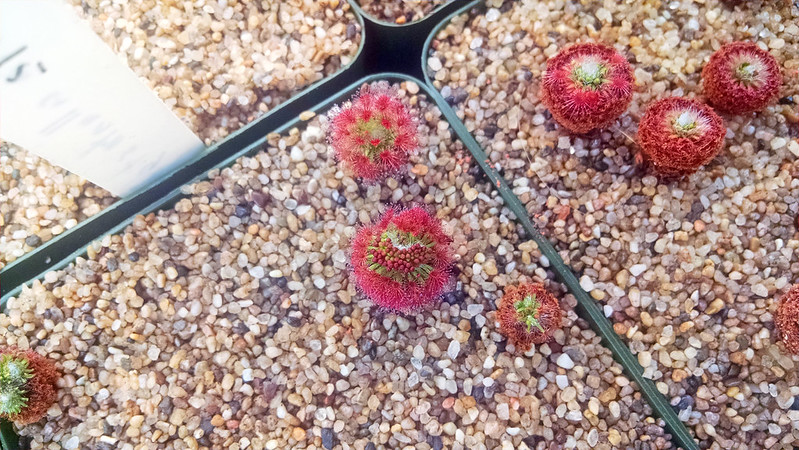
I just missed the second Drosera felix flower.

Drosera felix.
It's much too precious.
It's still really pretty, how delicately the petals are folded. I should feed this guy.

Finally, my Drosera spiralis has started to bloom again.

Drosera spiralis.
Always stoked to see this guy flowering.
I just fed one of its older leaves, which may have prompted it to start flowering. I'm a bit torn – I love D. spiralis flowers, but I don't want it to sap energy from the plant before the show. Maybe I'll compromise and take flower stalk cuttings in a couple weeks.

Sunday, February 7, 2016

U. subulata and D. felix flowering

I watched the Superbowl at a friend's house today and ate a truly massive amount of ceviche. I hope your day was similarly fruitful. It's been a week and a half since my last post! I've been all over the place lately. One of the nicest things going on in the collection right now is this Utricularia subulata flower stalk.

Utricularia subulata flower.
Such a yellow flower!
U. subulata is a very frustrating plant. It's got a wonderful flower with a cool zig-zag flower stalk and these weird dew drops at the base of the peduncles. Very cool! Except it mostly produces cleistogamous flowers for me. Cleistogamous flowers form buds, but never bother to actually produce a flower – they just self-fertilize within the bud, then spill seed everywhere. I probably get several hundred cleistogamous flowers for each real flower stalk. Why can't you be better U. subulata? I want to love you!

Another plant that has been looking pretty legit is this Pinguicula moctezumae I received in a trade a bit ago.

Pinguicula moctezumae.
I should separate these two out.
I've never really cared for P. moctezumae, but I think that's because it tends to clump (which is not my favorite characteristic in a plant). These are actually really attractive under lights. Also, the flowers of this species are really nice. Someday!

My Pinguicula gigantea is blooming again for the first time in a while. But I'm posting today because it's been doing pretty well on the gnats lately.

Pinguicula gigantea.
It's not good to be a flying insect in my garage.
You can find photos of P. gigantea that are absolutely covered in gnats, which I think is super gross and ugly. Those are mostly grown in pretty humid greenhouses – I just don't have that many bugs in my growing areas. Still, good to know that mine can actually do work once in a while.

My Drosera brevifolia has responded well to feeding and is pretty much full-sized now.

Drosera brevifolia.
So tiny! Those wedge-shaped leaves are so distinctive.
Gotta feed these again soon. Gonna want to re-seed this colony to get a few more going. Very cute plants! Nice red color too.

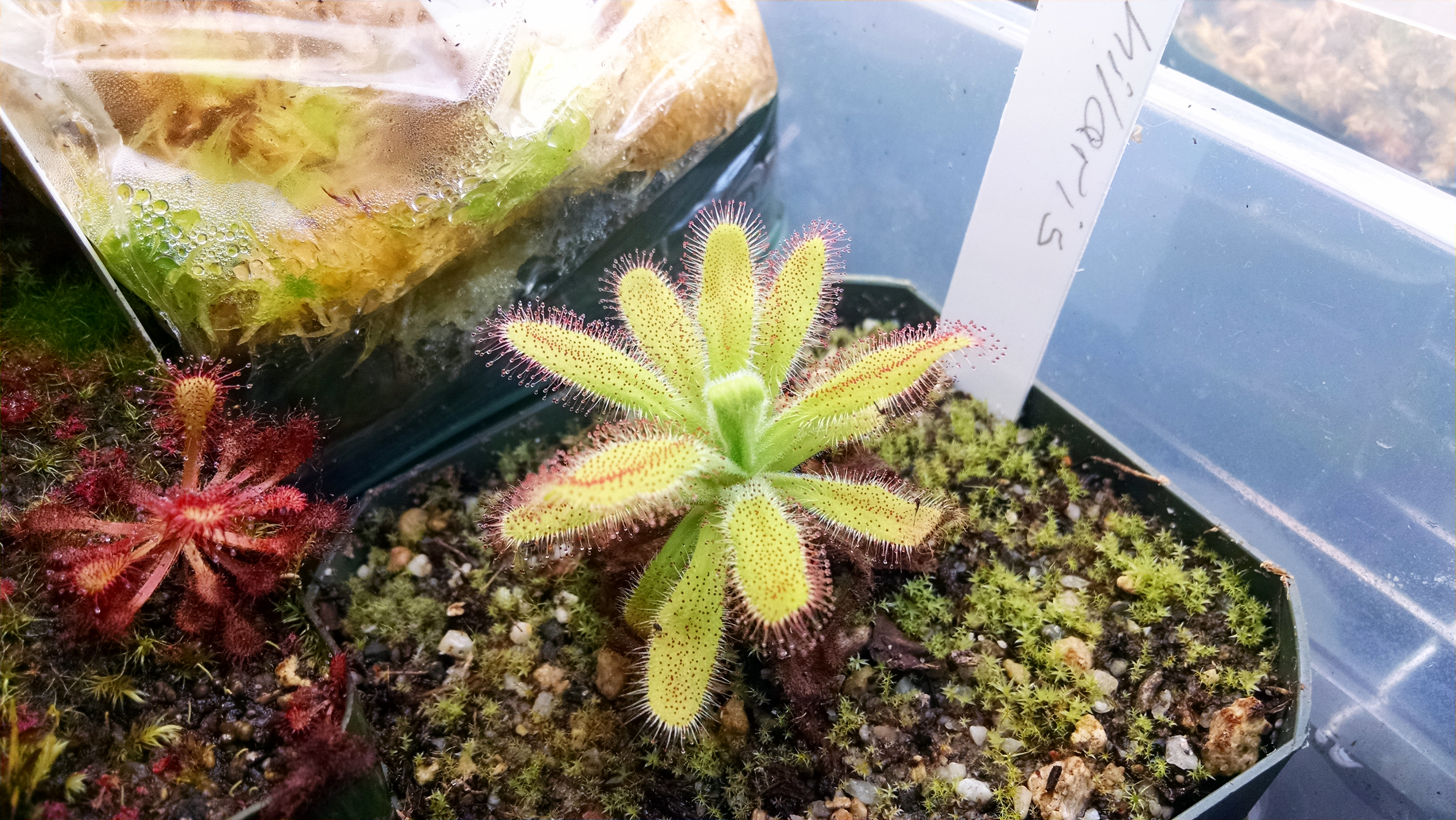
I recently took a trip to California Carnivores, where I picked up this sweet Drosera hilaris.

Drosera hilaris.
It's just starting to color up under the lights.
This is one of the neater South African species. I've heard conflicting reports of it being a summer dormant plant. It may just be that it is optionally dormant in hot weather. Apparently this one really likes cool temps. We'll see how it does!

Finally, the delight of winter so far has been my blooming Drosera felix. The other day I was lucky enough to catch a flower open.

Drosera felix with open flower.
So. Cute. Oh my god.
This plant is hands-down the cutest thing in my collection right now. Look how fuzzy the flower stalk is! I got another good picture of this flower from a different angle and shared it on my Instagram. I always try to have different pictures up there!

Winter's not so bad.

Wednesday, January 27, 2016

What I've been up to lately (hint: selling gemmae)

For the last couple weeks my pygmies have been producing lots and lots of gemmae. Last year I threw a lot of gemmae out, so this year I determined to do better. I've shared some with friends, and I've also sold a lot of gemmae, mostly via Facebook. Here's what I shipped out this morning!

Gemmae packages being shipped off.
Lots of stuff headed to the post office.
This is a non-trivial amount of work! Last year I learned that gemmae that have been harvested and packetized have an extremely short shelf life, so now I harvest per order. I put on a podcast and it's nice, but it takes time. I don't mind though, because I really like spreading different plants around. It's sort of an insurance policy – inevitably I'm going to lose some plants, and if more people are growing them it will be easier for me to get them back later.
Freshly-harvested pygmies look funny.

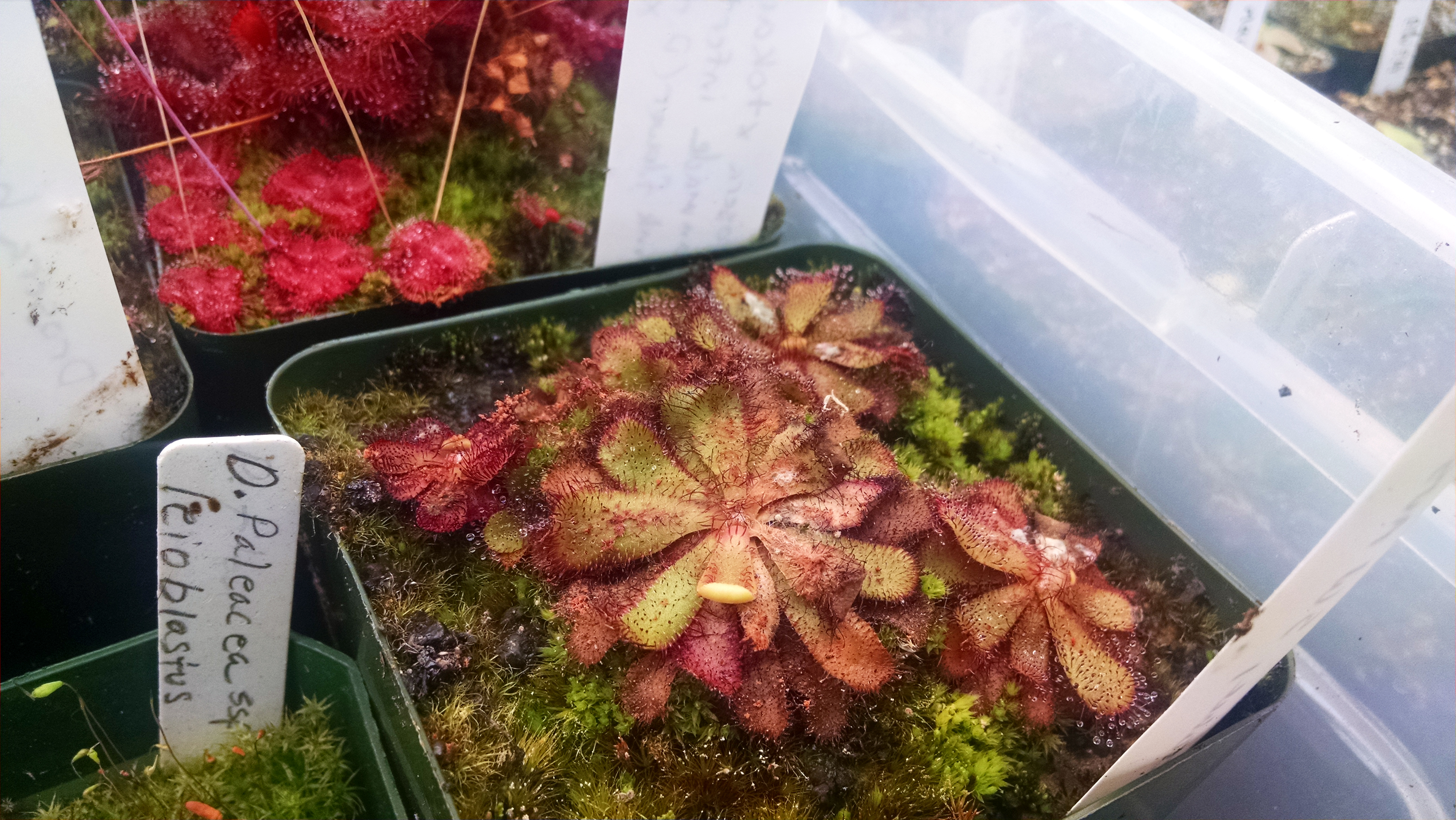
Drosera leucoblasta with gemmae.
Drosera leucoblasta with gemmae (and recently-harvested).
I've still got a good amount of gemmae left, including Drosera leucoblasta, Drosera sargentii, Drosera paleacea, Drosera callistos, and Drosera helodes, among others. If you'd like to get some, email me at sundews.etc@gmail.com. I've been charging $5 per pack, with $3 for basic shipping, and various options for cold weather. Let me know!
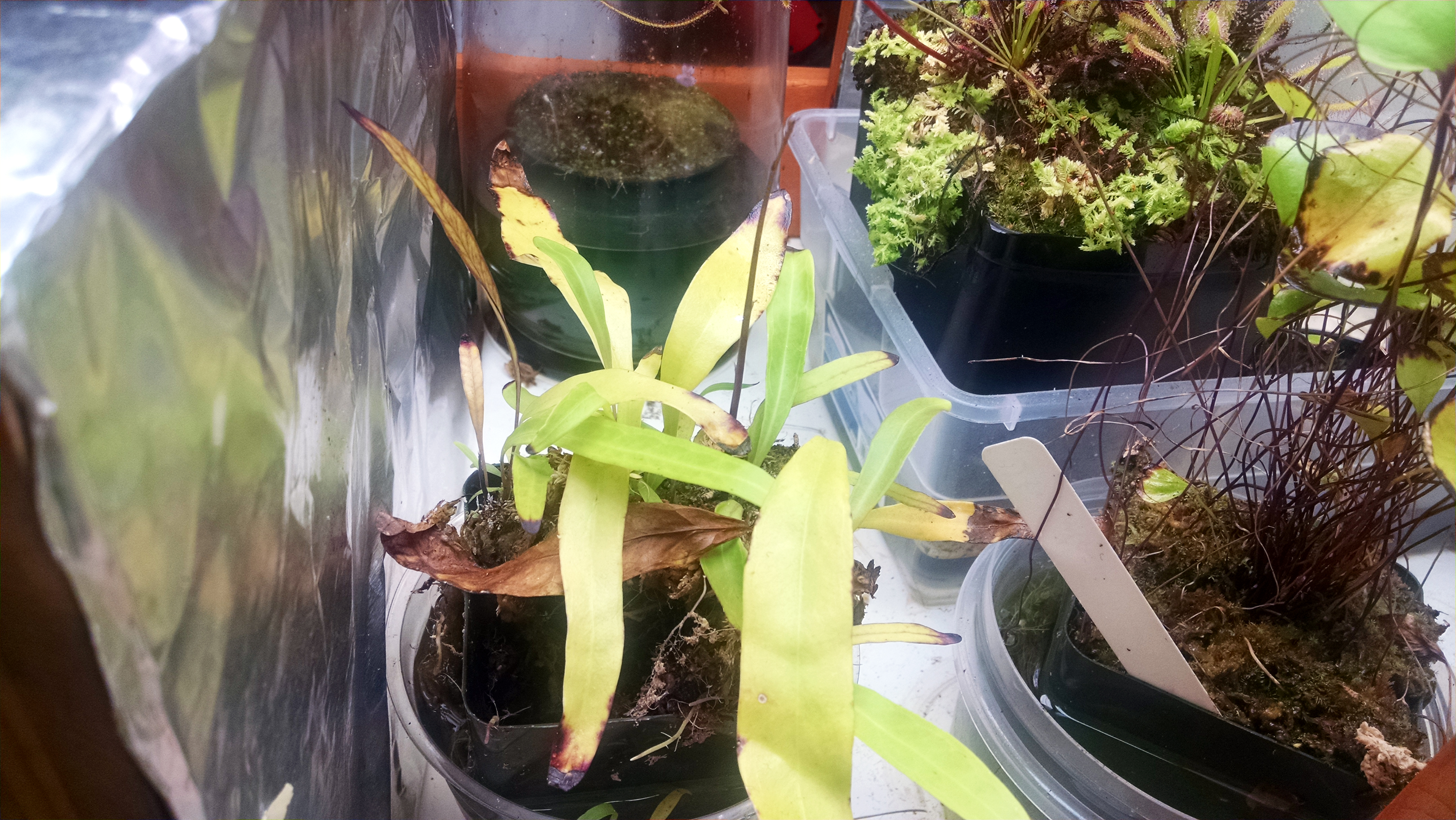
Besides pygmies and gemmae (and pygmies and gemmae and pygmies and gemmae), I've been spending a fair amount of time thinking about utrics lately. My Utricularia longifolia is blooming again!

Utricularia longifolia in bloom.
Blooming U. longifolia. No aphids this time!
I guess this is just the time of year for it. Last year it I first noticed the bloom in mid-February. My clump is a bit more mature now. I should have taken a picture of the bottom of the pot – it's a solid mass of stolons and traps. It's pretty funny. Maybe this year I'll pot this up into a much larger pot – I've been threatening to do that for a while. I gave a chunk to my friend Anne, who will be growing it outside. Interested to see how it does!

I haven't killed my Utricularia cornigera! That's exciting!

Utricularia cornigera.
Brand new leaf! I'm very happy.
As I've mentioned before, this pot had gotten much too dry and had lost all it foliage. However, it still had a big fat stolon, which I buried in the pot once I moved it to a wetter tray. Looks like we've got life now! I should fertilize this a bit once it grows in.

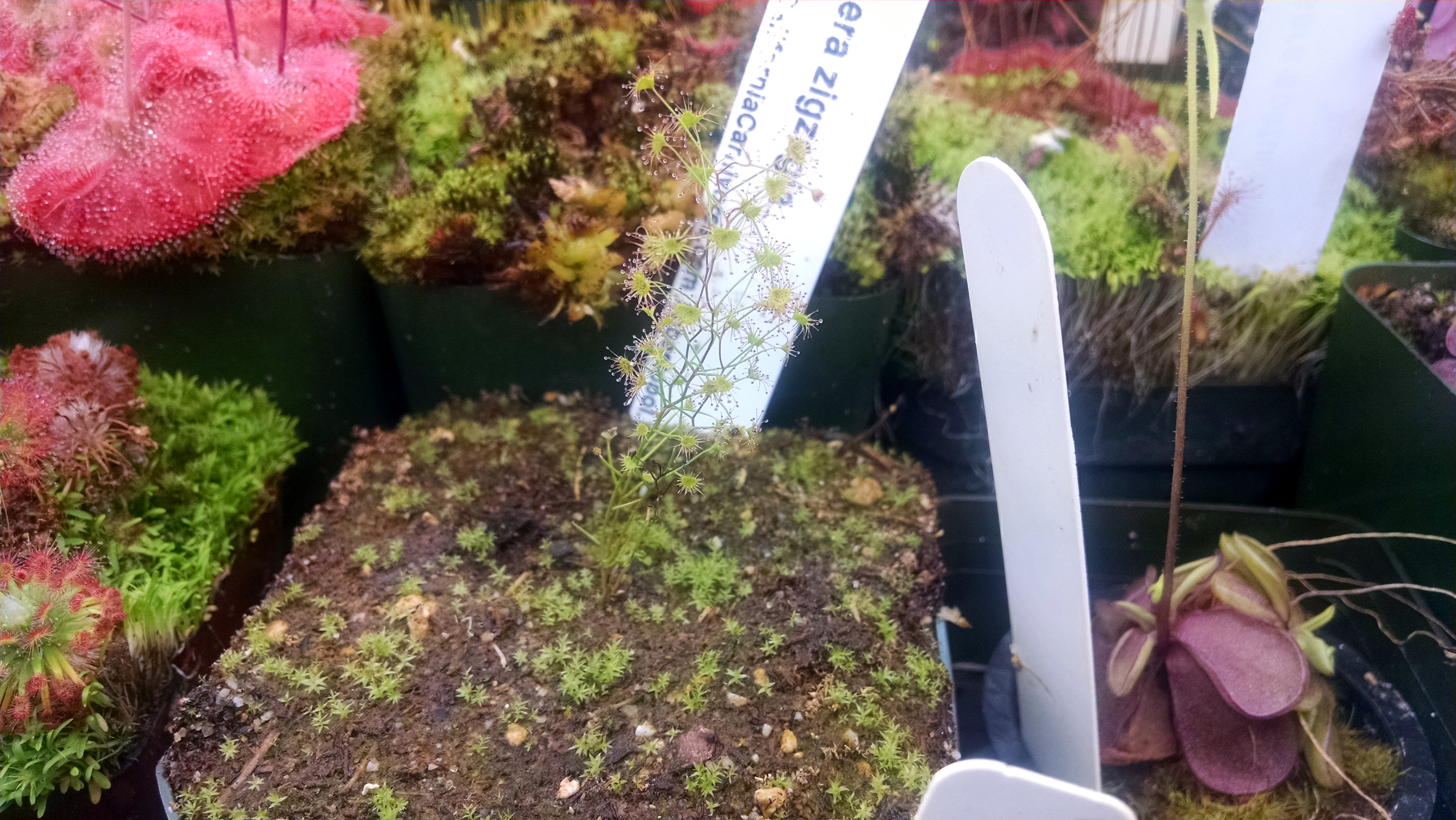
At the recent BACPS meeting I picked up a new tuberous sundew, the delightfully-named Drosera zigzagia.

Drosera zigzagia.
One of the best specific epithets in the genus.
I've gotten a new burst of confidence re: tuberous Drosera since my Drosera ramellosa came back from dormancy. Gotta get all the tubers I can now.

Something more to add to my confidence in growing the summer-dormant species is the fact that Drosera cistiflora is back as well.

Drosera cistiflora.
Arise! Awaken!
There was a little dried out nob on the pot where the old stem had been, and when I flicked it away I exposed this bit of stem to the lights, so it's growing! Now I really really want to get it to flower for me. That would be a real feather in the cap! We'll see.

Thursday, January 21, 2016

D. ramellosa is back (and other surprises)!

Aw yeah check this action out:

Drosera ramellosa.
Drosera ramellosa (finally) emerging from dormancy.
I was sure I had lost all of my winter-growing sundews. I started hydrating them back in late October, and after almost 3 months of nothing I had pretty much given up hope. But here we are! Now I need to feed this guy aggressively to try and get some good tuber development. Nothing yet from Drosera rupicola or Drosera cistiflora, but I'm still holding out hope.

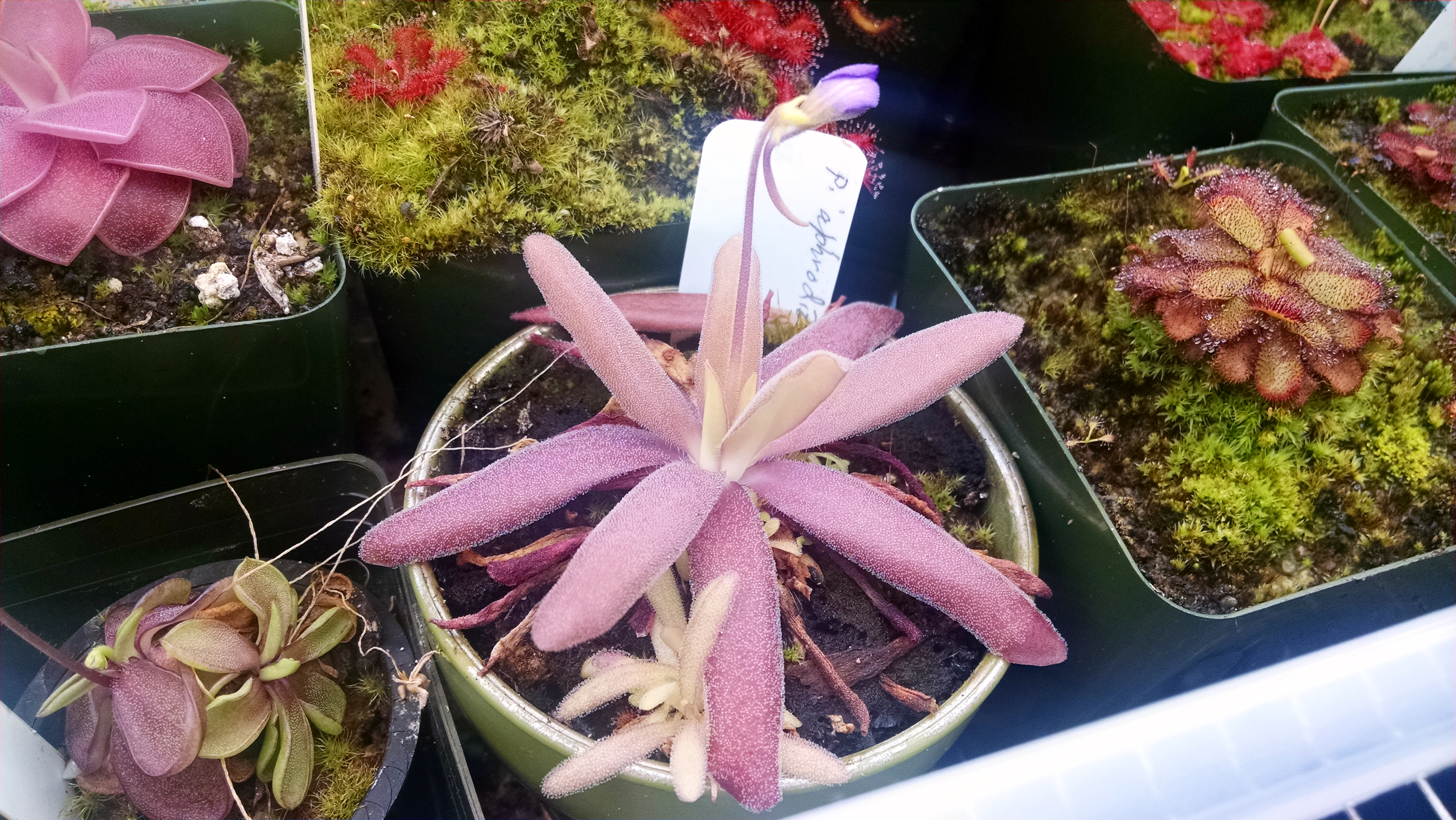
In terms of other surprises, my Pinguicula 'Aphrodite' is blooming for the first time.

Pinguicula 'Aphrodite'.
That color is absolutely unreal.
It's also looking like, fantastic right now. This is one of my favorite pings, easy. I'm excited to see the flower!

The Pinguicula lusitanica that started blooming back in November ripened, spilled a bunch of seed (I managed to collect some), and has already germinated.

Pinguicula lusitanica and seedlings.
And so it begins.
Look at all the little babies! You can see the dead mother plant there to the right of the large plant. Barry Rice said that this species could be an "entertaining little weed" and I think I agree with him! I'm considering making an outdoor mixed bog at some point, and this would be a great species to just toss thither and yon.

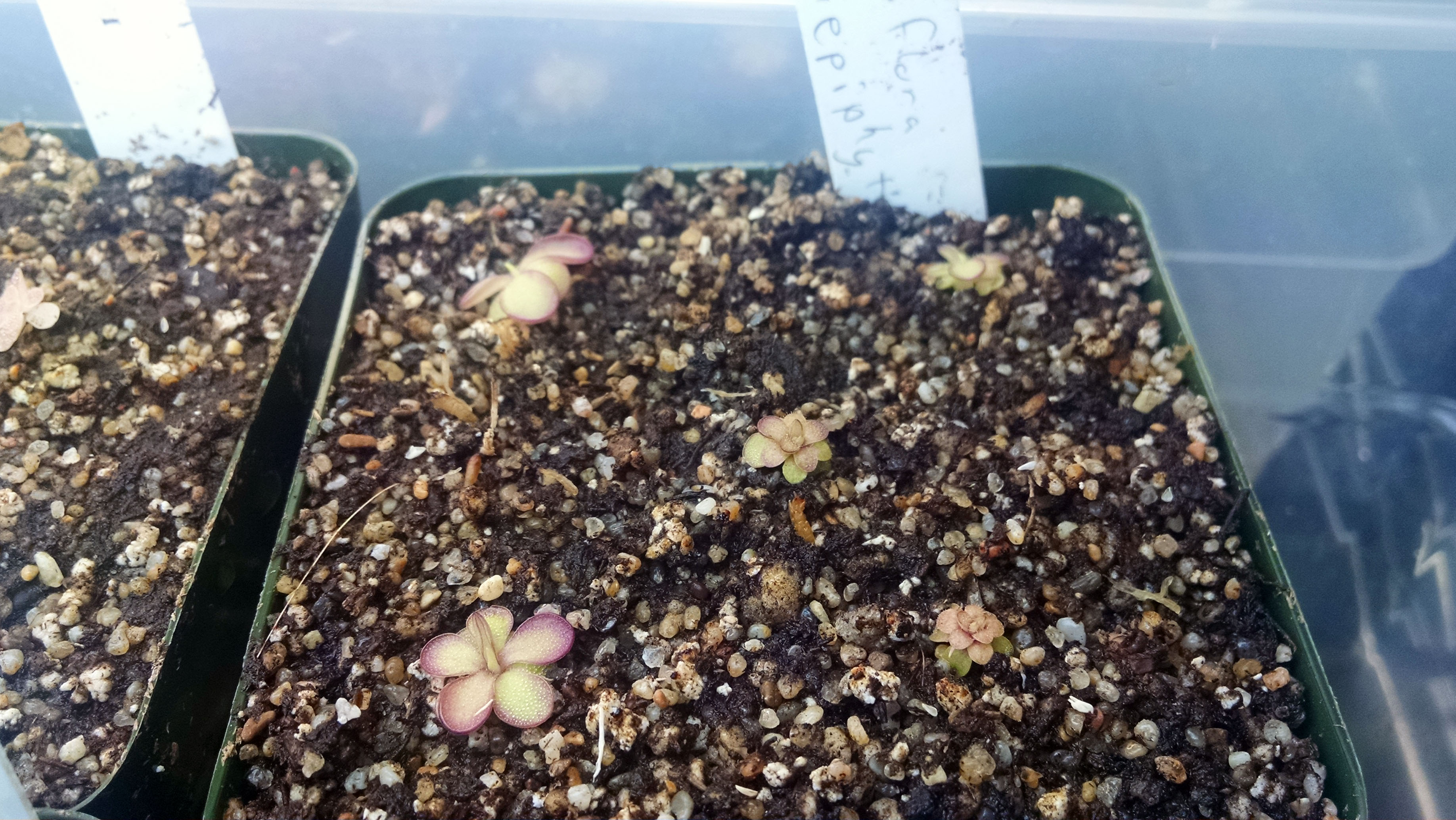
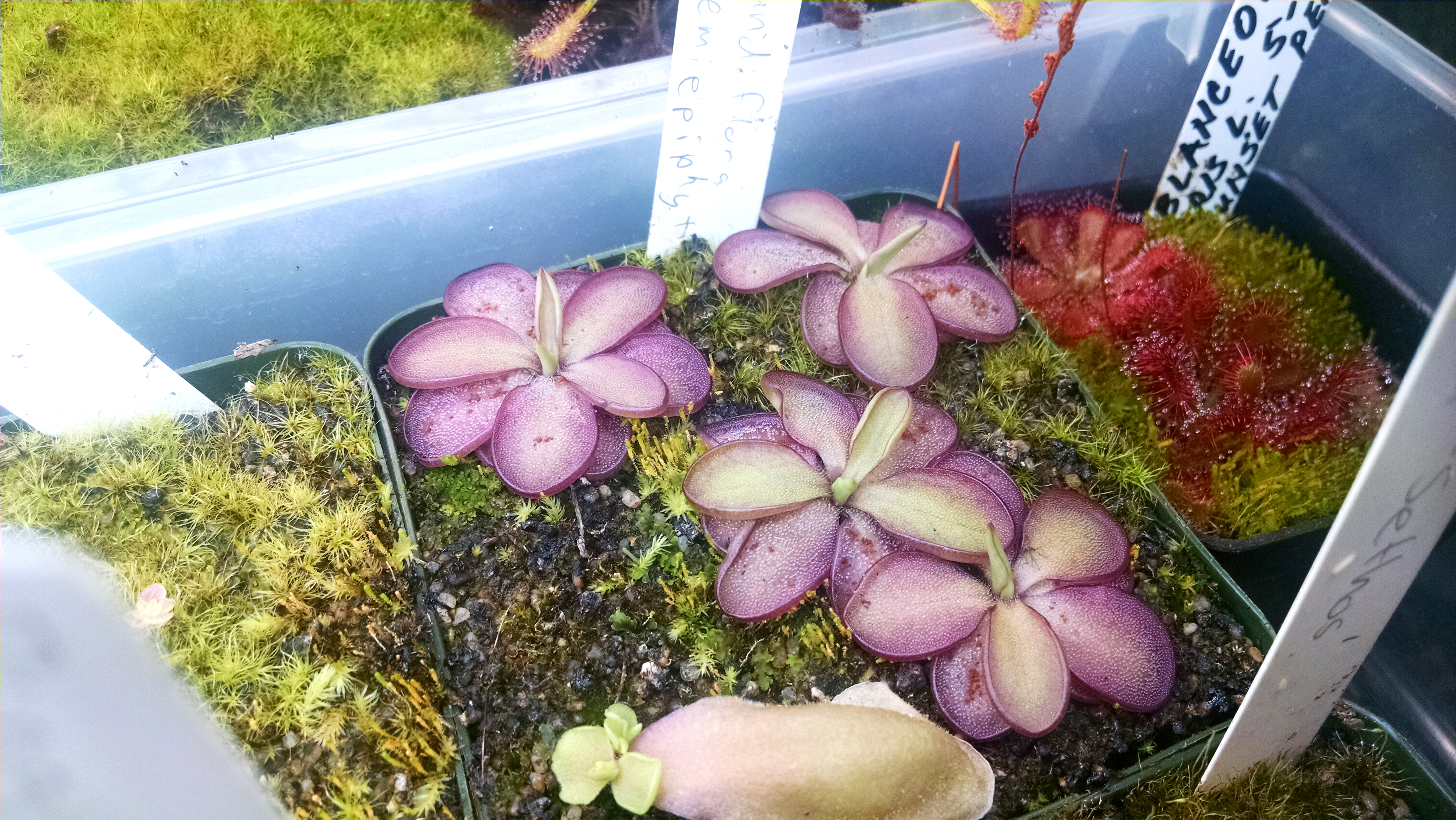
Finally, my Pinguicula rotundiflora × hemiepiphytica. I didn't feature this plant in my recent year-to-year comparison post, (because I didn't have it last January) but I should have. Look at this!

P. rotundiflora × hemiepiphytica less than a year ago.
P. rotundiflora × hemiepiphytica, March 2015.
P. rotundiflora × hemiepiphytica today.
P. rotundiflora × hemipiphytica, January 2016.
 That's like, 10 months of growth. Incredible little hybrid! This is why you shouldn't be afraid of getting pings as very small starts – they grow in just fine.

Exciting day over all I think.

Wednesday, January 20, 2016

South American Drosera roundup, January 2016

I've become quite keen on South American sundews lately. They're a sort of intermediate difficulty – rarer than the South African subtropicals (Drosera capensis etc.) and harder to propagate. However, they haven't proven all that much more difficult to grow, at least not in my conditions. In fact, they seem to like my conditions quite a bit. Drosera felix is even blooming for me!

Drosera felix aka Drosera kaieteurensis with flower stalk forming.
Incredible red color and a fuzzy flower stalk. What's not to like?
Look at at that flower stalk. It's so fuzzy! Apparently lots of people consider this plant synonymous with Drosera kaieteurensis, but I'm going to keep referring to it as D. felix because that's how I received it (in case taxonomy gets reshuffled again), and because it's an adorable name.

My Drosera graomogolensis root cuttings are going well!

Drosera graomogolensis root cuttings.
Two so far. They're big too!
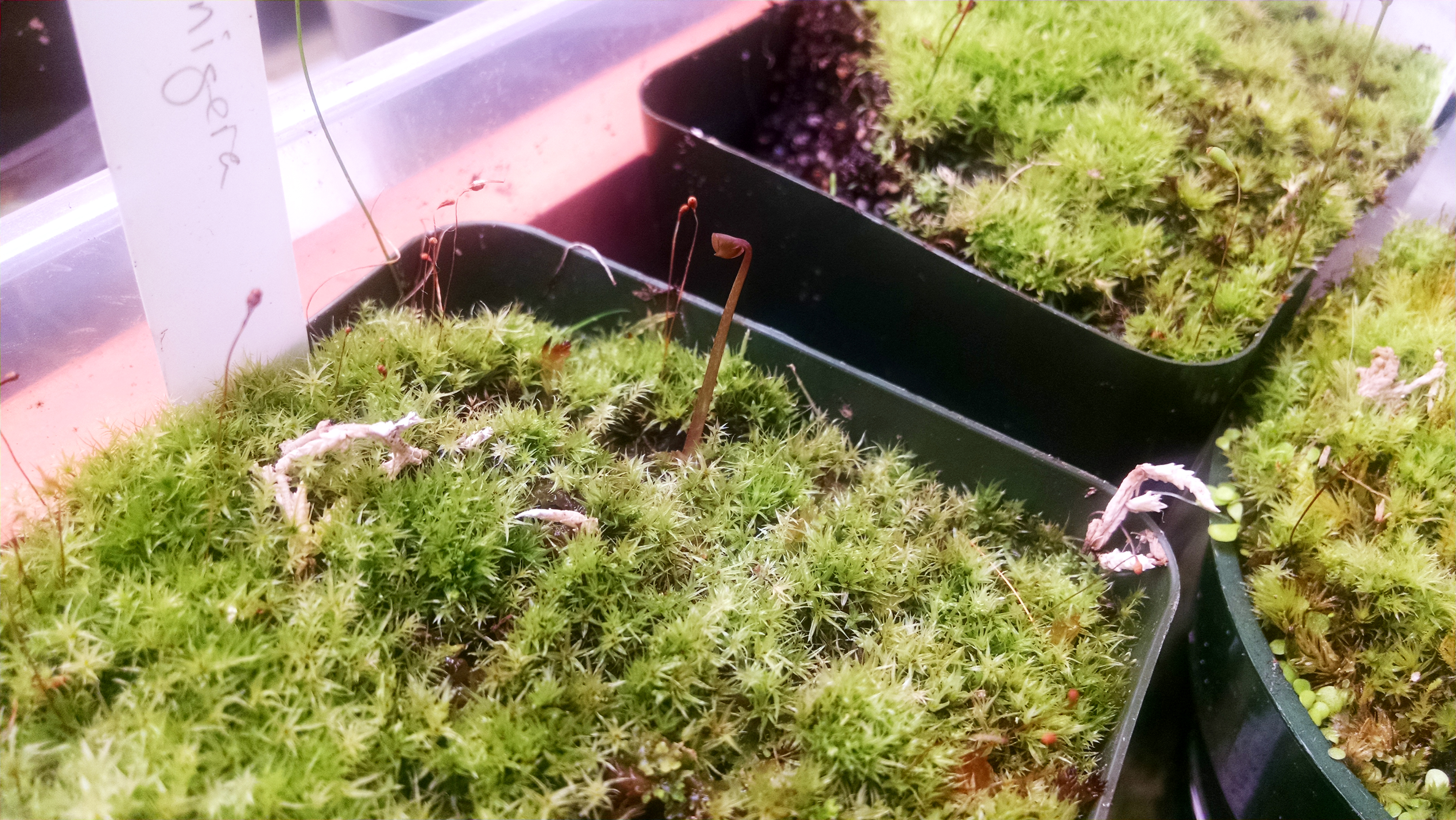
I think I can get 2 or 3 more plantlets out of this root, so I'm going to leave the humidity tent on for a while more. Very pleased with the progress so far. Really looking forward to being able to harden this guy off.
My largest Drosera tomentosa seedling is still pretty small.

Drosera tomentosa seedling.
So little still. Good luck buddy!
I've fed these guys once or twice, but I think I should do it again. This is the perfect size to start really feeding. Gotta be careful about mold though – lately that's been much more common when I'm feeding my sundews. Not sure why.

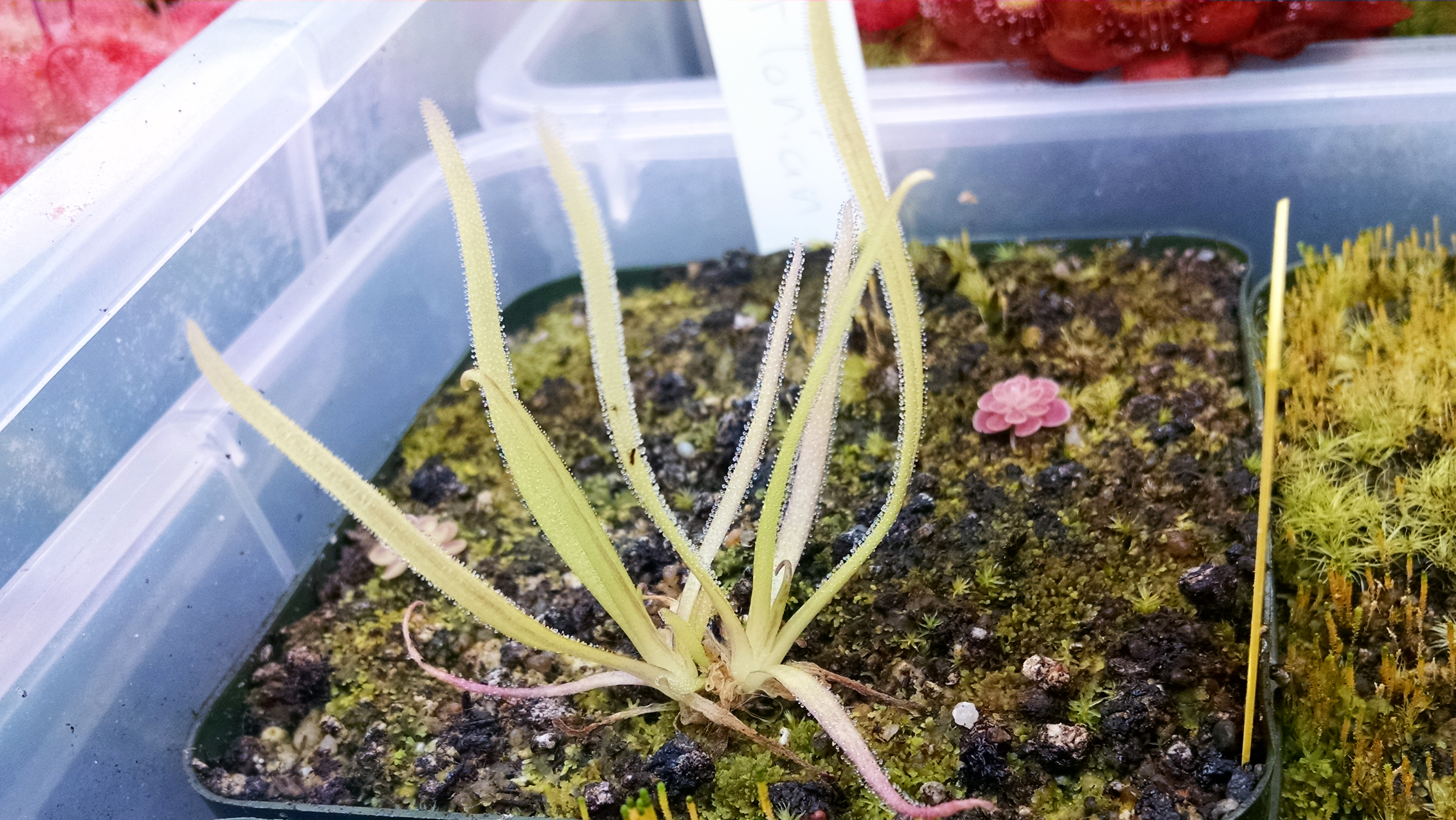
Drosera sessilifolia is another South American species, though I almost forgot about it for this post. I group it with Drosera burmannii in my mind, since they're both in Drosera subgenus Thelocalyx.

Drosera sessilifolia.
There are a lot of flower stalks going on in this pot. I need to address that somehow.
Those two in front got a heavy feeding recently, which is why they're not showing as much color. They also got a lot of mold on the food, I think because I had ground it a few days prior and left it out to accumulate mold spores. Lesson learned!

Finally, my favorite of the South American plants, Drosera spiralis.

Drosera spiralis.
I really, really like this plant a lot.
It's perennially difficult to get a good photo of this plant, since it grows right up into the lights. That's actually a problem I need to solve soon, since I want to start prepping it for the BACPS show in June. I guess I can always raise the lights a bit. Killer plant though, it's supporting almost 6 leaves right now. That's a lot for this species!

If you've had success with Drosera for a year or so I strongly encourage you to try out some South American forms. They're quite nice, and very satisfying. And if you grow any SA sundews, hit me up! I'd love to trade and talk shop.