Showing posts with label Drosera capillaris. Show all posts

Thursday, April 7, 2016

Blogging is hard

I was staring at my plants earlier, trying to think up a blog post, and I realized that I was having a hard time thinking of what to post about. I think that's because I've been sort of out of the posting loop, and that the good thing to do was to just post about some plants. So here they are.

At the recent BACPS meeting I was given a chunk of a very cool plant, Utricularia babui.

Utricularia babui.
I love new utrics.
This utric produces blue-to-purple flowers that are shaped similarly to Utricularia gramnifolia. It's pretty uncommon, so I'm excited to have some.

My Drosera graomogolensis have grown in a bit after a recent feeding.

Drosera graomogolensis.
I should have started growing this plant a long time ago.
Great color on these also. Such a pretty plant!

This big Drosera capensis is looking pretty good right now – especially considering that I dropped my light fixture on top of it a couple week ago.

Drosera capensis.
This is a wonderful clone.
You can't even tell! D. capensis is such a trooper.

I've seen some size increase in my Pinguicula cyclosecta and Pinguicula esseriana.

Pinguicula cyclosecta and Pinguicula esseriana.
Keep going little pings.
I took a couple leaf pullings, cause you should always be propagating. There's a lot of growing in to do still though.

The Drosera barbigera have totally recovered from gemmae season and are looking awesome.

Drosera barbigera.
Little fireworks!
Doesn't look like I'm having any gemmae-related attrition this year either, which is great.

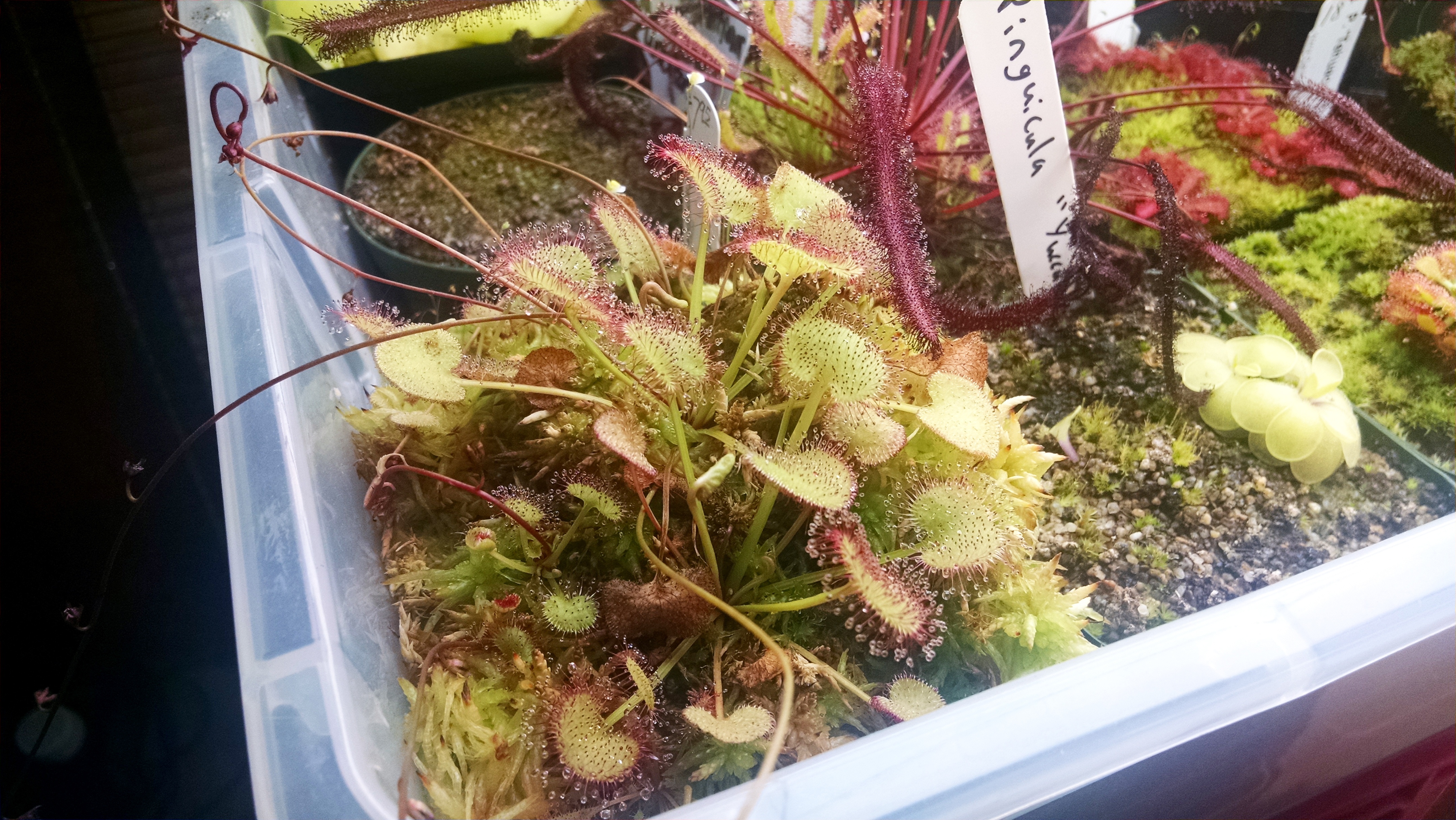
Finally, my long-arm Drosera capillaris are looking amazing right now.

Drosera capillaris.
Look how dewy!
These are the ones from Tate's Hell Swamp, FL. Best location data.

Sunday, November 8, 2015

Plants I haven't mentioned in a while

Sometimes it seems like I'm always posting about the same plants. Today I decided to check out a few species that I haven't paid much attention to lately.

Drosera collinsiae has been looking weirdly unhappy for the past month or two.

Drosera collinsiae.
At least the Utricularia bisquamata is going strong!
It looks sort of the way it does when it's heat stressed but that's definitely not the problem right now. This has never been a very vigorous plant in my conditions though, so it could be anything really. I wish it would perk up though!

The neighboring Drosera affinis is doing much better.

Drosera affinis.
Quite dainty. I like it.
I don't mention it much, but I really like this species. Its stem-forming habit is great – distinctive, but not ridiculous like Drosera madagascariensis. It's an elegant, delicate-looking plant.

I dug out some of the moss from around Drosera brevifolia so it can have a bit more room now.

Drosera brevifolia.
Maybe I can feed this guy again soon and encourage flowering.
I hope I didn't damage the roots in doing so. I really need to get this plant to flower one more time so I can start a new pot and throw this one out. That Sphagnum is really awful stuff, very dense and stiff. It just totally swallows up plants and doesn't even look nice.

I got this long-armed form of Drosera capillaris in the last NASC auction because I liked the location data: Tate's Hell Swamp, FL. It's actually a really handsome plant though!

Drosera capillaris long-arm (Tate's Hell Swamp).
Wonderfully dewy. Great plant!
That's one of the best red colors in my collection, and it's supporting a really large amount of leaves. Very vigorous plant, I like it a lot.

Friday, June 12, 2015

Introducing Drosera capillaris 'Emerald's Envy'

I've hinted a couple times in the last few weeks that I have a fun story to tell about the plant I've been calling Drosera capillaris (Alabama). It turns out I discovered a rare cultivar right under my nose!

Drosera capillaris 'Emerald's Envy' with flower stalk.
My first flower stalk on this plant in a long time. I need to get some more seed!
It started several months ago when I was browsing the ICPS website's list of registered cultivars. If you're looking for a really nerdy way to spend an hour or two, go spend some time reading cultivar descriptions, it's pretty cool. I came across the description for Drosera 'Emerald's Envy', which was a white-flowered form of D. capillaris that was collected from a population in Florida. It reminded me of my plants.

However, since my plants were labeled as being from Alabama, rather than Florida, I didn't want to assume that this was the cultivar. This all changed when I was over visiting Predatory Plants and noticed that Josh had the same D. capillaris plant (from California Carnivores). He told me that the "Alabama" on the label was a result of misreading the handwritten abbreviation "AL", which was supposed to stand for "Albino" or "alba".

Drosera capillaris 'Emerald's Envy' in a clump.
My favorite picture of this plant before I separated the clump.
I had to investigate further. First I contacted Damon at California Carnivores, who confirmed the story about the labels, adding that he didn't know the exact provenance of the original seeds they got, but that they very well could be from Florida. Next I contacted William Clemens, who registered the cultivar in 2006 (he's active on TerraForums as Joesph Clemens). Based on the picture I sent him and my description of the plants, he felt that my plant was indeed D. 'Emerald's Envy', which he was afraid had gone extinct in the 9 years since he registered the cultivar.

To quote from the cultivar description:
"...the entire leaf petiole and blade exhibit light to medium green coloration, even when grown in strong artificial light or full sunlight...the flowers of Drosera 'Emerald's Envy' are white--a somewhat unusual color (although white-flowered plants are occasionally encountered in the wild)...Drosera 'Emerald's Envy' may be propagated by seed or vegetative means, but no matter how the plant is propagated, in order to retain the name Drosera 'Emerald's Envy', the progeny must exhibit the light green leaf color, white flower color, and maintain the form of the standard, even when grown under conditions of strong light (including full sun)..."
You can read the full article here. Compare that description to the plants above, as well as to these long-arm form D. capillaris I got during the NASC auction.

Drosera capillaris long arm.
These have really settled in and are looking great, btw.
While the long petioles are a big difference, the color is really the striking thing. That red color is much more typical of D. capillaris.

Mr. Clemens was happy that this cultivar is still circulating, and so am I! It's really a lovely plant, and now it's got a cool name to boot. I've sold a few packets of seed over the last year – if you bought one of them I guess it's time to update your labels! Also if you bought a plant from California Carnivores with the label "Drosera capillaris Alabama" that displays the above characteristics you can as well. I think it would be cool if this cultivar could be more widely-recognized. It's easy to grow and propagate, and charming as heck.

Drosera capillaris 'Emerald's Envy'.
Drosera 'Emerald's Envy'.
Now that's a pretty plant.

Sunday, June 7, 2015

Some great-looking sundews

The BACPS Annual Show and Sale was yesterday, and it was lots of fun. I'm gonna make a big post about the juried show, but that's going to take a lot of work editing pictures and whatnot. In the meantime here's a few plants that you might appreciate.

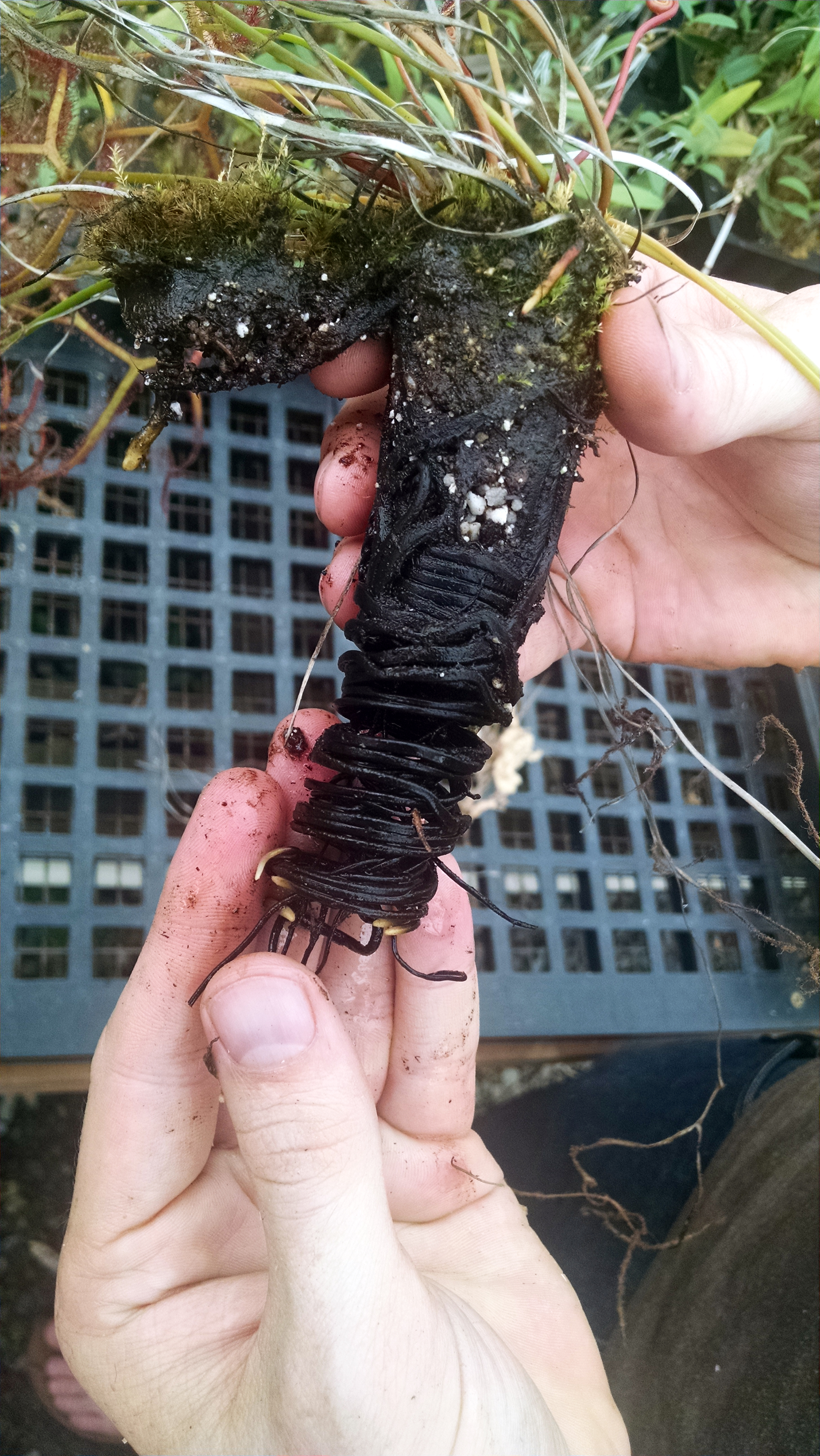
This Drosera binata was discovered while I was helping repot some plants over at Predatory Plants in advance of the show.

Drosera binata with dense roots.
Sproing!
That spring-looking thing at the bottom is the root ball. The plant had actually pushed itself out of its 1-inch plug, which is how Josh noticed it. Apparently this is descended from a D. binata he received for free at the first BACPS meeting he attended after coming back to the Bay after college. That plant apparently grew a huge root ball over the next couple years and then when he went into business selling plants he unpotted it and made a whole bunch of cuttings. That one little freebie has spawned thousands of D. binata plants for him to sell. What a great clone!

Speaking of spawning new plants, my Drosera capillaris "Albino" is flowering for the first time in a long time.

Drosera capillaris with flower stalk.
I've been waiting for another flower on this guy.
You'll noticed I used the descriptor "Albino" instead of the location "Alabama." There's a story there, but I'm not quite ready to tell it yet. Still doing more research. Definitely looking forward to getting some more seed from this guy though.

My Drosera prolifera is doing as well as I've ever seen it doing lately.

Drosera prolifera.
Lots of plants!
It's going through another bout of flowering, so there are lots of new plantlets. I'll have to either pot this up into a larger size or divide the pot pretty soon – I'm running out of spots to stick the plantlets into the moss.

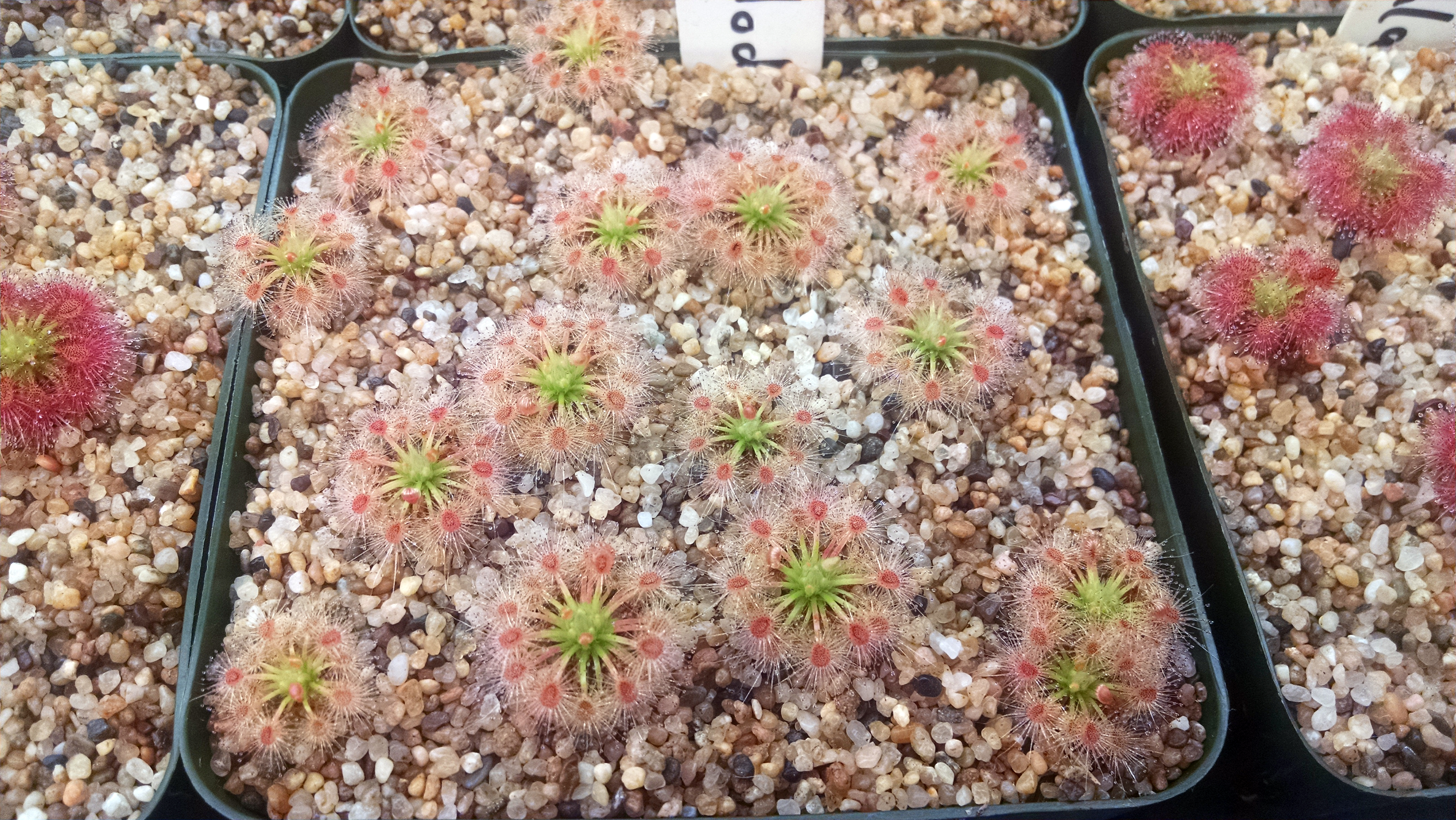
On the pygmy front, this new pot of Drosera helodes is looking fantastic.

Drosera helodes.
Perfect little sundews.
The thing I really like about this species is the contrast between the white tentacles and the red laminae, which turn into neat little circles. Great distribution in the pot too.

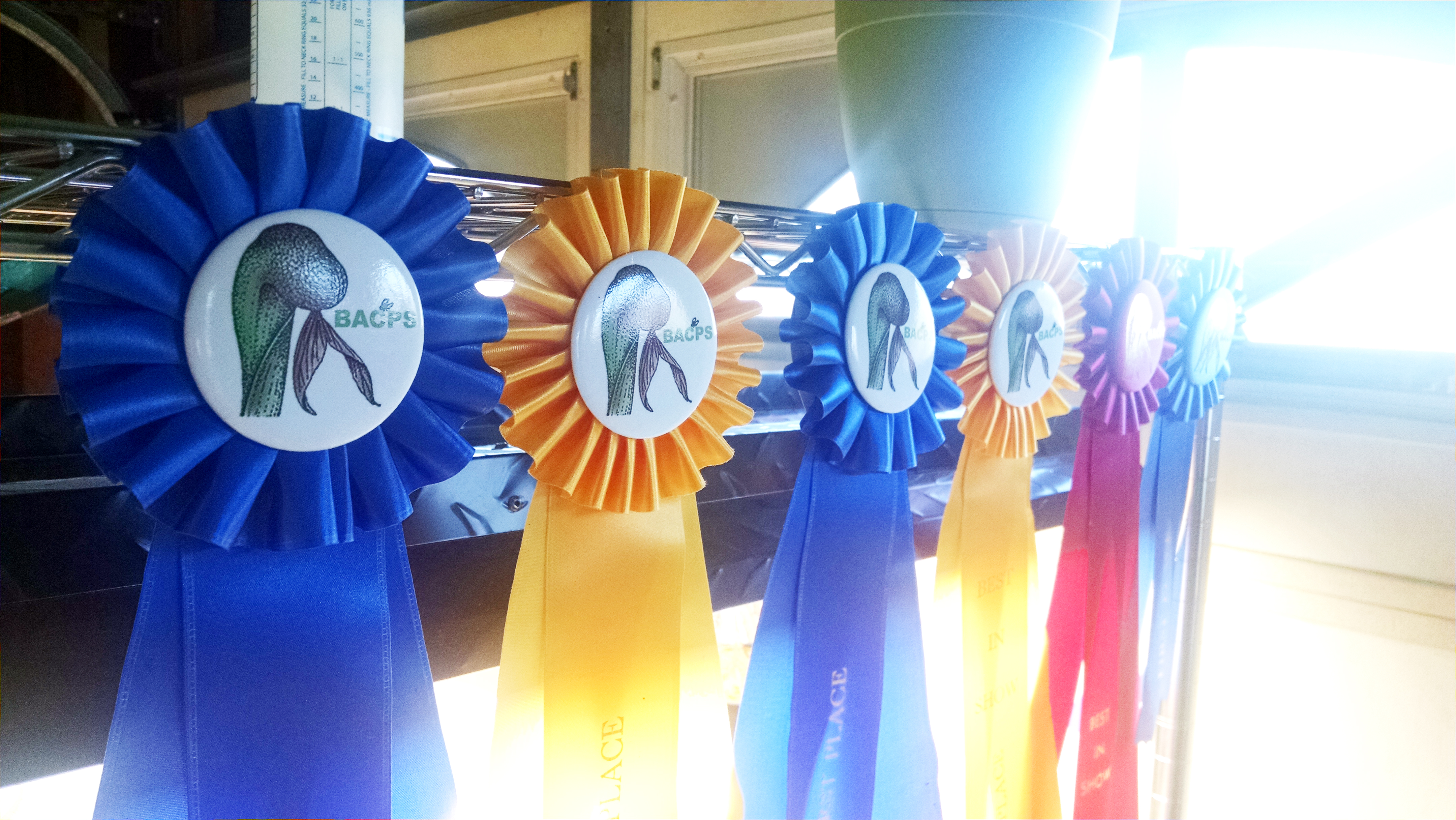
Finally, just to whet the appetite for the upcoming show post.

Ribbons from the BACPS show.
It was lots of fun, but I was tired by the end.
It was a good day!

Tuesday, May 12, 2015

Some of my NASC auction acquisitions

As I mentioned a bit ago the NASC held its annual benefit auction at Terra Forums about a month ago. I donated several plants, and bid on several plants. I'm still waiting on some of my flytraps to arrive, but I'll just go ahead and post about the plants that have shown up.

First up is the most exciting, and the one for which I paid the most, Pinguicula reticulata.

Pinguicula reticulata.
So small, but so full of promise!
It's not huge now, but it's very attractive when mature. Also, the flowers are beautifully veined.

Another ping with a beautiful flowers is Pinguicula rotundiflora.

Pinguicular rotundiflora.
Let's see some strikes on those leaves.
I cannot wait until I have a little pot full of these guys in flower. It's adorable. There were lots of leaves to try as pullings when it arrived too, hahahah.

This next plant is Drosera capillaris, which I already have. This, however, is a very different long-arm form, and it came with location data I couldn't resist: Tate's Hell Swamp.

Drosera capillaris.
I had to get at least one sundew.
I've said it before, but Drosera capillaris is a very underrated species.

The grower from whom I received the P. rotundiflora and the D. capillaris (as well as a Pinguicula debbertiana that, alas, didn't survive shipping) sort of messed up shipping, and in his second package he sent along a handsome bonus: Drosera slackii!

Drosera slackii.
When it rains it pours I guess.
I'm really hoping this is a different clone from the one I got from California Carnivores recently. That would leave the possibility of someday getting seed, if I provide excellent conditions and get lucky.

This last acquisition is actually one I split with my friend Anne, who works at the Cactus Jungle. It's a seedling plug of several little baby Sarracenia leucophylla f. viridescens, aka anthocyanin-free S. leucophylla.

Anthocyanin-free Sarracenia leucophylla seedlings.
Sarracenia seedlings take longer, but that just builds anticipation!
Little babies! I'm going to grow them out a bit under my lights and then we'll divide the plug between us. These are going to look awesome in a couple years, see if they don't!

I can't think of anything better than buying carnivorous plants for charity, hahahah.

Saturday, March 7, 2015

Sundews Etc. one year in

One year ago today I made my first post here on the blog, about my blooming Drosera capillaris.

Drosera capillaris.
D. capillaris, 3-7-2014, from Flowers and D. capillaris "Alabama".
Things were so much simpler back then.

Here are some Fun Facts about the Sundews Etc. blog:
  • Around 17% of my traffic comes from Ukraine. Thanks for tuning in, Ukrainian growers!
  • Both of my Grower Interviews are among my top 10 most popular posts. I guess I should do some more.
  • Based on the labels (to the right) I talk about Drosera burmannii more than any other species (big surprise), but pygmy sundews as a group are a close second.
  • There are just shy of 1100 photos of carnivorous plants on this blog for 153 posts, around 7 per post on average.
Now, let's look back at some old posts and see how far we've come.

March

Dionaea muscipula.
Dionaea muscipula, 3-12-2014, from Things are growing!
April 

Drosera scorpioides
Drosera scorpioides, 4-3-2014, from Pygmies and D. adelae.
May

Drosera 'Marston Dragon'
Drosera 'Marston Dragon', 5-26-2014, from The Housefly and the Dragon.
June

Drosera allantostigma.
Drosera allantostigma, 6-20-2014, from I really love Drosera allantostigma.
July

Drosera capensis 'Albino'
Drosera capensis 'Albino', 7-4-2014, from Repotting a few sundews.
August

Drosera helodes and Drosera allantostigma.
Drosera helodes and Drosera allantostigma, 8-26-2014, from Checking in on various plants.
September

Drosera adelae
Drosera adelae. 9-11-2014, from Drosera adelae is offset crazy.
October

Sarracenia leucophylla
Praying mantis and Sarracenia leucophylla, 10-25-2014, from A thief among the Sarracenia.
November

Pinguicula laueana × emarginata
Pinguicula laueana × emarginata. 11-21-2014, from Pinguicula roundup, November 2014.
December

Utricularia calycifida.
Utricularia calycifida flower, 12-6-2014, from A few new blooms.
January

Drosera ultramafica × spatulata
Drosera ultramafica × spatulata, 1-27-2015, from Some progress shots.
February

Drosera venusta
Drosera venusta, 2-9-2015, from Random pictures of pretty sundews.

Finally, here are a few more posts I noticed looking through the archives that might be of interest to newer reader.
And of course, there are Plant Profiles, Cultivation Guides, and Grower Interviews on my Blog Series page.

Thank you all for reading – sharing pictures and talking about my plants with fellow growers makes everything a lot more fun. Here's to another good year!

Monday, December 22, 2014

Update: the Summer Batch

 Back at the beginning of July I started a round of propagation I referred to as the Summer Batch. I started 4 species from seed and 4 from leaf cuttings. It's been 5 months, so let's see how things stand.

First up, the seeds. Drosera capillaris was the most successful in this respect, and I've got a couple decent-looking seedlings.

Drosera capillaris seedlings.
D. capillaris is a very pretty little sundew.
As well as a couple Drosera tokaiensis.

Drosera tokaiensis seedlings.
D. tokaiensis is a pretty vigorous grower usually. Hope these take off soon.
And, hilariously, one lonely little Drosera burmannii (Humpty Doo) that germinated after like 4 months.

Drosera burmannii Humpty Doo seedling.
This one took a while.
I still haven't seen any Drosera intermedia 'Cuba' sprout. I know it's not the seeds, since I've seen seed that I sent to other people germinate.

In all I'm disappointed with the seedling success rate (although pleased that D. capillaris germinated without cold stratification). I'm not sure what exactly went wrong. I think that fancy bag of peat I used may have something to do with it – the Drosera sessilifolia and D. burmannii (Hann River) that I started on my standard peat a couple months later have been doing great.

I'm more pleased with how my leaf cuttings performed, although not necessarily elated. First up, only one of my 6 Drosera adelae plants struck, although considering the current state of my main pot, this is more a blessing than anything else.

Drosera adelae plantlets.
The red color is very nice on these plantlets.
On the other hand I have several nice looking plantlets of Drosera venusta that have come up. Only one of the three cuttings struck, but dang they're pretty.

Drosera venusta plantlets.
This is really a lovely sundew. I wish my mature plant was growing better.
I also had pretty good luck with Drosera madagascariensis. Two of the three cuttings struck, and one even has a little stem going already.

Drosera madagascariensis plantlets.
It's already got that lean oh no.
The cutting I'm happiest about is this Drosera anglica CA x HI. If you follow the blog you'll know I recently lost the mother plant to aphids (essentially – it's still got some green but the prospects are grim). This plant is pretty much the size the mother plant was when I received it in March. Not too bad!

Drosera anglica CA x HI.
Really a stunning plant. I need to keep this one alive.
I'll have to start propagating off of this plant now, since I really want to be able to share this guy with the BACPS and others.

What have I learned from the Summer Batch? The first thing I learned is that I played with too many variables. Changing up the peat I use, using seed starter trays for the first time, messing with a bunch of different species – it's hard to draw a coherent picture. I definitely think that the peat is part of the problem, and I don't plant on using it again (especially since it's so expensive).

The main thing I learned is that I need to be propagating more, if only to keep generating backup plants. Now I just need to make some more room under my lights.

Sunday, November 16, 2014

How are things over here?

There's a lot going on in this little tray right now.

Sundew tray.
Each tray is like its own neighborhood.
 First off, it appears I was wrong about that caterpillar on my Drosera burmannii being the only one.

Drosera adelae with caterpillar damage.
Chewed leaves and caterpillar poop. Great.
I found another in my Drosera adelae pot last night. Luckily there are lots of traps open on my Venus fly-trap right now. Also D. adelae is a very vigorous plant in my conditions and I'm sure it will recover just fine. Even if one or two of the plants succumb, there's a lot of root in that pot that will form new plantlets.

Next door, it looks like there are gemmae forming on Drosera allantostigma.

Drosera allantostigma forming gemmae.
Still looking good, although the colors are more orange and less pink than they used to be.
I need to get some media ready!

In the same pot I have a little cleistogamous flower stalk of Utricularia subulata.

Cleistogamous Utricularia subulata flower stalk.
Another charming weed.
I like it. It's got a nice sculptural quality, and the dew drops at the crooks are pretty neat. I've said it before, but I think the weedy Utricularia get short shrift.

This Drosera capillaris seems to also have a bit of humic acid buildup, like the Drosera aliciae over in my community pot.

Drosera capillaris.
It's still pretty, but I need to help it get healthier.
Apparently flushing the pots can help. Another chore to toss onto my list for a day that I have free to spend with my plants.

Meanwhile I can't tell if Drosera filiformis is dormant or dead or what.

Dormant (or dead) Drosera filiformis.
Right now this is more of a "liverwort and moss pot" than a "D. filiformis" pot.
I'm definitely not chucking them out any time soon, but I wouldn't be amazed if these guys aren't gonna wake back up. I think the media is too dense for their taste. We'll see though. Give it a couple months.

My Drosera brevifolia pot is a good example of why you shouldn't give up on plants too soon.

Drosera brevifolia.
I've always liked the organic look of this pot.
See that plant in the middle? This is what it looked like back at the beginning of October:

Drosera brevifolia, apparently (but not actually) dead.
Back from the dead!
Welcome back little guy!