Showing posts with label Drosera brevifolia. Show all posts

Sunday, February 7, 2016

U. subulata and D. felix flowering

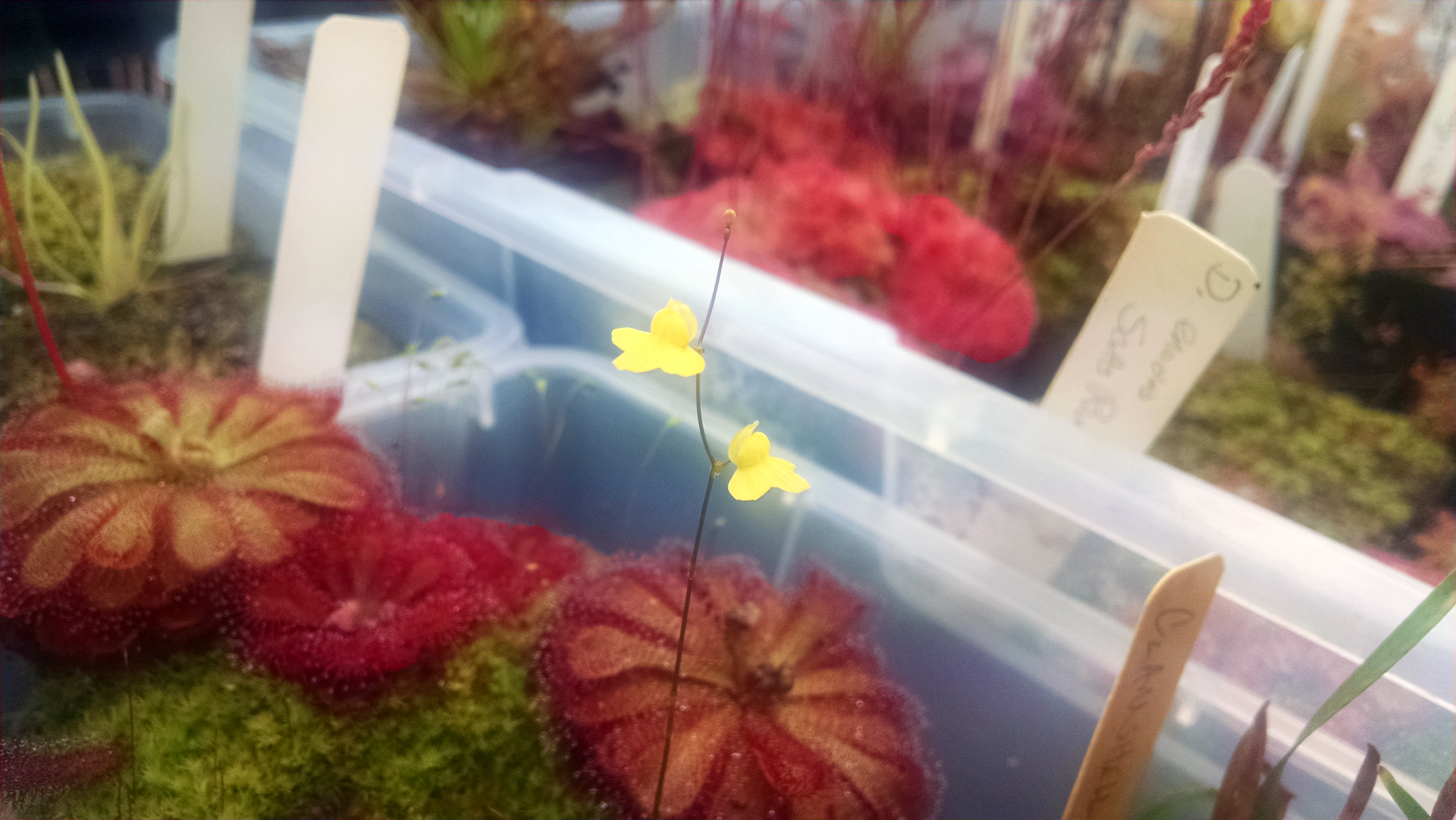
I watched the Superbowl at a friend's house today and ate a truly massive amount of ceviche. I hope your day was similarly fruitful. It's been a week and a half since my last post! I've been all over the place lately. One of the nicest things going on in the collection right now is this Utricularia subulata flower stalk.

Utricularia subulata flower.
Such a yellow flower!
U. subulata is a very frustrating plant. It's got a wonderful flower with a cool zig-zag flower stalk and these weird dew drops at the base of the peduncles. Very cool! Except it mostly produces cleistogamous flowers for me. Cleistogamous flowers form buds, but never bother to actually produce a flower – they just self-fertilize within the bud, then spill seed everywhere. I probably get several hundred cleistogamous flowers for each real flower stalk. Why can't you be better U. subulata? I want to love you!

Another plant that has been looking pretty legit is this Pinguicula moctezumae I received in a trade a bit ago.

Pinguicula moctezumae.
I should separate these two out.
I've never really cared for P. moctezumae, but I think that's because it tends to clump (which is not my favorite characteristic in a plant). These are actually really attractive under lights. Also, the flowers of this species are really nice. Someday!

My Pinguicula gigantea is blooming again for the first time in a while. But I'm posting today because it's been doing pretty well on the gnats lately.

Pinguicula gigantea.
It's not good to be a flying insect in my garage.
You can find photos of P. gigantea that are absolutely covered in gnats, which I think is super gross and ugly. Those are mostly grown in pretty humid greenhouses – I just don't have that many bugs in my growing areas. Still, good to know that mine can actually do work once in a while.

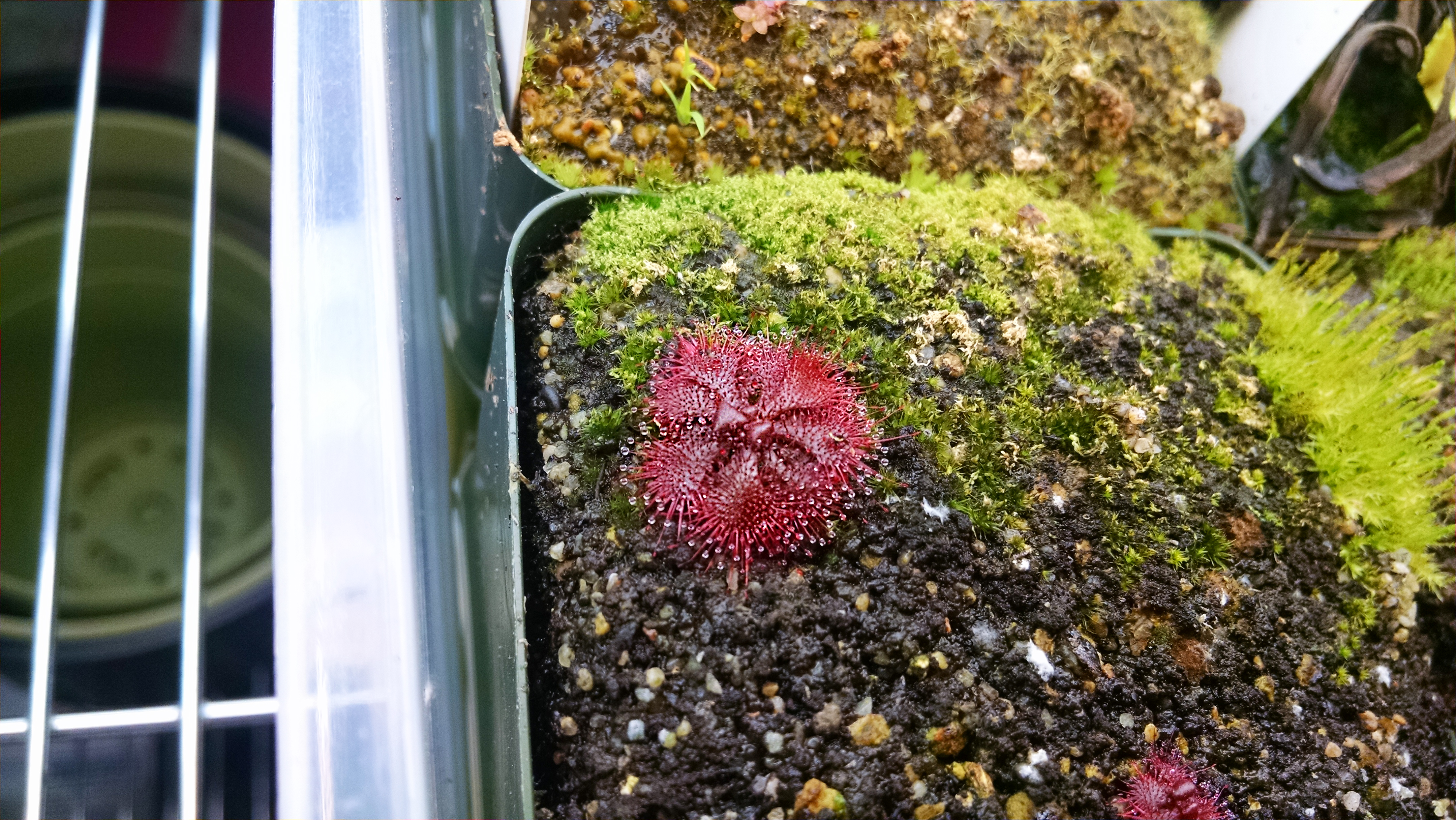
My Drosera brevifolia has responded well to feeding and is pretty much full-sized now.

Drosera brevifolia.
So tiny! Those wedge-shaped leaves are so distinctive.
Gotta feed these again soon. Gonna want to re-seed this colony to get a few more going. Very cute plants! Nice red color too.

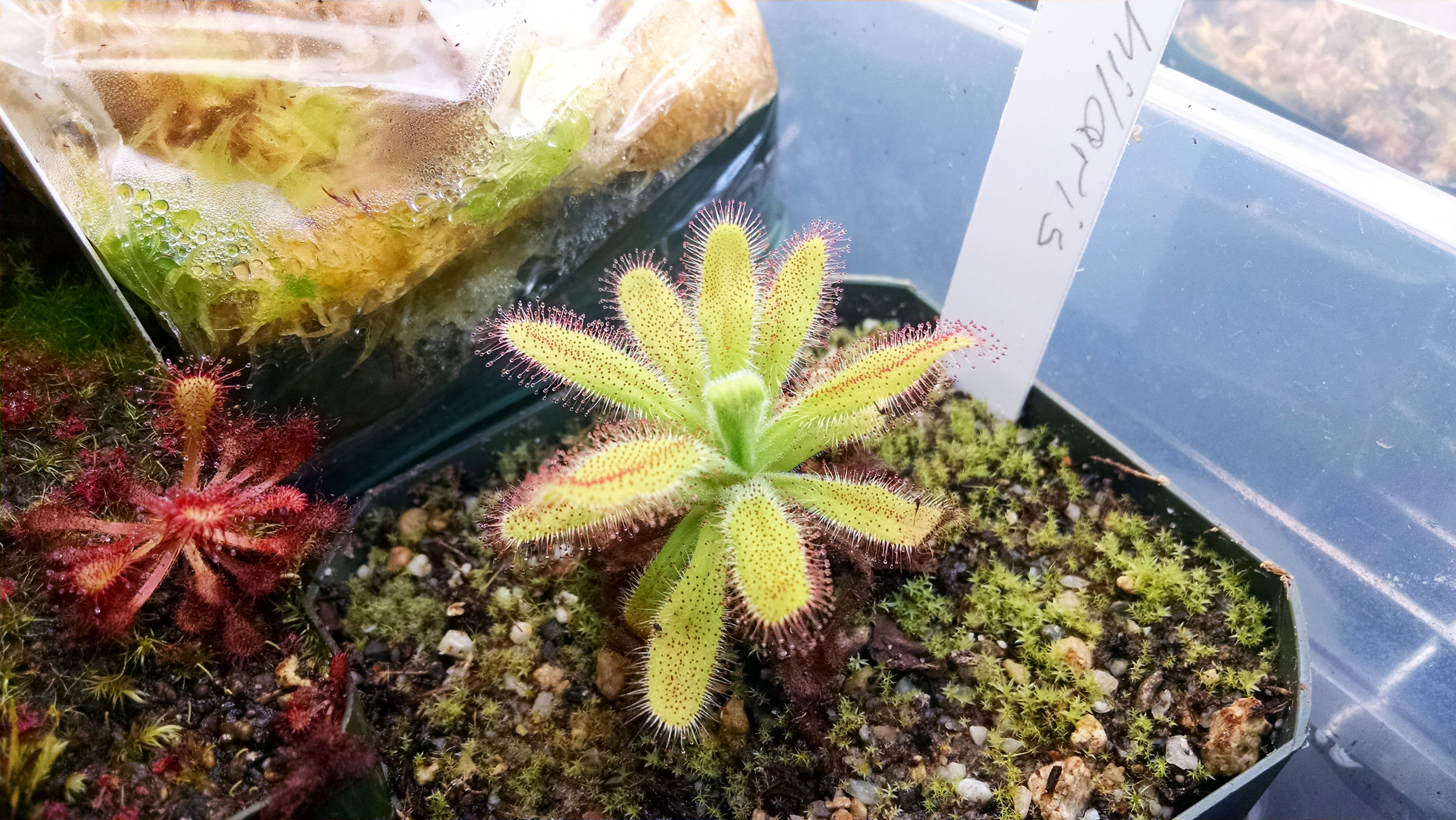
I recently took a trip to California Carnivores, where I picked up this sweet Drosera hilaris.

Drosera hilaris.
It's just starting to color up under the lights.
This is one of the neater South African species. I've heard conflicting reports of it being a summer dormant plant. It may just be that it is optionally dormant in hot weather. Apparently this one really likes cool temps. We'll see how it does!

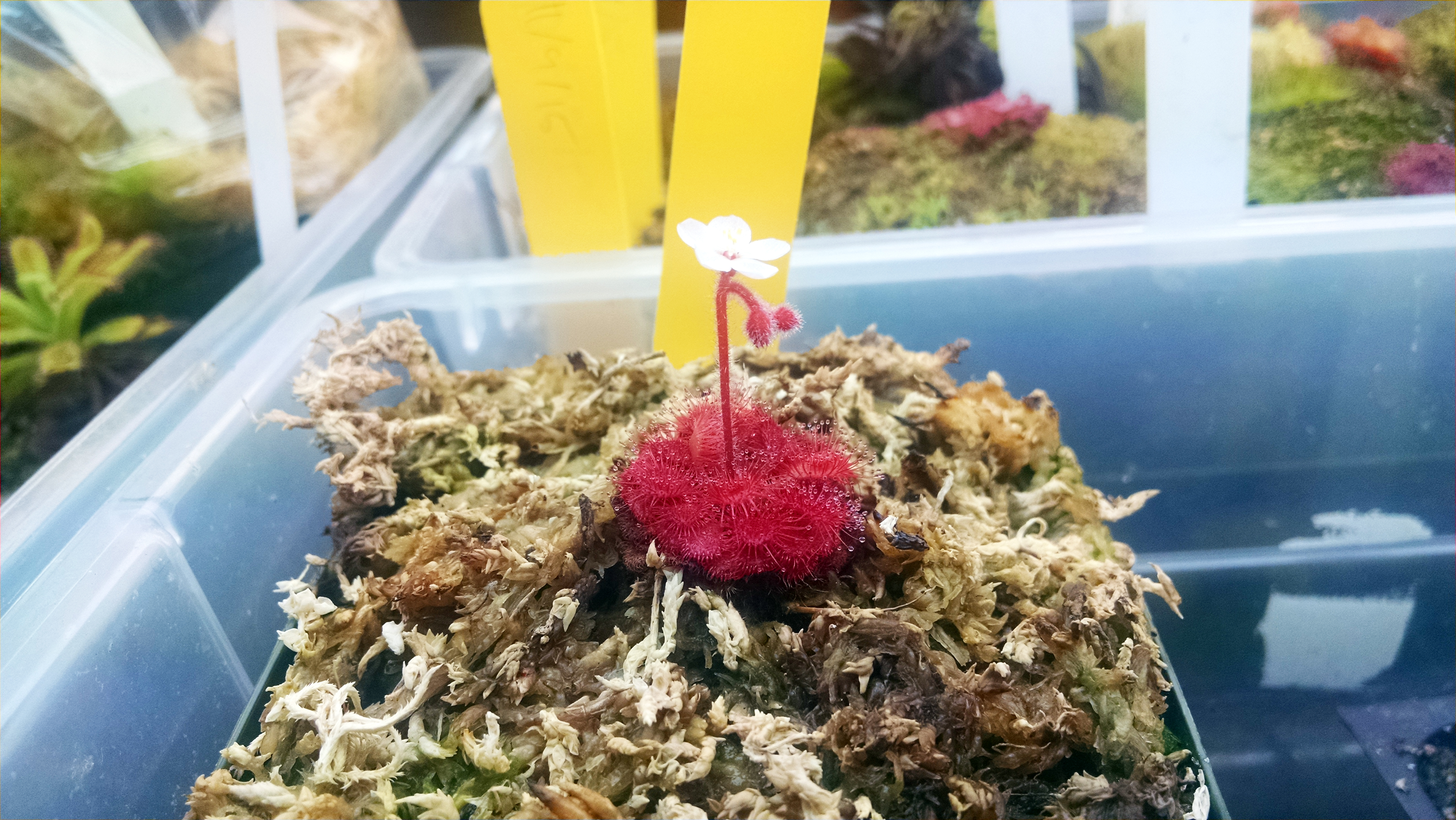
Finally, the delight of winter so far has been my blooming Drosera felix. The other day I was lucky enough to catch a flower open.

Drosera felix with open flower.
So. Cute. Oh my god.
This plant is hands-down the cutest thing in my collection right now. Look how fuzzy the flower stalk is! I got another good picture of this flower from a different angle and shared it on my Instagram. I always try to have different pictures up there!

Winter's not so bad.

Monday, November 23, 2015

Plants pulling through

Here's a silly story:

A few weeks ago I was rearranging my collection and I took my small pot of Pinguicula gigantea × moctezumae out of its tray and set it on top of my shelves. In the dark. In a dry tray. Over two weeks later I was walking to my car, looked in the little window in my garage door, and noticed my plant. I rushed back inside, and put it in a proper tray, in the water, under the lights.

It's totally fine.

Pinguicula moctezumae × gigantea.
There's even a leaf pull that struck in this time.
It's barely even etiolated. This pot was in the dark for over 2 weeks. The soil was bone-dry and rock hard. And a couple days later you can't even tell. This is an offset from a plant that my friend Anne got when she was 11, and is the only carnivore she never managed to kill. Great plant!

Another plant that's getting over a rough patch is my Drosera 'Emerald's Envy'.

Drosera capillaris 'Emerald's Envy.'
One of my favorites! Glad it's coming back.
This plant bloomed hard, sending up two flower stalks in quick succession (from which I was able to harvest a healthy amount of seed). Right then we had our last heat wave of the summer, and I think the combination just stressed it out. It had sat around with no traps, just petioles, for over a month, but now it's getting back to business. I've been feeding the new traps in order to give it a good burst of energy.

I've also begun to re-hydrate my Drosera cistiflora pot.

Drosera cistiflora...hopefully.
Fingers crossed!
We'll see if I'm successful with it. My tuberous pots aren't showing any sign of life so far, but I'm still holding out hope. This one as well – it went to sleep late, so it didn't get a particularly long dormancy. We'll see!

On the other side of things, my Drosera brevifolia have germinated!

Drosera brevifolia seedlings.
There are at least 4 seedlings in this pot. Try and spot them!
I noticed (and took this picture) a few days ago, and given the size of the seedlings I'd say they probably germinated sometime in early November. That means it took something like 18 weeks from when I sowed them back in late July. Don't give up on your seeds too quickly! Now I'm just waiting on those red Drosera filiformis.

The nearby Drosera burmannii (Gunung Keledang) have had a bit of a head start, and one in particular is looking excellent.

Drosera burmannii (Gunung Keledang) seedlings.
Loving that color combination.
I should finish hardening these off and get some serious feeding started.

The last set of seed is the one I'm most excited about, Drosera tomentosa.

Drosera tomentosa seedlings.
Now they just need to out-compete the moss.
I hope this is one of the forms with extravagantly fuzzy flower stalks. They're so cute! I'm trying to find South American sundews right now, btw, and would be happy to trade for plants, roots, leaf cuttings, or seed. Email me at sundews.etc@gmail.com!

Finally, it's that time of year again. I've spotted the first gemmae of the season! These are Drosera leucoblasta.

Drosera leucoblasta showing gemmae.
The first gemmae forming is the real sign of autumn.
Pygmies are my favorite, as I've said before. And since I already mentioned trading earlier in this post, I might as well say that I'd love to do gemmae swaps with all comers this season. Here is my current list of pygmies:

D. allantostigma
D. barbigera
D. callistos
, Brookton large form
D. × Carbarup
D. dichrosepala
D.
× Dork's Pink
D. enodes (Scotts River)
D. grievei
D. helodes
D. leucoblasta
(Brookton)
D. leucostigma
D. mannii
D. nitidula
D. occidentalis
var. microscapa
D. omissa, pink flower
D. oreopodion
D. palacea
, giant form
D. patens
D. pulchella
, orange flower
D. pygmaea
D. roseana
D. sargentii
D. silvicola
D. scorpioides
, pink flower
D. spilos

And these are the plants I'm looking for this season! The ones in bold are the ones I'm most excited about.

D. androsacea
D. citrina
D. closterostigma
D. echinoblastus
D. eneabba

D. gibsonii
D. hyperostigma
D. lasiantha
D. microscapa
D. miniata
D. nivea
D. parvula
D. pedicellaris
D. platystigma
D. pycnoblasta
D. rechingeri
D. sewelliae
D. stelliflora
D. walyunga


I love trading! Feel free to hit me up to trade whenever.
Sunday, November 8, 2015

Plants I haven't mentioned in a while

Sometimes it seems like I'm always posting about the same plants. Today I decided to check out a few species that I haven't paid much attention to lately.

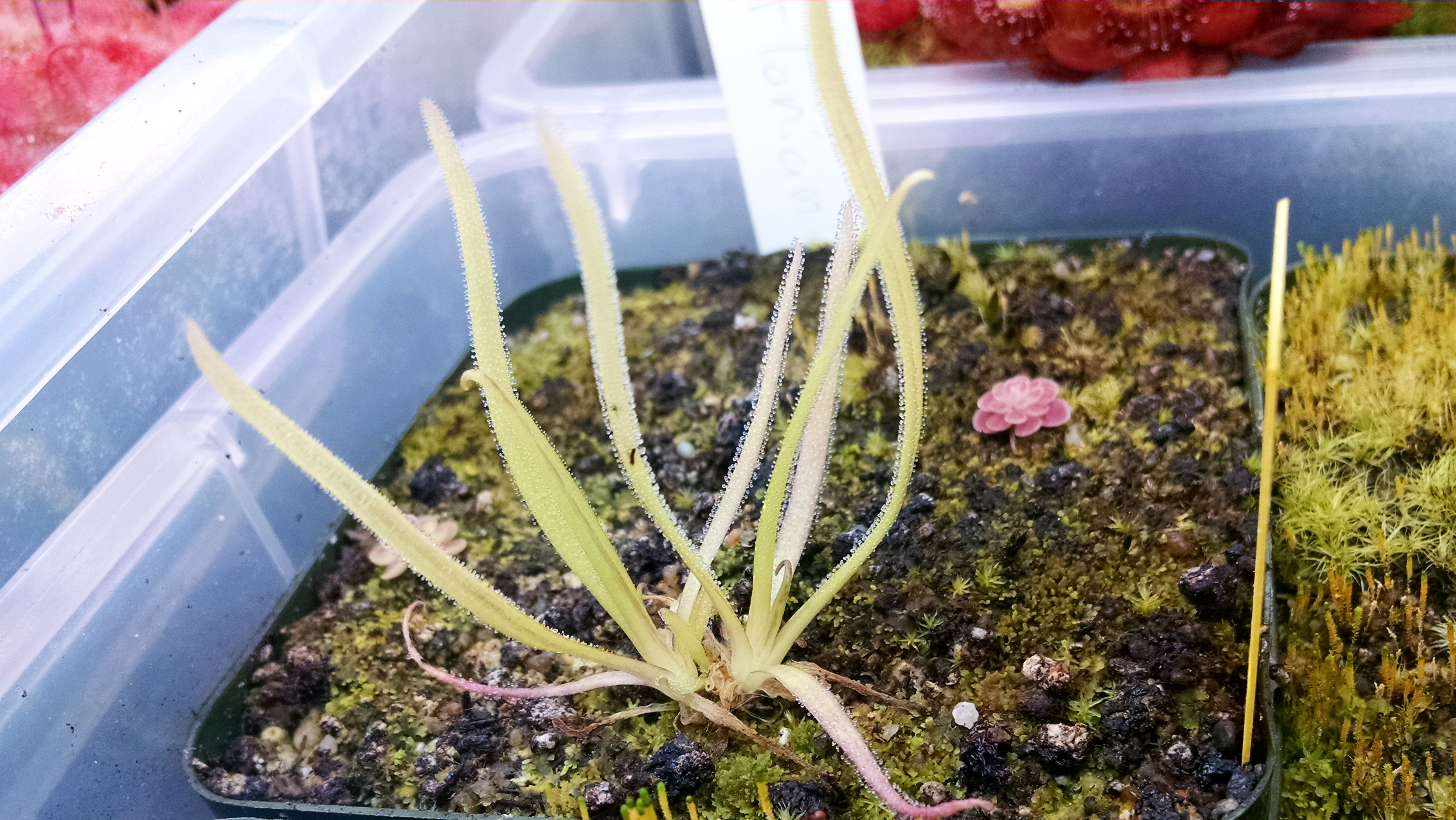
Drosera collinsiae has been looking weirdly unhappy for the past month or two.

Drosera collinsiae.
At least the Utricularia bisquamata is going strong!
It looks sort of the way it does when it's heat stressed but that's definitely not the problem right now. This has never been a very vigorous plant in my conditions though, so it could be anything really. I wish it would perk up though!

The neighboring Drosera affinis is doing much better.

Drosera affinis.
Quite dainty. I like it.
I don't mention it much, but I really like this species. Its stem-forming habit is great – distinctive, but not ridiculous like Drosera madagascariensis. It's an elegant, delicate-looking plant.

I dug out some of the moss from around Drosera brevifolia so it can have a bit more room now.

Drosera brevifolia.
Maybe I can feed this guy again soon and encourage flowering.
I hope I didn't damage the roots in doing so. I really need to get this plant to flower one more time so I can start a new pot and throw this one out. That Sphagnum is really awful stuff, very dense and stiff. It just totally swallows up plants and doesn't even look nice.

I got this long-armed form of Drosera capillaris in the last NASC auction because I liked the location data: Tate's Hell Swamp, FL. It's actually a really handsome plant though!

Drosera capillaris long-arm (Tate's Hell Swamp).
Wonderfully dewy. Great plant!
That's one of the best red colors in my collection, and it's supporting a really large amount of leaves. Very vigorous plant, I like it a lot.

Wednesday, March 4, 2015

A few annual species

When I first started growing carnivores I didn't really like the idea of growing annuals. Having to resow your pots every year seemed like it would be a real chore. However, I've reached a point now where I'm interested in all sorts of plants I didn't think I was interested in before. Plus, the whole thing about annuals is that they grow super quickly. Case in point, Byblis liniflora.

Byblis liniflora sprouts.
Little B. liniflora sprouts everywhere.
Byblis liniflora sprouts.
There are at least 10 total in the pot, maybe more.
These seeds were sown less than 2 weeks ago, on February 19th. I hadn't even begun regularly checking this pot for germination yet – they probably actually sprouted a couple days ago, perhaps 10 days after sowing. That's quick!

I started some Drosera indica at the same time, and while it's not quite as dramatic, there are definitely several sprouts in the pot.

Drosera indica sprouts.
Look for the tiny green dots.
Now, of course, I want to get all the different species in what was once the D. indica complex – Drosera hartmeyerorum, Drosera serpens, the lot. That's the fundamental addiction of collecting.

I also love how serious annual species get about flowering. Consider this Drosera brevifolia (which, while not strictly annual, has a lot of annual-like characteristics, especially in habitat).

Drosera brevifolia blooming.
I should really get a clean pot of D. brevifolia going.
It's almost totally engulfed in Sphagnum (which I should really trim back), but damnit it's going to bloom. That's a plant with moxie.

Finally, Bloom Watch: Utricularia longifolia has moved into its second week. Buds are forming and color is developing.

Utricularia longifolia flower bud.
I am so excited about this.
Nice! It's gonna be a great show.

Friday, February 6, 2015

Back from the dead

Look! My first Utricularia sandersonnii blue form flower in months and months.

Utricularia sandersonii blue form.
These little flowers are so darn cute.
Lost in a sea of moss and Utricularia subulata flower stalks, the Angry Bunny rises again. I don't remember if U. sandersonii is self fertile. I hope it is, cause I'd really like to have a clean pot of it, and I feel like it would be difficult (though perhaps not impossible) to clean off a chunk of stuff from this pot to transplant. Such a pretty lavender color.

After much waiting and speculation, the truth is revealed: my Drosera filiformis Florida Red was dormant rather than dead. It's waking up now!

Drosera filiformis Florida red emerging from dormancy.
Rise and shine little guy.
It went to sleep in August or so, which is a long time for a nap. No matter! I'll let it wake up, feed it heavily for a couple months, and then get propagating. Everybody likes red D. filiformis.

My aphid-ravaged Drosera anglica CA × HI is actually looking pretty good right now.

Drosera anglica CA × HI.
It helps that this is such a vigorous hybrid.
It may be almost time to repot it (and wash away all the soil) so that I can have a clean, aphid-free start. Not sure what I'll do with that Drosera ultramafica × spatulata in there. I'd love to share it around, but I don't want to introduce aphids into anyone's collection. Maybe it'll just end up getting tossed. It happens.

Finally, remember that Drosera brevifolia that came back from the dead a while ago? Now it's in danger of being totally consumed by Sphagnum.

Drosera brevifolia and Sphagnum moss.
I need to clear out this moss.
I feel like I need to start a new clean pot of these guys as well. I have a few seed packets, it's just...I need to make more room under my lights. Again. Story of my life.

Saturday, December 13, 2014

Drosera brevifolia germination trial

Back in November I sold some Drosera burmannii and Drosera brevifolia seeds to a fellow named Adam. We had a bit of a back-and-forth on Facebook about whether the D. brevifolia required cold stratification. I told him that as far as I could find people said it didn't require stratification, but it might benefit from it. He decided to run a (very small) trial with the 12 seeds in his packet, with half getting a 2-week cold stratification and the other half not. The first non-stratified seed germinated after 8 days.

Drosera brevifolia seedling.
First germination, 11-30-2014
After 9 days the plant put out its first carnivorous leaf.

Drosera brevifolia seedling.
First carnivorous leaf, 12-9-2014.
Drosera brevifolia seedling.
First carnivorous leaf, 12-9-2014.
And after 13 days, we see a second carnivorous leaf.

Drosera brevifolia seedling.
Second carnivorous leaf, 12-13-2014.
Drosera brevifolia seedling.
Second carnivorous leaf, 12-13-2014.
So far only one of the 6 non-stratified seeds has germinated.

The first of the stratified seeds germinated today, 6 days after sowing. Now we get to wait and see if any patterns start to emerge. Adam says he's interested in doing progressively larger trials once he brings these plants to flower. I'm excited to see his results!

Sunday, November 16, 2014

How are things over here?

There's a lot going on in this little tray right now.

Sundew tray.
Each tray is like its own neighborhood.
 First off, it appears I was wrong about that caterpillar on my Drosera burmannii being the only one.

Drosera adelae with caterpillar damage.
Chewed leaves and caterpillar poop. Great.
I found another in my Drosera adelae pot last night. Luckily there are lots of traps open on my Venus fly-trap right now. Also D. adelae is a very vigorous plant in my conditions and I'm sure it will recover just fine. Even if one or two of the plants succumb, there's a lot of root in that pot that will form new plantlets.

Next door, it looks like there are gemmae forming on Drosera allantostigma.

Drosera allantostigma forming gemmae.
Still looking good, although the colors are more orange and less pink than they used to be.
I need to get some media ready!

In the same pot I have a little cleistogamous flower stalk of Utricularia subulata.

Cleistogamous Utricularia subulata flower stalk.
Another charming weed.
I like it. It's got a nice sculptural quality, and the dew drops at the crooks are pretty neat. I've said it before, but I think the weedy Utricularia get short shrift.

This Drosera capillaris seems to also have a bit of humic acid buildup, like the Drosera aliciae over in my community pot.

Drosera capillaris.
It's still pretty, but I need to help it get healthier.
Apparently flushing the pots can help. Another chore to toss onto my list for a day that I have free to spend with my plants.

Meanwhile I can't tell if Drosera filiformis is dormant or dead or what.

Dormant (or dead) Drosera filiformis.
Right now this is more of a "liverwort and moss pot" than a "D. filiformis" pot.
I'm definitely not chucking them out any time soon, but I wouldn't be amazed if these guys aren't gonna wake back up. I think the media is too dense for their taste. We'll see though. Give it a couple months.

My Drosera brevifolia pot is a good example of why you shouldn't give up on plants too soon.

Drosera brevifolia.
I've always liked the organic look of this pot.
See that plant in the middle? This is what it looked like back at the beginning of October:

Drosera brevifolia, apparently (but not actually) dead.
Back from the dead!
Welcome back little guy!

Monday, October 6, 2014

Plants having weird problems

I've got a few plants right now that aren't looking so hot.

Drosera aliciae with black leaves.
Get well soon little guy.
I recently featured this Drosera aliciae plant enjoying being fed, but now all the most recent leaves are black and not developing. I have no idea what this means! The other D. aliciae in the pot is looking great.

I've also got some weirdness going on with my Drosera anglica CA x HI.

Drosera anglica CA x HI with strange growth.
It looks weirdly smooshed right now.
The nice, big, well-developed leaves are all moving outward and down, as usual, but the younger leaves inside are more sparse and smaller. Also, there's something weird going on right in the center.

Drosera anglica CA x HI with mutated flower stalk.
I'm pretty sure that's a flower stalk!
It looks like a malformed flower stalk maybe? It might even be mechanically blocking new leaf growth. How weird. I may do some surgery on it soon to get it out of there.

It's not a huge mystery what's happened with this Drosera brevifolia.
Drosera brevifolia bloomed out.
This is a neat little "habitat" vignette.
It has bloomed itself to death. I knew it was coming. I've got some collected seed, so I hope to start a new round of these guys soon. I think the little dew in the foreground is a D. brevifolia rather than some other weed, but we'll have to wait and see.

And finally, since it's not all bad news, check out how well that flower stalk on my Drosera spiralis is doing.

Drosera spiralis with flower stalk.
Reaching for the stars.
Nice!

Wednesday, August 13, 2014

Possible Drosera brevifolia seedling

I like my Drosera brevifolia pot because it really seems like an ecosystem.

Drosera brevifolia
I really like the pronounced red color of this plant.
There are the two main plants, another wedged up underneath the center plant, ever-expanding mounds of Sphagnum, and various and sundry other mossy algal things. Plus, D. brevifolia is really funny and small. It would be fun, when I have some more time to fiddle with my plants, to put together little vignettes of sundews all growing together, maybe with other carnivores too.

In terms of really small though, do you see something just down from the center plant?

Drosera brevifolia sprout, hopefully.
It's a whole, tiny little world down there.
A little sprout! It's even got its first couple carnivorous leaves. I know some D. brevifolia seed got spilled when I put off harvesting a seed pod for a while, so I'm hoping that's what this is. It's also totally possible that it's a Drosera capensis or Drosera aliciae seedling, since those plants go nuts and have long stalks in the same neighborhood as this pot.

Guess we'll see!

Sunday, July 6, 2014

Drosera madagascariensis and other flower stalks

I was quite excited today to see that the largest Drosera madagascariensis I received from Not a Number during the NASC Auction has a flower stalk!

Drosera madagascariensis flower stalk.
Discovering surprises like this is one of my favorite things about having a collection of plants.
I love this species, and am super excited to start some seedlings in the next month or two. Better feed this plant well for the next few weeks so the seed sets nice and strong. The whole pot of them are looking nice.

Drosera madagascariensis in the tray.
I'm using that cocktail straw as a bit of a stake for the plant as it grows lankier.
There's also some madness going on nearby with my Drosera prolifera. Through the magic of false vivipary the one plant I received has already become 3 or 4, and there's another flower stalk on the way.

Drosera prolifera colony.
I think these might like somewhat higher humidity, but they're certainly still growing well.
The mother plant has become more compact as well, probably due to my higher light conditions (this plant is being kept brighter than normal for its species). It's also trying to reach into other pots too!

Drosera prolifera flower stalk.
I should replace that peat:sand pot on the left with some LFS and start a new colony.
Every D. prolifera flower stalk produces a plantlet on the tip (thus the specific epithet "prolifera"), and the stalks stretch out horizontally, so they'll invade all your other pots. It makes propagation a total breeze though.

Speaking of non-vertical flower stalks, I'm having to keep an eye on my Drosera burmannii.

Drosera burmannii with long flower stalk.
These four look like undersea creatures almost..
That flower stalk started out upright, but now it's leaning. There are still buds developing, so I don't want to clip it yet, but eventually it's going to be pushed all the way down by new growth.

Drosera burmannii pushing its flower stalk over.
Got that peachy pink "just fed" color.
I don't want to lose a bunch of seed from it spilling out, and I certainly don't want a bunch of surprise D. burmannii popping up in my other pots, so I may just end up clipping it a bit early. This stalk is about 6 inches (15 cm) tall – the one of my largest specimen is twice that! I'm going to be swimming in D. burmannii seed pretty soon.

On the total opposite side of the size spectrum, one of my Drosera brevifolia has sent up a stalk with two buds for the first time.

Drosera brevifolia blooming.
I can't imagine seeking these tiny little guys out in the wild.
Drosera brevifolia flower stalk.
Well done D. brevifolia. Well done.
I usually get 10-12 seeds per bud, so it's been slow accumulating seed compared to my other plants. I suspect they might need cold stratification, but I'm not sure. Guess I can do some test germination to see. I also know some seed spilled into the pot, so if it germinates soon I guess we'll have our answer. These are really fun, and are smaller than most of my pygmy sundews.

It's my great dream to have lots of Drosera seed available to sell and trade and share. Getting closer!