Showing posts with label Drosera 'Marston Dragon'. Show all posts

Saturday, September 17, 2016

Plants I've looked at in the last six weeks: an incomplete catalogue

Hahahah okay let's just admit that I'm probably not going to make 17 posts in a month again (like I did back in April '14) any time soon. Okay well, that established let's see what photos have been languishing on my phone not being posted anywhere.

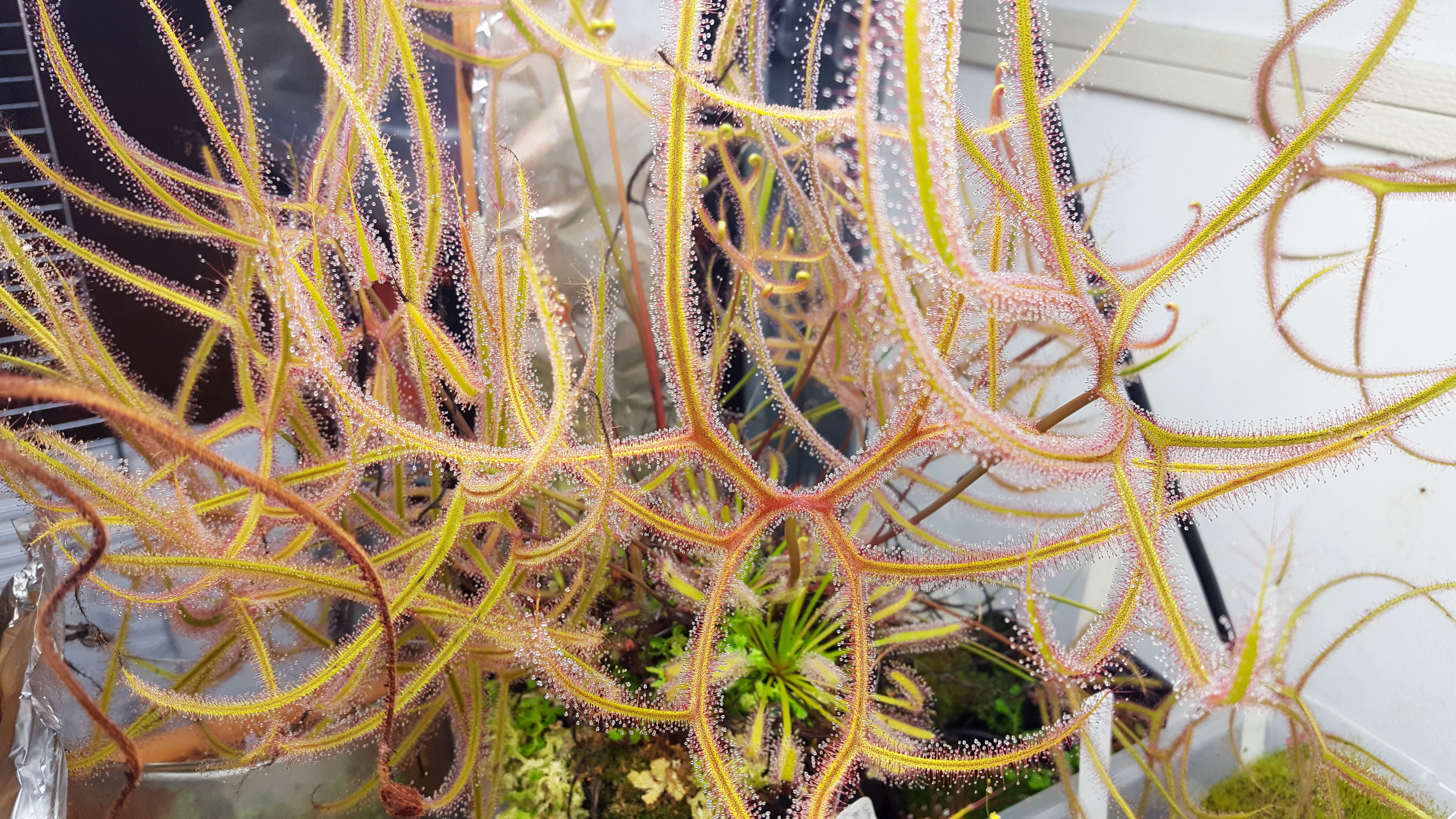
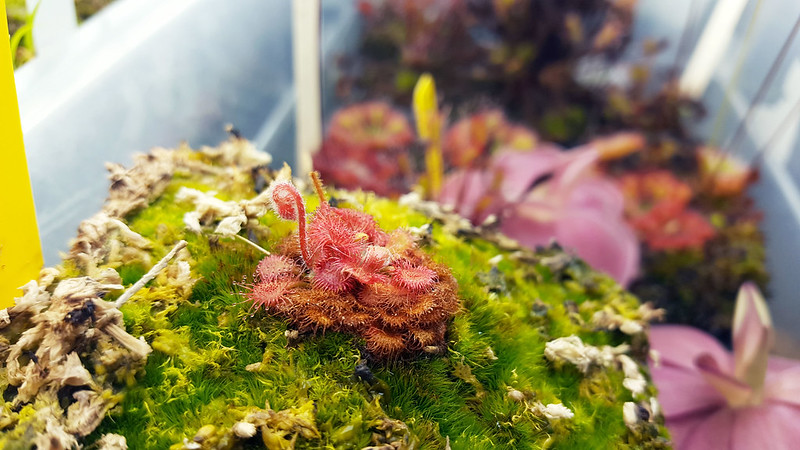
Drosera binata 'Marston Dragon' looked pretty nuts back on July 31st.

Drosera binata 'Marston Dragon'.
I wonder what the total volume of that dew is. Probably an ounce or two.
I still have no idea what I'm supposed to do with this plant. At least it looks rad as heck.

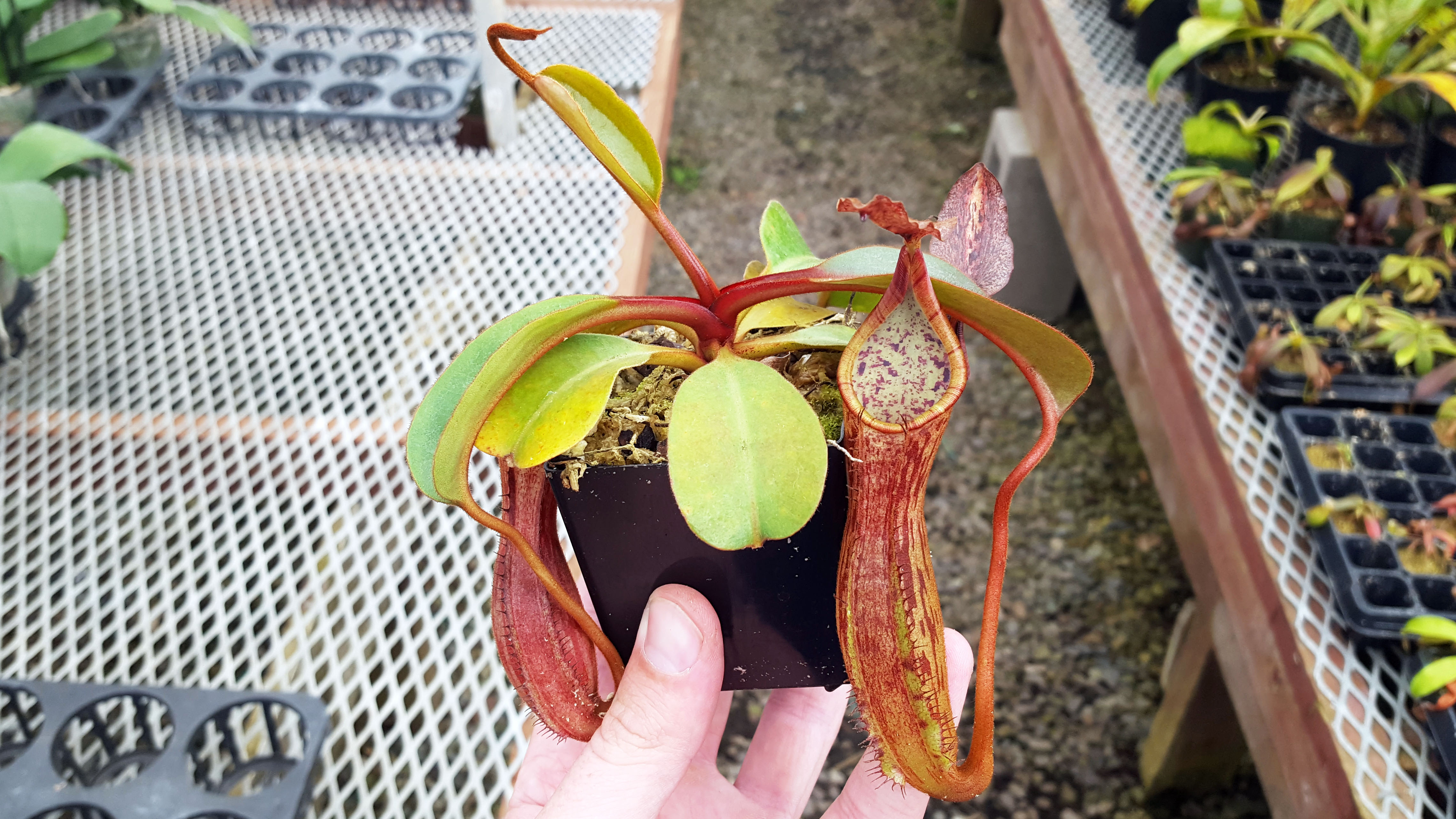
Fair warning, since I'm gonna be using pictures I've taken at work a fair amount, there are gonna be more neps than there have been on the blog in the past. Considering this Nepenthes eymae × jacquelineae though, can you blame me?

Nepenthes eyemae × jacquelineae.
I really like the glaucous character of the pitcher body.
This is a freshly-opened pitcher on what is probably my 4th favorite nep in the greenhouse (please don't ask me what the top 3 are, I have no idea). Wowzer!

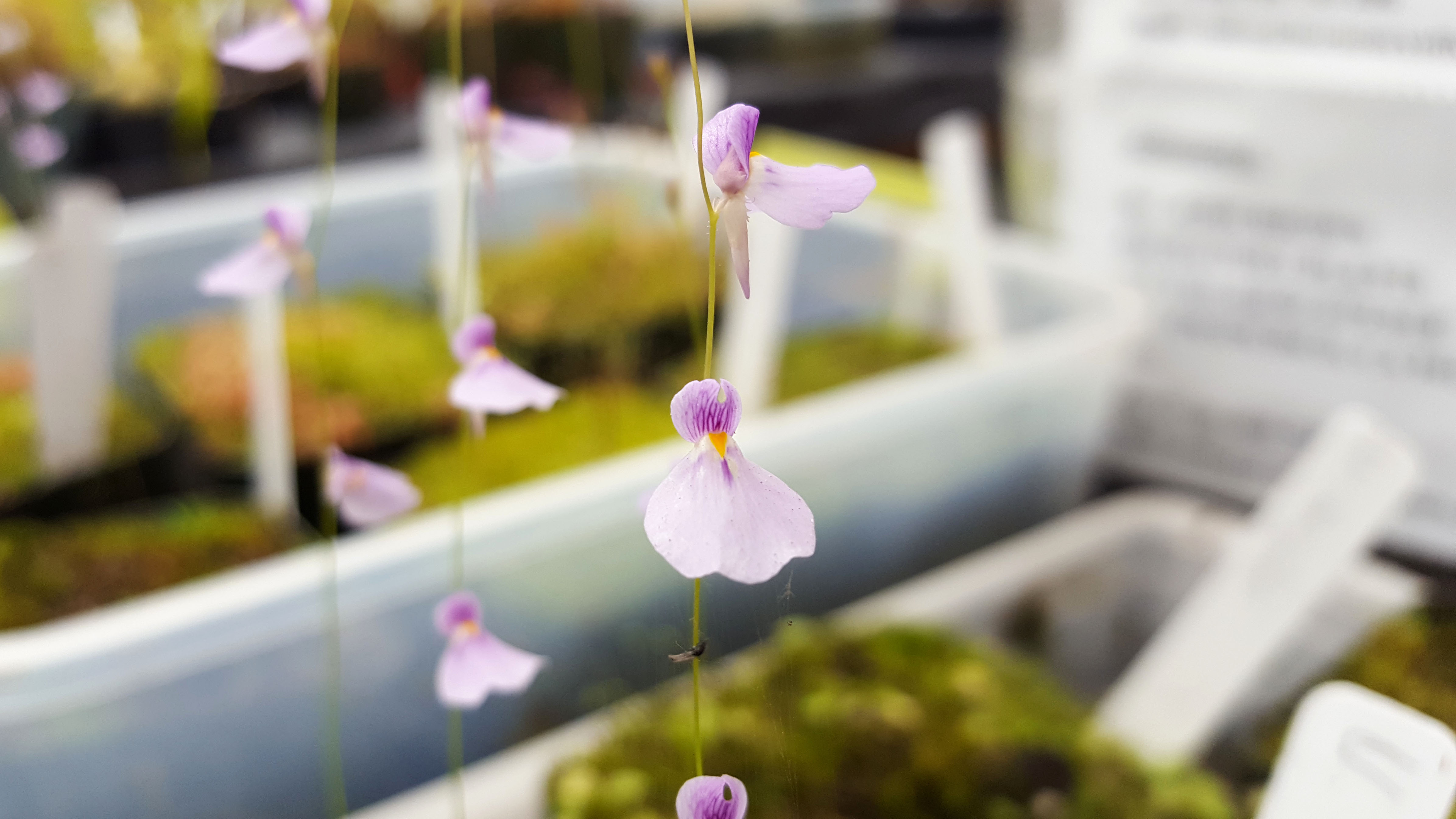
Don't worry though, there are also utrics at the greenhouse, such at this Utricularia blanchetii.

Utricularia blanchetii flower.
So small and fancy.
This is probably the most floriferous of the new little terrestrials I've been messing with lately. It's also completely adorable!

And at home, I still have sundews, even if I'm barely able to rouse myself to water them properly. Here's my Drosera kaieteurensis starting a new flower stalk.

Drosera kaieteurensis with flower stalk.
Note that I didn't refer to it as Drosera felix. That because when I showed photos of it to Fernando Rivadavia he was unequivocal that the fuzzy flower stalk indicated D. kaieteurensis. He had no strong opinions about the purported synonymy of the two taxa, but insisted that if the flower stalk was fuzzy it couldn't be D. felix. So there.

Another South American sundew with a difficult-to-spell toponym for its specific epithet is Drosera graomogolensis. It's also a total beast in spite of all my neglect.

Drosera graomogolensis.
This is an extravagant plant.
Root cuttings are an awesome way to get big plants fast, especially if it's one of the species with big fat roots. Great stuff!

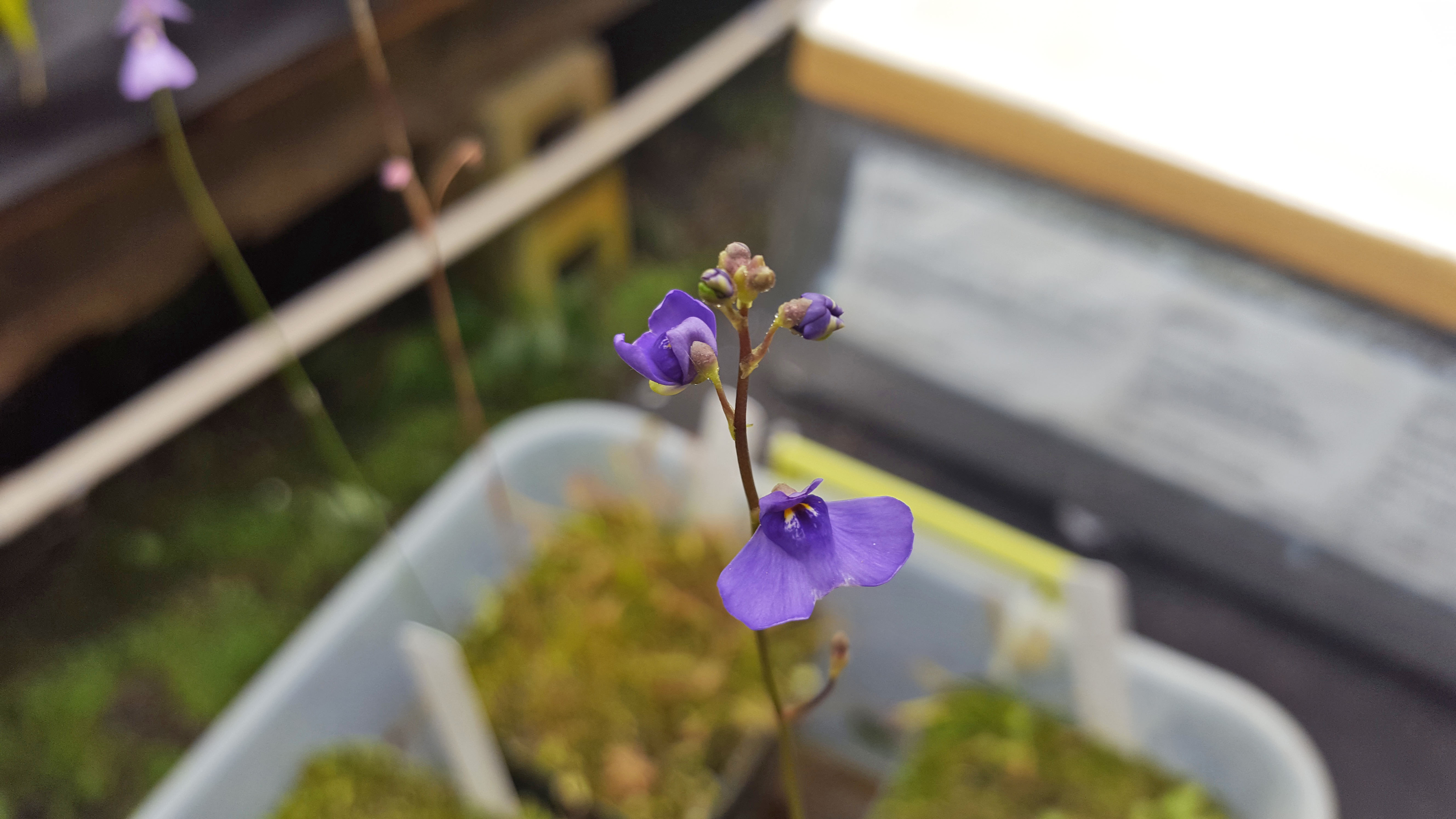
Another utric that I'm super stoked about is Utricularia biloba, which opened its first flowers for me a week or so ago.

Utricularia biloba flower.
These also have a neat chubby spur that's bright green.
As others have said of this species, photos don't do justice to the color, which is a deep violet with a hazy blue depth to it. Weirdly, the blue comes out more for me if I blink rapidly while looking at the flowers. Super interesting plant! Thanks Howard!

Finally, I've been selling select plants on Facebook – one-off neps, as well as new items like utrics and sundews that aren't in huge production yet. This Nepenthes fusca sold almost immediately this morning. I can't imagine why.

Nepenthes fusca.
I wish we had way more of this species than we currently do. It's wonderful!
Anyway, those are some plants. They're pretty cool.

Tuesday, June 16, 2015

Sundew hybrids

There just aren't that many sundew hybrids. In part it's because of the genetic diversity in the genus. As much as one might wish to cross Drosera burmannii with Drosera cistiflora it's just not going to happen – Drosera species can only be crossed with relatively close relatives. Sarracenia and Nepenthes species, on the other hand, can all freely hybridize and produce fertile offspring.

Another limiting factor is that sundew hybrids are, broadly speaking, boring. Compare Drosera ×tokaiensis, probably the most well-known sundew hybrid (Drosera spatulata × rotundifolia) with Sarracenia ×catesbaei, one of the most common Sarracenia hybrids (Sarracenia flava × purpurea). To the untrained eye the two parents of D. ×tokaiensis are almost indistinguishable, while the parents of S. ×catesbaei are strikingly distinct. Morphological difference between parent plants is the most basic element in making an interesting hybrid.

Anyway, I started thinking of all this when I took this picture of Drosera ×snyderi to show to my friend Josh.

Drosera ×snyderi (Drosera dielsiana × nidiformis).
It took these plants a bit to settle in, but they're looking good now (aside from the aphid spraying).
D. ×snyderi is the unpublished, botanically invalid name for Drosera dielsiana × nidiformis. It's a pretty good-looking plant, really, and actually produces viable seed. It was created by the mad scientist of Drosera hybrids, Ivan Snyder.

Right nearby is this highly desirable hybrid, Drosera ×"Andromeda". Another unpublished name, this one indicates Drosera schizandra × prolifera.


Drosera ×"Andromeda" (Drosera schizandra × prolifera)
Plantlets! At least two!
This plantlet is the one I started directly on the moss. The cutting I started in water and then transferred to the moss seems to have withered. Another data point against the water float method for me – transfer to media seems to really mess with the plant.

Some sundew hybrids are really fantastic, such as this Drosera ultramafica × spatulata.

Drosera ultramafica × spatulata.
This hybrid really snuck up on me to become awesome.
This pot got 3rd in Sundews at the recent BACPS show. It's a beautiful bright red, even with regular feeding. I had thought that this was a sterile hybrid but I was wrong! There are plantlets all over my collection now.

The only rival the above plant has for redness in my collection is this Drosera ×tokaiensis, the "×" symbol signifying a man-made, rather than natural, hybrid of D. spatulata and D. rotundifolia.

Drosera ×tokaiensis (Drosera spatulata × rotundifolia).
This guy has been sadly ignored on the blog heretofore.
This plant is a darker, more maroon red color, and is in fact sterile. In case you're curious, by the way, you can make the × symbol by holding the ALT key and pressing 0-2-1-5 on the numpad in that order.

The natural D. tokaiensis is not quite as red, but it sets seed and has a charm all its own.

Drosera tokaiensis.
The Community Pot is one of my oldest groups of sundews.
I've definitely neglected the Community Pot lately (I lost Drosera allantostigma, alas), but it's just been chugging along. Need to trim those flower stalks though.

I also have some pygmy sundew hybrids! The first, Drosera ×Dork's Pink, indicates Drosera lasiantha × callistos, a man-made hybrid that was published in a recent issue of the CPN.

Drosera ×Dork's Pink (Drosera callistos × lasiantha).
A pretty plant with a silly name.
For my money this is one of the prettiest pygmies going. The dew isn't as stunning as usual because I recently sprayed for aphids, but the color is wonderful.

There's also Drosera ×carbarup, a naturally occurring D. occidentalis × platystigma.

Drosera ×carbarup (Drosera occidentalis × platystigma).
These are showing a bit of aphid damage unfortunately.
There are several widespread pygmy hybrids, in fact. I tend to shy away from hybrids as a general rule, so I've yet to acquire most of them. This one is very nice though!

One of my favorite hybrids is another Ivan Snyder creation, Drosera anglica CA × HI.

Drosera anglica CA × HI.
Got extra plantlets to spare too!
This plant mixed the large, robust, but dormancy-requiring California form of D. anglica with the tropical, dormancy-free, but small and fragile Hawai'i form. The result is one of the prettiest plants in my collection. This is one of my absolute favorites.

Finally, if I'm going to include D. anglica CA × HI I have to include Drosera 'Marston Dragon', which is a hybrid of Drosera binata dichotoma "Giant" with D. binata multifida extrema.

Drosera binata 'Marston Dragon'.
That's a lot of plant.
The botanical validity of all those names is in doubt, by the way. But there's no doubt that this is a huge sundew. I need to do something about it.
Monday, April 13, 2015

Last week of the NASC benefit auction

Every year the online carnivorous plant forum TerraForums hosts a benefit auction for the North American Sarracenia Conservancy. The NASC is really cool – they restore habitat, perform controlled burns, and organize ex situ conservation to maintain genetic diversity (and in the hopes that sites may be restored and repopulated in the future).

During the auction people put plants up for bidding, and the winning bid is payed to the NASC, though the person donating the plant usually receives money from the winning bidder for shipping. Last year I spent a lot of money during the auction! This year I'm planning on spending somewhat less, but I'm also able to donate a lot more. The following are all plants or seeds you could win from yours truly.

Plants

Drosera capenis red form.
Drosera capensis red form offset.
Drosera 'Marston Dragon'.
Two Drosera 'Marston Dragon' plants.
Pinguicula rotundiflora × hemiepiphytica.
Pinguicula esseriana.
Pinguicula 'Pirouette'.
Pinguicula 'Pirouette' (plantlets to the right of the mother plant).

Seeds

Drosera anglica CA × HI.
Drosera intermedia 'Cuba'.
Drosera burmannii (Humpty Doo, NT, Australia).
Most of the items can only be shipped within the US, but you don't need to be a TF member to bid. Anyone can bid as a guest, provided you leave an email address so you can be contacted if you win an auction. Go forth and bid! There are lots of rare/uncommon plants available, and it's for a good cause.

Expect an update on my winning bids in the next few weeks, hahahah.

Sunday, March 8, 2015

Drosera roseana already making gemmae (plus some Utricularia Sect. Orchidioides)

As I've covered before, I started a bunch of new pygmy sundew species back on December 10th. My Drosera omissa caught me off guard by flowering after 9 weeks – quick turnaround. But now the Drosera roseana have I think topped that feat.

Drosera roseana with gemmae.
D. roseana is a very pretty sundew, besides being (apparently) really really vigorous.
Gemmae. That's just over 12 weeks to go from being a gemma to producing a healthy crop. That's nuts. There's another plant in this same pot doing the same thing. Pygmy sundews are so cool. If you're not growing pygmies you're just messing around.

Today I also noticed new growth on the two members of Utricularia Sect. Orchidioides that I have in my collection. Here's the Utricularia cornigera I bought at the last BACPS meeting.

Utricularia cornigera.
This Utric can get very large. I'm excited.
This is the first new leaf it's put up since being in my collection. I'm glad to see that it seems to like my conditions fine.

My Utricularia humboldtii I received from BACPS Newsletter Editor and Utricularia fanatic Tony Gridley.

Utricularia humboldtii.
I'm going to need to trim off some of the old growth soon.
See those two new leaves in the foreground? I didn't treat this plant very well when I first received it. It sat around in a plastic baggie for around a week after the meeting, and then I just potted it up without any concern for humidity or anything. Luckily it seems to have taken it all in stride. Now I have to be careful that I not let it grow too well, since Tony said, and I quote, "If you win the BACPS show with it I'll never speak to you again."

In more springtime news, my recently-acquired Pinguicula laueana is unfurling its first carnivorous leaf of the season.

Pinguicula laueana.
P. laueana has nice foliage in addition to the striking flowers.
And also it looks like Drosera 'Marston Dragon' is putting out its first serious new leaf post-dormancy.

Drosera 'Marston Dragon'.
The Dragon is stirring.
You know I never really appreciated the spring before I started growing plants. Spring is awesome.

Saturday, March 7, 2015

Sundews Etc. one year in

One year ago today I made my first post here on the blog, about my blooming Drosera capillaris.

Drosera capillaris.
D. capillaris, 3-7-2014, from Flowers and D. capillaris "Alabama".
Things were so much simpler back then.

Here are some Fun Facts about the Sundews Etc. blog:
  • Around 17% of my traffic comes from Ukraine. Thanks for tuning in, Ukrainian growers!
  • Both of my Grower Interviews are among my top 10 most popular posts. I guess I should do some more.
  • Based on the labels (to the right) I talk about Drosera burmannii more than any other species (big surprise), but pygmy sundews as a group are a close second.
  • There are just shy of 1100 photos of carnivorous plants on this blog for 153 posts, around 7 per post on average.
Now, let's look back at some old posts and see how far we've come.

March

Dionaea muscipula.
Dionaea muscipula, 3-12-2014, from Things are growing!
April 

Drosera scorpioides
Drosera scorpioides, 4-3-2014, from Pygmies and D. adelae.
May

Drosera 'Marston Dragon'
Drosera 'Marston Dragon', 5-26-2014, from The Housefly and the Dragon.
June

Drosera allantostigma.
Drosera allantostigma, 6-20-2014, from I really love Drosera allantostigma.
July

Drosera capensis 'Albino'
Drosera capensis 'Albino', 7-4-2014, from Repotting a few sundews.
August

Drosera helodes and Drosera allantostigma.
Drosera helodes and Drosera allantostigma, 8-26-2014, from Checking in on various plants.
September

Drosera adelae
Drosera adelae. 9-11-2014, from Drosera adelae is offset crazy.
October

Sarracenia leucophylla
Praying mantis and Sarracenia leucophylla, 10-25-2014, from A thief among the Sarracenia.
November

Pinguicula laueana × emarginata
Pinguicula laueana × emarginata. 11-21-2014, from Pinguicula roundup, November 2014.
December

Utricularia calycifida.
Utricularia calycifida flower, 12-6-2014, from A few new blooms.
January

Drosera ultramafica × spatulata
Drosera ultramafica × spatulata, 1-27-2015, from Some progress shots.
February

Drosera venusta
Drosera venusta, 2-9-2015, from Random pictures of pretty sundews.

Finally, here are a few more posts I noticed looking through the archives that might be of interest to newer reader.
And of course, there are Plant Profiles, Cultivation Guides, and Grower Interviews on my Blog Series page.

Thank you all for reading – sharing pictures and talking about my plants with fellow growers makes everything a lot more fun. Here's to another good year!

Friday, January 2, 2015

Drosera binata status

My big old Drosera 'Marston Dragon' is going dormant, or it is dormant, or something.

Dormant Drosera 'Marston Dragon'.
My half-dormant D. 'Marston Dragon', looking a bit ragged.
A lot of the leaves have died back, but it hasn't gone totally bare like I was expecting. It probably needs somewhat lower temperatures to go properly dormant.

My other two Drosera binata clones are looking sort of droopy too, although that's definitely also because they're too far from the lights to be as upright and happy as possible.

Drosera binata.
Droopy D. binata.
Drosera binata.
Another one!
I'm not sure how I feel about having these D. binata clones in my collection. Right now they're taking up a lot of space, and I'm really hesitant to start running more lights. The D. 'Marston Dragon' is really striking when it's in full growth, but it does require me to lift my lights way up. I dunno, it's something I'll be thinking about.

I almost prefer immature plants, like these plants I started from leave cuttings.

Drosera 'Marston Dragon' from leaf cuttings.
Cute little D. 'Marston Dragon' leaf cutting plantlets.
Or this bunch that came from flower stalk cuttings.

Drosera 'Marston Dragon' from flower stalk cuttings.
These are still in active growth, not going dormant at all.
What I really need to do is build some sort of windbreak so I can grow plants outside. Then it would make a lot more sense to have multiples. We'll see if that project actually gets done, hahahah.

As an addendum to this post, check out how good Drosera venusta has been looking lately.

Drosera venusta.
A very lovely-looking plant lately.
The dew is looking as good as it ever has. I've heard some people talking recently about how this is a sort of odd species that will decline for no reason and then bounce back for no reason, even when conditions stay the same. I hope it settles in for me, since it's really pretty.

Sunday, September 21, 2014

Propagation check-in

I've got a number of propagation projects going right now. Really, I could be doing a lot more propagation – I have extra space, and all the materials. I just haven't taken the time to prepare pots of media. Oh well! Let's see what's going on right now. I already discussed my Drosera natalensis and Drosera aliciae seedlings in this recent post.

First up, I've begun hardening off the leaf cutting half of the Summer Batch.

Hardening off Drosera leaf cuttings.
Boring photo, but exciting development!
I cut 3 holes into the humidity tent. Gonna leave it like that for at least a week, and then start cutting more. I really want to ease these plants into my ambient humidity. I was able to take a peek at the Drosera adelae at least.

Drosera aliciae plantlets.
The Drosera anglica just behind is really big.
They're pretty red! Also fairly small – I'll be able to start feeding these plants once they're hardened a bit more, and we should see some pretty good growth.

I'm also starting to think that the seed batch should start getting hardened off. Drosera tokaiensis and Drosera capillaris have germinated, and Drosera burmannii and Drosera intermedia 'Cuba' have not. This is especially surprising, because I've already gotten germination from the Drosera sessilifolia seed I sowed one month ago.

Drosera sessilifolia germination.
The germinated seed is a little bit up and left of center. Good luck.
I know it's difficult to see, but some of the flecks in that pot are germinated seeds.

The Drosera capensis (Bainskloof) leaf cuttings I started at the same time are also doing well.

Drosera capensis (Bainskloof) leaf cutting strike,
Come on little guy, get growing!
I believe I also saw a strike on the water-float cutting, but it was too hard to get a picture.

Serious development is underway with Drosera ultramafica x spatulata and Drosera 'Marston Dragon' plantlets.

Drosera ultramafica x spatulata and Drosera binata 'Marston Dragon' plantlets.
Some recently-fed plantlets.
The D. 'Marston Dragon' plantlets have started putting up the tall leaves, rather than the sort of generic rosette they had at first. The D. ultramafica x spatulata are of a size to start getting fed in a serious way.

The D. 'Marston Dragon' flower stalk cuttings started out with upright leaves, and they're still chugging along.

Drosera binata 'Marston Dragon' plantlets.
Little baby dragons.
I've got quite a batch of these going – hopefully they put on some good size before going dormant, and I can separate them out in early spring.

Finally, I've got this weird little Drosera capensis windowbox thing I've been working on for the last several months.

Drosera capensis pot.
Now that I have these plants I'm not sure what to do with them!
There are some large plants in there, and one has already started flowering. Now I just need to figure out what to actually do with this big box of bug eaters.


The Summer Batch

Sown/Started:

  • 7-9-14 Drosera intermedia 'Cuba'
  • 7-9-14 Drosera burmannii Humpty Doo
  • 7-9-14 Drosera tokaiensis
  • 7-9-14 Drosera capillaris Alabama
  • 7-9-14 Drosera adelae
  • 7-9-14 Drosera anglica CA x HI
  • 7-9-14 Drosera madagascariensis Masoala, Madagascar
  • 7-9-14 Drosera venusta

Germinated/Struck:

  • 8-4-14 Drosera anglica CA x HI, struck. Date approximate.
  • 8-11-14 Drosera tokaiensis, germinated.
  • 8-11-14 Drosera capillaris Alabama, germinated.
  • 8-11-14 Drosera madagascariensis Masoala, Madagascar, struck
  • 8-11-14 Drosera adelae, struck
  • 8-14-14 Drosera venusta, struck

Hardening off begun:

  • 9-21-14 Drosera anglica CA x HI
  • 9-21-14 Drosera madagascariensis Masoala, Madagascar
  • 9-21-14 Drosera adelae
  • 9-24-14 Drosera venusta