Showing posts with label blooms. Show all posts

Saturday, September 17, 2016

Plants I've looked at in the last six weeks: an incomplete catalogue

Hahahah okay let's just admit that I'm probably not going to make 17 posts in a month again (like I did back in April '14) any time soon. Okay well, that established let's see what photos have been languishing on my phone not being posted anywhere.

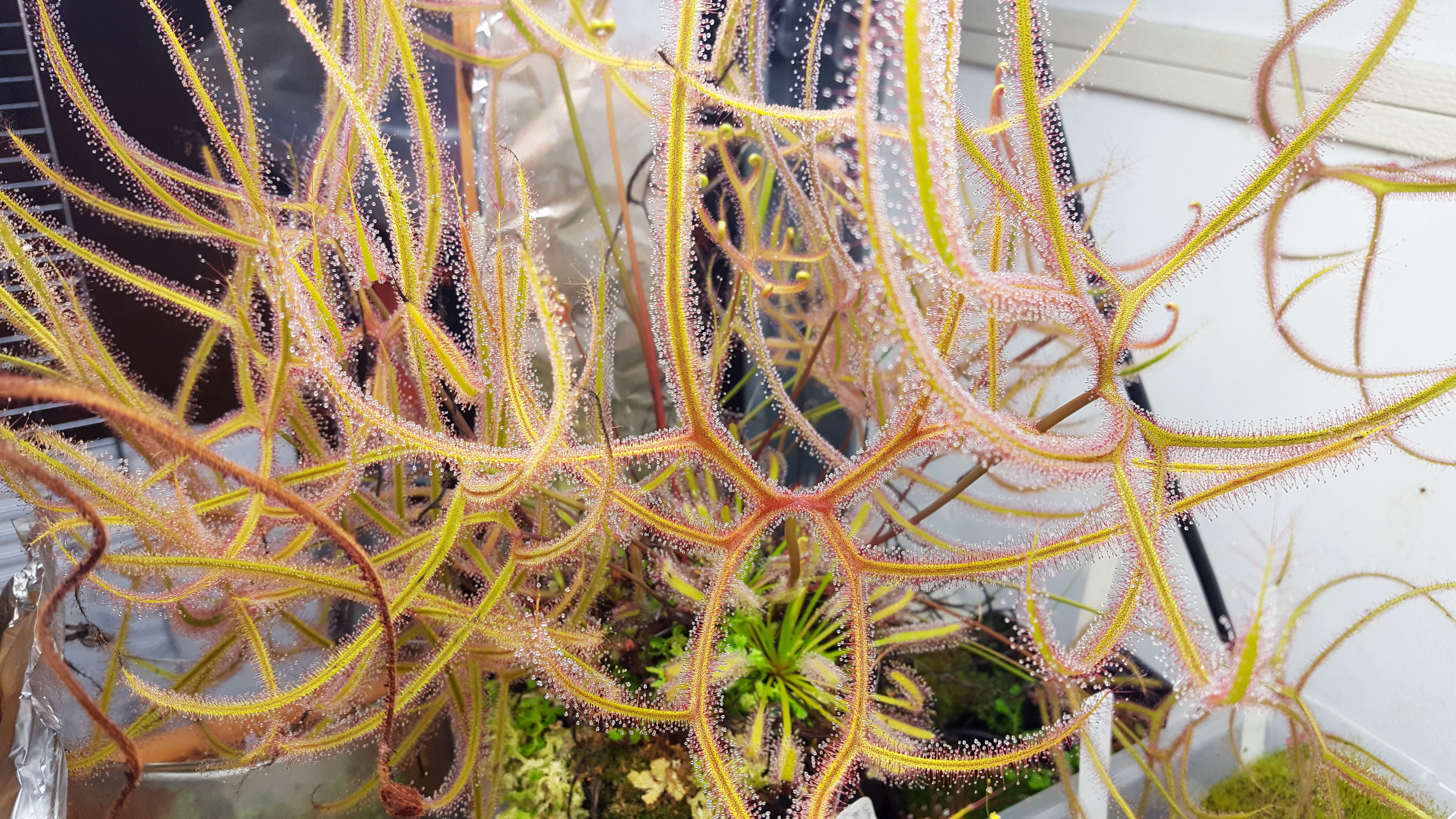
Drosera binata 'Marston Dragon' looked pretty nuts back on July 31st.

Drosera binata 'Marston Dragon'.
I wonder what the total volume of that dew is. Probably an ounce or two.
I still have no idea what I'm supposed to do with this plant. At least it looks rad as heck.

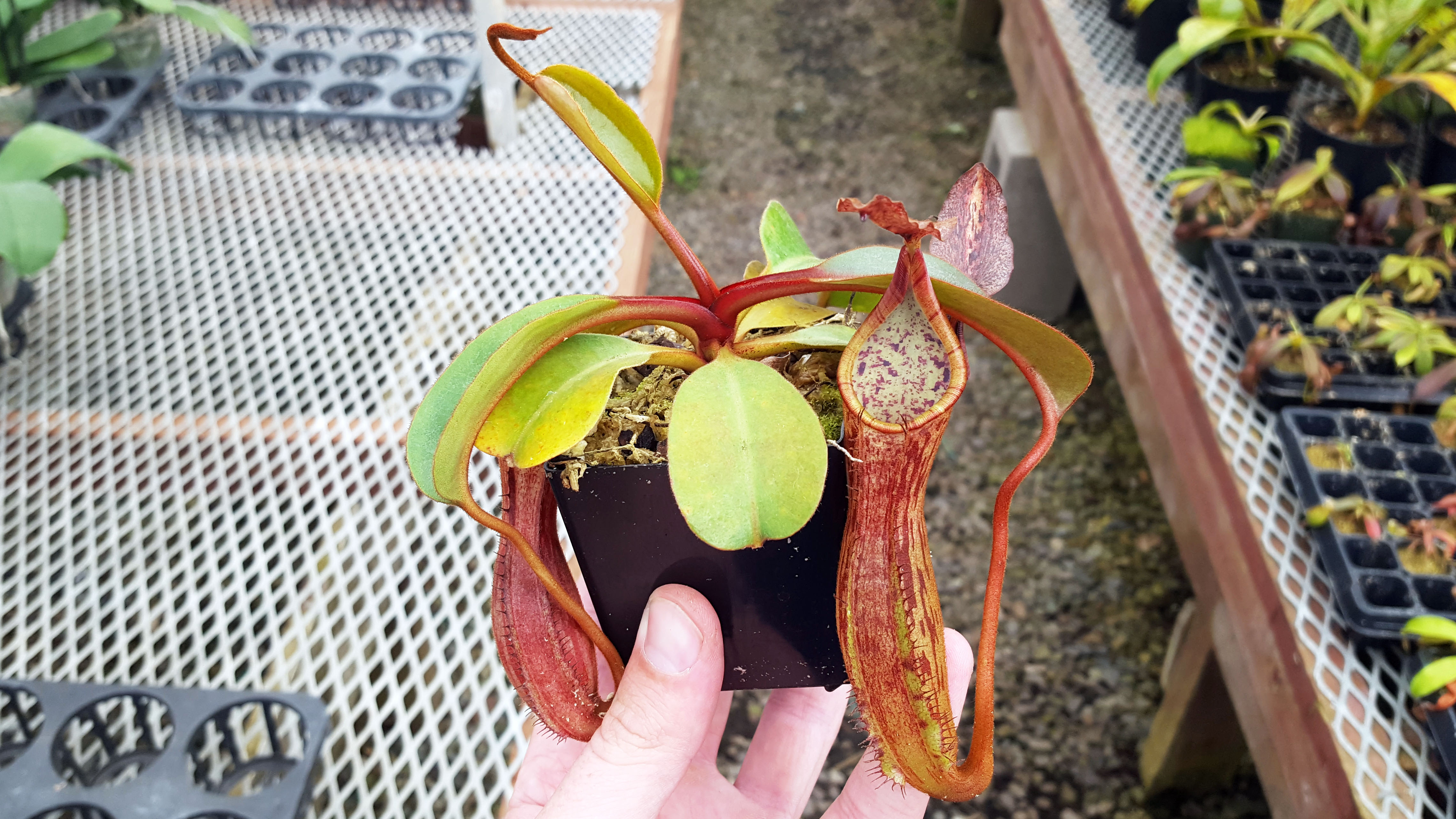
Fair warning, since I'm gonna be using pictures I've taken at work a fair amount, there are gonna be more neps than there have been on the blog in the past. Considering this Nepenthes eymae × jacquelineae though, can you blame me?

Nepenthes eyemae × jacquelineae.
I really like the glaucous character of the pitcher body.
This is a freshly-opened pitcher on what is probably my 4th favorite nep in the greenhouse (please don't ask me what the top 3 are, I have no idea). Wowzer!

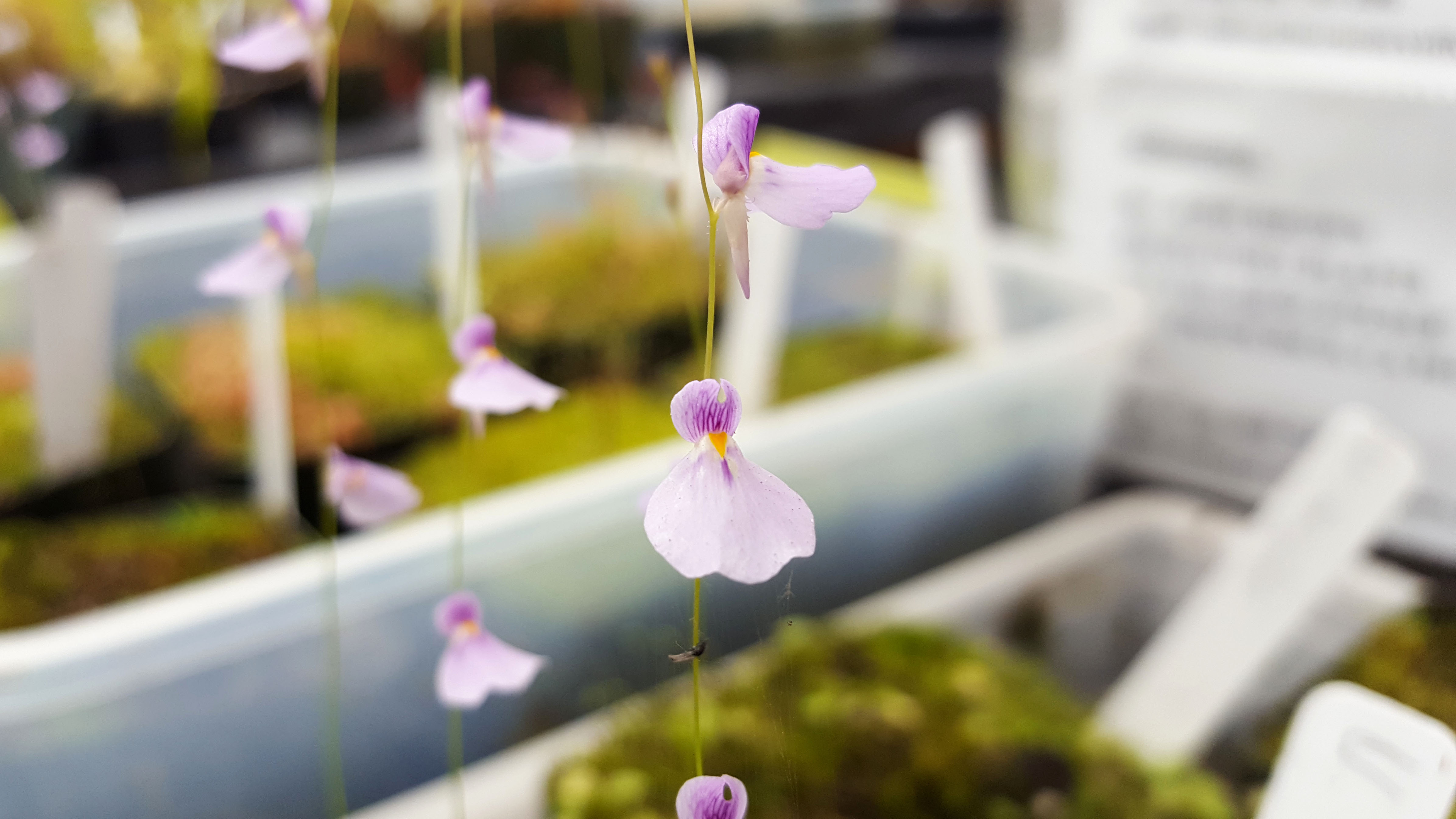
Don't worry though, there are also utrics at the greenhouse, such at this Utricularia blanchetii.

Utricularia blanchetii flower.
So small and fancy.
This is probably the most floriferous of the new little terrestrials I've been messing with lately. It's also completely adorable!

And at home, I still have sundews, even if I'm barely able to rouse myself to water them properly. Here's my Drosera kaieteurensis starting a new flower stalk.

Drosera kaieteurensis with flower stalk.
Note that I didn't refer to it as Drosera felix. That because when I showed photos of it to Fernando Rivadavia he was unequivocal that the fuzzy flower stalk indicated D. kaieteurensis. He had no strong opinions about the purported synonymy of the two taxa, but insisted that if the flower stalk was fuzzy it couldn't be D. felix. So there.

Another South American sundew with a difficult-to-spell toponym for its specific epithet is Drosera graomogolensis. It's also a total beast in spite of all my neglect.

Drosera graomogolensis.
This is an extravagant plant.
Root cuttings are an awesome way to get big plants fast, especially if it's one of the species with big fat roots. Great stuff!

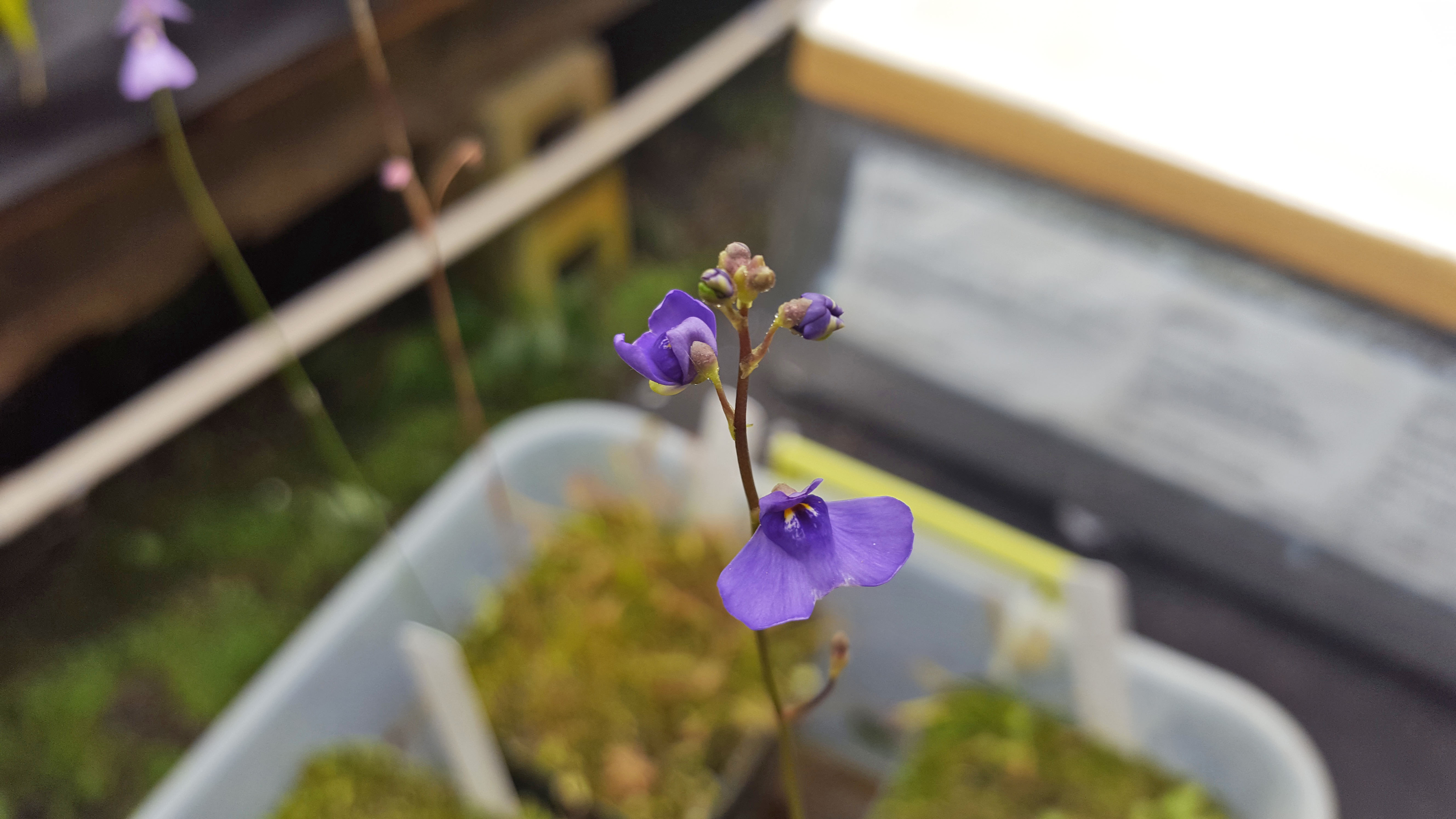
Another utric that I'm super stoked about is Utricularia biloba, which opened its first flowers for me a week or so ago.

Utricularia biloba flower.
These also have a neat chubby spur that's bright green.
As others have said of this species, photos don't do justice to the color, which is a deep violet with a hazy blue depth to it. Weirdly, the blue comes out more for me if I blink rapidly while looking at the flowers. Super interesting plant! Thanks Howard!

Finally, I've been selling select plants on Facebook – one-off neps, as well as new items like utrics and sundews that aren't in huge production yet. This Nepenthes fusca sold almost immediately this morning. I can't imagine why.

Nepenthes fusca.
I wish we had way more of this species than we currently do. It's wonderful!
Anyway, those are some plants. They're pretty cool.

Tuesday, June 28, 2016

Misidentified plants are basically inevitable

This weekend my friend Amir came over to see my collection. He was quite taken with the plant I've been referring to as Byblis liniflora, in part because it's a lovely plant, but also because he grows B. liniflora and mine looked nothing like his.

Byblis rorida.
What a lovely plant. So delicate!
Later that evening he sent me some texts suggesting – very convincingly – that I was actually growing Byblis rorida. From growth habit to color to flower shape, it seems pretty clear that I had gotten my seeds with an incorrect ID. Luckily B. rorida isn't really self-fertile (like B. liniflora), or I might have distributed seed incorrectly as well.

I also recently flowered a plant that I've known for a couple years as Pinguicula rotundiflora × hemiepiphytica. There have been some stirrings lately that this is probably an incorrect ID, and this flower pretty much confirms it for me.

Pinguicula laueana × emarginata flower.
This flower is very clear in my mind.
The argument is that this plant is actually Pinguicula laueana × emarginata, and this flower seals the deal. There's no hint of Pinguicula rotundiflora anywhere in this plant, and this flower both looks intermediate to Pinguicula laueana and Pinguicula emarginata, and a great deal like the ping I have that came identified as a hybrid of such. It's good to know I guess!

In that same pot I placed a leaf I received as the same hybrid. It is clearly not.

Unknown Pinguicula.
Call it Pinguicula unknownii.
I don't know what it is, so I assume it's a Pinguicula moranensis (hah). I basically need to flower this plant to have any idea what it is, and even then a diagnosis is going to be tough. I'll probably give this one away to someone who doesn't know about carnivorous plants and won't care about the ID.

How does stuff like this happen? Partly because plant IDs are mostly a loooooong game of telephone, especially for plants that primarily circulate in the hobby through trading, rather than by being produced in nurseries. Very few hobbyists actually have the training to go read a species description, analyze some herbarium specimens, and make an independent ID. Changing labels can be very risky, since sometimes plants can look very different in different conditions. Generally I think people should keep the tags they received unless they're very very confident in changing them. That can just introduce more problems into people's labels.

Some of you who have read the blog may remember when I "rediscovered" a cultivar called Drosera capillaris 'Emerald's Envy'. It's one of my favorite plants!

Drosera 'Emerald's Envy'.
It's so pretty and jewel-like. What a nice plant!
I did a lot of work before I felt comfortable changing the labels. I tracked down a couple different rumors I'd heard, and even reached out to the person who wrote the cultivar and tried to trace my plants to him (I couldn't quite draw the line all the way, but he felt that my plants matched the ones he wrote up years ago). I'm glad I did the work, because it's nice having a cultivar designation to go along with a nice plant.

I know I'm getting a bit crazy when I'm considering buying monographs to see if I can independently key out difficult species in my cultivation. I guess that's the way these things end up.

Wednesday, June 22, 2016

Mostly about flowering

This is what comes of letting your Drosera burmannii flower without concomitant feeding.

Drosera burmannii "Hann River".
This is the "Hann River" form, incidentally.
They're quite fallen off from where they were even in March. I think this phenomenon is why people insist that D. burmannii is an annual even though it demonstrably is not – the effort required to not let it bloom itself to death is tiresome, so it ends up dying. I've got to admire its drive to reproduce I guess.

What it needs to do is what this Drosera scorpioides has done and catch some serious prey.

Drosera scorpioides.
Look at this big shiny fly!
Incidentally, this species has never flowered for me. I love seeing small plants catch large prey though, it's always delightful.

This Pinguicula gypsicola × moctezumae has a really nice color to it.

Pinguicula gypsicola × moctezumae.
So pink and pretty!
This pot is really a mess. You can't really tell in the picture, but there are like 6 species and 3 genera in here. Oof.

I love the look of this flower stalk on Pinguicula rotundiflora × hemiepiphytica.

Pinguicula rotundiflora × hemiepiphytica.
This is much too cute.
New ping flowers always look so bashful. Never flowered this one before, so I'm excited!

Nearby my Drosera aliciae is not doing well.

Drosera aliciae.
Just chill out man.
This is one of my first carnivores, and it's been trying in vain to get off a flower stalk for months and months. They all end up aborting, and the plant looks pretty bad now. I can't figure out why it doesn't just chill out about the whole thing. Oh well.

My first Utricularia praelonga flower petal has dropped and it looks pretty cool.

Utricularia praelonga petal.
It's a pretty good-sized flower for a utric.
This probably happened an hour or two before I took this picture, since it's still very fresh and well-shaped. I like how utric flowers just drop as a mass, it's very funny. I'm really getting into Utricularia lately, which is like the most niche part of an already niche hobby. But check out this flower stalk!

Utricularia praelonga flower stalk.
Growing plants is so much fun.
It's almost 18 inches high, and has these bright yellow flowers. That's pretty cool man! I think so at least.

Monday, June 13, 2016

Stuff keeps growing

So, when I'm trying to talk people into growing carnivorous plants, I usually tell them something like this:
Carnivorous plants aren't very hard to grow. The things that kill them kill them right away. But if you spend just a little time setting up a system for them to grow in, they need almost no maintenance at all.
It's really fortunate for me lately that that is true, since I've not been giving my plants much maintenance/attention in the last couple weeks, and by god, they keep growing. Take Utricularia praelonga. Since I all-too-recently threatened it, it's opened not one, but three flowers.

Utricularia praelonga flowers in bloom.
Look at this flower stalk! It's getting quite tall.
Wowee! This is really quite cool. They're like larger, somewhat more interesting Utricularia subulata flowers. Here's a closeup:

Utricularia praelonga flower blooming.
A lovely flower after all.
The ruffles on the "labium" (it's not a labium, but I don't know how else to refer to the bottom petal on a non-orchid zygomorphic flower) are really cool, and the whole flower faces upward in a neat way. Quite large too, over a centimeter in diameter. I'm very proud of this plant!

I've also got a nice little bloom spray on my Utricularia babui.

Utricularia babui flowers.
I like the shape a lot, it's bulbous in the middle.
I'd thought that this plant was supposed to be bluish, but my Utricularia gramnifolia is much more blue, and these are distinctly purple. Therefore, either my idea was wrong (possible), one or both of the aforementioned plants are mislabeled (sadly common), or the taxonomy and description of these taxa are a mess and need to be sorted out (very likely). In any case, I quite like this plant – I rarely see this many flower stalks on fresh utric plug. Usually they wait until the pot has been more widely colonized to bloom in force.

My Pinguicula rotundiflora × hemiephiphytica has a flower bud.

Pinguicula rotundiflora × hemiepiphytica bud.
I love new ping flowers.
I've heard a bit of back-and-forth about whether this hybrid actually exists, or is just a labeling mistake. I think this flower will help me make a determination for myself at least. Both of the parent species have pretty distinctive flowers, and I feel like I should be able to tell if this plant is of their ilk or not. I guess we'll see in time!

Oh yeah, I started some Drosera esmereldae seeds.

Drosera esmereldae seeds.
Just some moss you know.
There's not actually anything to look at, but it's nice to have the blog here as a record of propagation attempts. I hope these take – this is a species I've wanted for a while.

Here's a problem: I've got three species in this pot, which I knew at the time was a bad idea.

Pinguicula moranensis, Drosera occidentalis, and Drosera zigzagia.
This is what I get for not preparing enough soil.
The "dead" plant is Drosera zigzagia, which I should take out of the tray for its dormancy. The ping up front is a nice Pinguicula moranensis start that I can just move to another pot. The problem is those two nubs on the left. Those are Drosera occidentalis plants that I accidentally broke from their roots while harvesting gemmae. They're 100% alive (just dormant), which gives the lie to the idea that pygmies can't handle root damage. The problem is that I don't want to make this pot go dry and risk killing them now. I might just dig out that section of pot and replant it. We'll see.

Speaking of pygmies, my Drosera grievei seems to not have reverted from its crestate state.

Crested Drosera grievei pygmy sundew.
Cresting forms are always fun.
That's pretty cool really. None of the gemmae from this plant made crestate plants, but that's okay, I like this one. My pygmies are looking pretty so-so this year though (I should make a post about that). I'll have to make fresh pots this year.

Finally, to end on a pretty note, my Drosera capensis wide-leaf form is really looking nice.

Drosera capensis wide leaf form.
This is just a really good plant.
So far I'm really pleased with this acquisition. The real question will be if the seed offspring maintain the wide leaves. If not, I'm still happy with this one at least. So dewy!
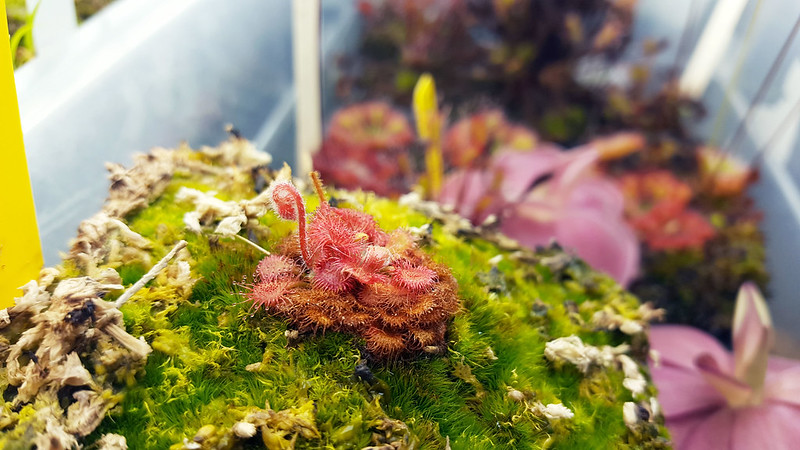
Monday, May 30, 2016

A brief post in which I threaten Utricularia praelonga

You've got to be kidding me Utricularia praelonga. I first noticed your flower stalk in mid-April. Over 3 weeks ago I boldly declared that you would be open in a day or two. And this is what I've got so far.

Utricularia praelonga flower.
This has been absolutely glacial.
At least your spur is visible. This is progress. Maybe you'll be open tomorrow. Maybe Wednesday. I mean, look at this, your flower stalk is almost 15 inches (~38 cm) tall and I've had to stake it. My Utricularia longifolia is just over 16 inches (~41 cm) tall, and it's been in bloom for 4 months.

Utricularia praelonga flower stalk.
U. longifolia photobomb in this picture.
Now listen. I don't care when you open, except it had better be before Saturday. Because Saturday is the BACPS show, and I swear to all that is holy if you aren't open on Saturday I might forget how proud I am to get a flower from a plant that rarely blooms in cultivation and set you to soak in a bucket of saltwater. Just open. Please. I've been checking that bud every morning when I wake up and every evening when I get home from work for the last 3 weeks. You can just open. Please. Please open. Soon.

Saturday, May 7, 2016

Utricularia 'Betty's Bay' in flower

Fun new utric flower today. Utricularia 'Betty's Bay' is a location form and cultivar of Utricularia bisquamata that is notable for having flower much larger than the common weedy form, and also for not readily self-seeding. Here's a photo of its flower next to a standard U. bisquamata stalk I plucked.

Utricularia bisquamata 'Betty's Bay'
The color is a bit richer too!
Regular U. bisquamata is on the right, U. 'Betty's Bay' on the left. I think the flower stalk I'm holding got tilted forward as I was taking the picture, so it looks larger than it should. Even with that, it's clear to see that U. 'Betty's Bay' is definitely a superior clone! It's very pretty.

We're really really close on this Utricularia praelonga!

Utricularia praelonga flower stalk.
The tension is building.
You can see the color of the petals! It's gonna pop tomorrow or the next day. I'm stoked.

The neighboring pot of Utricularia lateriflora has some lovely blooms as well.

Utricularia lateriflora.
I've never been disappointed by a new Utricularia.
I love the combination of dark purple and white. This is a great little utric!

Finally, here's something weird. My Drosera filiformis Florida red is apparently still alive.

Drosera filiformis Florida red.
This is my white whale.
This plant keeps going dormant forever, but keeps not dying. If I were better at pot upkeep I would have thrown this away 2 or 3 times by now. Guess you should never clear out your collection ever! I hope I can get this one to grow in a bit.

Saturday, April 30, 2016

A few ping flowers

My Pinguicula 'Pirouette' flower has opened!

Pinguicula 'Pirouette' flower.
Ping flowers are so cheery.
It's very pretty, and a nice complement to the plant itself. It also confirms the identity of this plant for me – I wasn't 100% sure this was actually P. 'Pirouette' until I saw the flower.

Nearby, it sure seems like Pinguicula rotundiflora wants to bloom.

Pinguicula rotundiflora.
This plant is very adorable.
That little nub in the middle looks like a flower, but it's been hanging out for over a week. I hope it makes a move soon.

Pinguicula 'Aphrodite' is flowering again too.

Pinguicula 'Pirouette'.
I guess I really like pinkish pings.
I'm a bit ambivalent about this one flowering actually. I grow it mostly because I love the color and shape of the foliage, and it seems to have shrunk after the last couple of blooms. Oh well. It's still nice!


Finally, Praelonga Watch: 2016 has entered its 3rd week.

Utricularia praelonga.
Not my best photo, I know.
It wasn't easy to photograph, but the Utricularia praelonga flower stalk is now almost 5 inches tall. Let's see those flowers!

Saturday, April 23, 2016

Plant Profile: Utricularia longifolia

This is part of a series of posts describing my experiences with different species, their culture requirements, and photos of their growth in my collection. The full series can be read here, or by species at the Series page
If I were forced right now to rank all of my plants by how much I love them, Utricularia longifolia probably wouldn't be on top, but it would be a near-run thing. Consider this picture from a couple days ago.

Utricularia longifolia flowers.
U. longifolia flower, 4-21-2016, after nearly 8 weeks open.
See that flower in the middle? The one that's starting to wilt? It opened on the 27th of February. That means it's been open for 8 weeks. Take that orchids! And this is from a plant that probably couldn't be easier.

I got my U. longifolia during my first trip to California Carnivores, the time when I tried to buy a bunch of Damon's collection pots by accident. I think he fetched it smooth over my embarrassment. Sweet guy!

Utricularia longifolia.
U. longifolia, 7-22-2014. Just getting started!
U. longifolia is extremely low-maintenance in my conditions. Early on I had to move it to its own little tray because it kept sending out stolons toward other pots. That actually proved to be a pretty good move, since it let me give the plant a nice flood/dry cycle.

Utricularia longifolia.
U. longifolia, 1-26-2015. Long leaf! This is almost ready to bloom.
Lots of people have asked me for advice with U. longifolia, but I can't say anything definitive since I haven't tried growing it in different ways. Here's the basics: it's 18 inches and a bit offset from my lights, so not very intense light, though it is good light; in my garage, where temperatures tend toward the 50s and 60s, occasionally getting cooler in the winter, and ranging into the upper 70s during the hottest days of summer; planted in long fiber Sphagnum moss, I water its tray every 10 days or so. The water level almost always drops way down before I water it, though the moss never really dries out. I water to the very top, nearly flooding the pot. The secret to U. longifolia culture is probably buried somewhere in that description, but I don't know what is the important bit.

After 7 months or so of that treatment, I was rewarded with my first flower stalk.

Utricularia longifolia flower spike.
U. longifolia flower spike, 2-19-2015. I was so excited.
Much like many popular species of orchid, the scape takes several weeks to develop. This first year I only had 2 scapes, and they got hit with aphids, so it was a bit of a let down, though the first few flowers were nice. This year I got 6 flower stalks.

Utricularia longifolia in full flower.
U. longifolia in full bloom, 3-20-2016.
At the peak of the bloom there were 14 open flowers. It was amazing! The two largest stalks look like they'll have 6 or 7 buds in the full course of the bloom, while the smaller ones have 2-3. It seems like the peak of the bloom lasts 2 or 3 weeks, while the full bloom cycle will probably be around 3 months. Not bad at all!

One funny thing about confining my plant to its own little tray/pot is what happens below the pot. It's a bit nuts.

Utricularia longifolia stolons and traps.
U. longifolia, 4-21-2016. About 18 months of stolon development.
You can see the trap development right on the bottom there, and the density of stolons is nuts. This plant would probably like a LOT more space. A part of me is considering getting it into a big pot and seeing what happens. I'll let it finish blooming first, but I might need to mess around with it come summer.

Seriously, U. longifolia is a great plant. I've heard of being growing them in windowsills just fine, in greenhouses, under lights, and outside. If you find any, give it a shot! Maybe I'll try and divide mine up into a few pots to trade/sell. We'll see!

Utricularia longifolia flowers.
U. longifolia flower detail, 3-27-2016.

The Breakdown
  • media: Long-fiber Sphagnum seems to work well.
  • light: Modest light is fine. Probably gets longer leaves in dimmer light.
  • water: Seems to like periodic flood/dry cycles. I achieve this through the careful method of being terrible at watering on time.
  • temperature: Avoid frosts. Probably prefers cooler temperatures, but I bet it would be fine growing warmer as well.
  • feeding: Probably foliar feeding with something like MaxSea would work, but I've never done it.
  • propagation: Divisions are the way. Be careful keeping it near other pots, because the stolons will aggressively colonize its neighbors.
  • flowers: Starts blooming for me in the late winter/early spring.

Monday, April 18, 2016

Flowers in spring!

I've come to appreciate the effect of seasons on my growing environment more lately. I used to think that the fact that I grow under lights in my garage meant that my plants didn't really experience seasonality, considering the fairly stable temperatures and light quality. However, I'm starting to see that, for example, there is a distinct uptick in flowering into the spring. Let's look at it!

My Drosera felix is putting up a second flower stalk.

Drosera felix.
Look at the little fuzzles.
This plant has a special place in my heart. It's small and unassuming, but it's just such a trooper, and there's something so adorable about it. I've gotten some seed from the first stalk too!

Pinguicula 'Pirouette' is blooming for the first time.

Pinguicula 'Pirouette'.
This is such an elegant plant.
I love ping flowers. This one looks so demure as it's getting ready to bloom.

I've also gotten my first flower on Drosera mannii.

Drosera mannii.
Don't mind all the Utricularia bisquamata.
It looks like I've missed the first couple blooms, but I'll have to keep an eye out for it because apparently D. mannii has blooms bigger than the plants themselves.

Got a Drosera oblanceolata flower stalk!

Drosera oblanceolata.
I like how smooth the flower stalk is. That's not super common in Drosera.
I got this plant in winter, but I think the warmer temperatures are benefiting it a lot. It's looking better than it has since I got it. Nice plant!

Drosera collinsiae is starting to bloom again.

Drosera collinsiae.
Finally we've got dew on this guy.
I'm almost tempted to trim the flower stalk, since this is the best the plant has looked in months and I don't want it to decline. However, I really want seed, so I think I'll let it go. The last flower stalk aborted.

New flower stalk on Drosera 'Emerald's Envy'!

Drosera capillaris 'Emerald's Envy'.
The plant this stalk is coming from is just doing great.
This particular plant has never flowered before, and it looks like a good one. Gonna get some good seed off this one.

Drosera aliciae is trying to flower again.

Drosera aliciae.
Come on D. aliciae, we believe in you.
This plant really struggles. It's aborted the last 3 or 4 flower stalks it's attempted. I can't say why. Here's hoping this one takes.

Now comes to the bit of the post where I do some real bragging. First up, look at this Utricularia longifolia.

Utricularia longifolia flowers.
So many flowers!
You see that flower in the center of the photo? That flower opened on February 27th. We're closing in on two months for that one flower. There are 14 flowers open on this plant now, and it'll probably be in bloom for at least another couple months. There are a lot of plants I love, but U. longifolia is one I actually admire. It's just an exquisite plant.

Finally, look at this.

Utricularia praelonga flower stalk.
I'm really really excited.
See that brown growth there? That's a flower stalk. A flower stalk on Utricularia praelonga. This plant is known for rarely flowering in cultivation, and no one really knows why. Go ahead and do an image search, there are very few photos of it. I am so stoked on this. This is the most exciting thing since my winter-growing sundews woke up. More photos to come!

Spring is great.