Showing posts with label Drosera scorpioides. Show all posts

Wednesday, June 22, 2016

Mostly about flowering

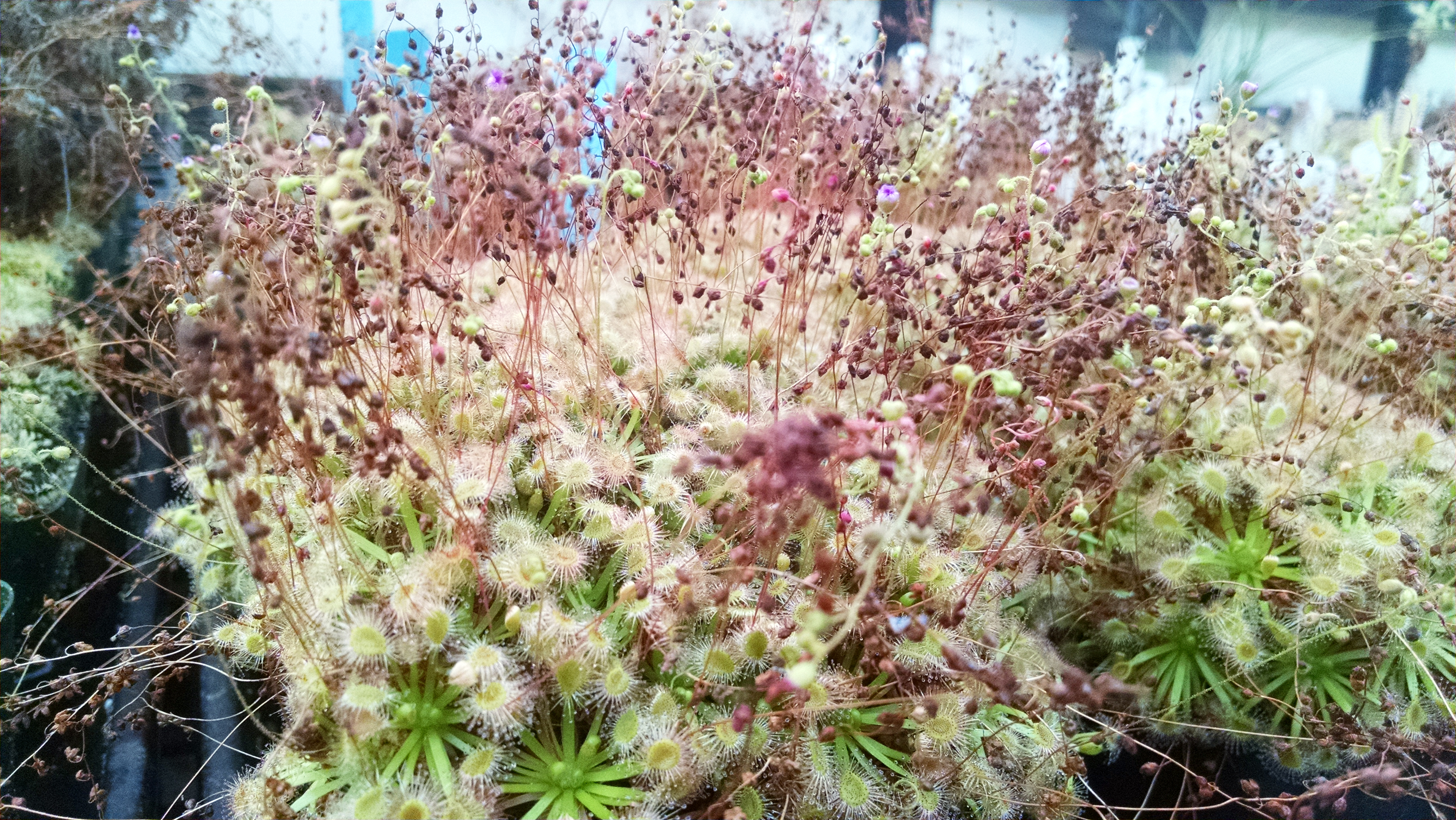
This is what comes of letting your Drosera burmannii flower without concomitant feeding.

Drosera burmannii "Hann River".
This is the "Hann River" form, incidentally.
They're quite fallen off from where they were even in March. I think this phenomenon is why people insist that D. burmannii is an annual even though it demonstrably is not – the effort required to not let it bloom itself to death is tiresome, so it ends up dying. I've got to admire its drive to reproduce I guess.

What it needs to do is what this Drosera scorpioides has done and catch some serious prey.

Drosera scorpioides.
Look at this big shiny fly!
Incidentally, this species has never flowered for me. I love seeing small plants catch large prey though, it's always delightful.

This Pinguicula gypsicola × moctezumae has a really nice color to it.

Pinguicula gypsicola × moctezumae.
So pink and pretty!
This pot is really a mess. You can't really tell in the picture, but there are like 6 species and 3 genera in here. Oof.

I love the look of this flower stalk on Pinguicula rotundiflora × hemiepiphytica.

Pinguicula rotundiflora × hemiepiphytica.
This is much too cute.
New ping flowers always look so bashful. Never flowered this one before, so I'm excited!

Nearby my Drosera aliciae is not doing well.

Drosera aliciae.
Just chill out man.
This is one of my first carnivores, and it's been trying in vain to get off a flower stalk for months and months. They all end up aborting, and the plant looks pretty bad now. I can't figure out why it doesn't just chill out about the whole thing. Oh well.

My first Utricularia praelonga flower petal has dropped and it looks pretty cool.

Utricularia praelonga petal.
It's a pretty good-sized flower for a utric.
This probably happened an hour or two before I took this picture, since it's still very fresh and well-shaped. I like how utric flowers just drop as a mass, it's very funny. I'm really getting into Utricularia lately, which is like the most niche part of an already niche hobby. But check out this flower stalk!

Utricularia praelonga flower stalk.
Growing plants is so much fun.
It's almost 18 inches high, and has these bright yellow flowers. That's pretty cool man! I think so at least.

Wednesday, January 13, 2016

Assorted plant stuff

One can't always have a nice themed post. This is one of those times.

My Pinguicula laueana × emarginata is blooming again.

Pinguicula laueana × emarginata flower.
Lovely flower of P. laueana × emarginata.
This has got a really pretty flower. It's interesting, I've only ever flowered this plant, my Pinguicula gigantea, and my Pinguicula emarginata. I don't know what triggers flowering in pings. I've got several that I think are big enough to flower, but they just haven't.

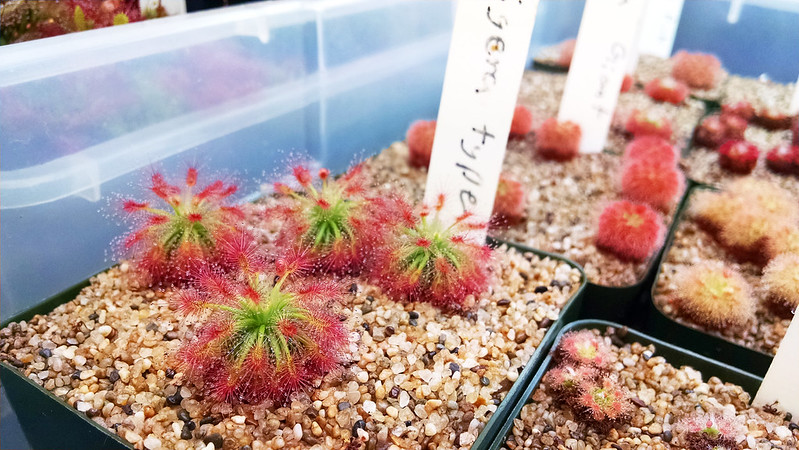
In pygmy news, there are finally gemmae forming on my Drosera scorpioides.

Drosera scorpioides with gemmae.
D. scorpioides gemmae is quite the hot item.
I think I'm going to need to start a new pot of these guys or risk losing these to attrition. Should get a good crop though, last year I had a lot.


The Drosera barbigera look funny and squashed with their gemmae.

Drosera barbigera with gemmae.
Funny smooshed plants.
Such nice color this time of year too.

Drosera burmannii (Gunung Keledang) is growing in, and isn't quite as red as it was before.

Drosera burmannii Gunung Keledang.
One can never have enough Drosera burmannii.
I quite like this form, especially if it maintains that green leaf, red tentacle coloration. It's taken well to feeding.

My Byblis liniflora continues to be lovely, and continues to be impossible to photograph.

Byblis liniflora.
This plant is very dream-like.
I feel like this would need to be in a black box with bright diffused light to photograph well. Has anyone out there managed to get a good picture of B. liniflora? I'd love tips.

Finally, I haven't posted about Pinguicula rotundiflora lately, but it is way too cute.

Pinguicula rotundiflora.
Look at those cute little leaf margins!
Now this is a plant that I want to flower. Luckily this one is pretty easy to propagate, as evidenced by all the babies in the pot. Maybe I can have a whole bunch in flower together. That would be adorable.

So I guess that's what's up around here.

Tuesday, October 20, 2015

Pygmy sundew check-in

Another programming note before we get into the post: The Bay Area Carnivorous Plant Society is having its Fall Meeting on Saturday the 24th at the Lake Merritt Garden Center, 666 Bellevue Ave. in Oakland from 12:00 to 4:00. The topic will be...pygmy sundews! We're heading into gemmae season, so we've all gotta be prepared. There will be lots of photos, a guide to building an aspirator for harvesting gemmae, and more. California Carnivores will be there selling plants, and everyone's gonna have a good time. If you're in the area it would be awesome if you could make it through. Okay, on to the post.

I've been checking in on my pygmies more lately so I can see when gemmae start forming. There are several pots I need to re-sow this year to keep the collection looking tidy. Consider Drosera pygmaea and Drosera roseana here.
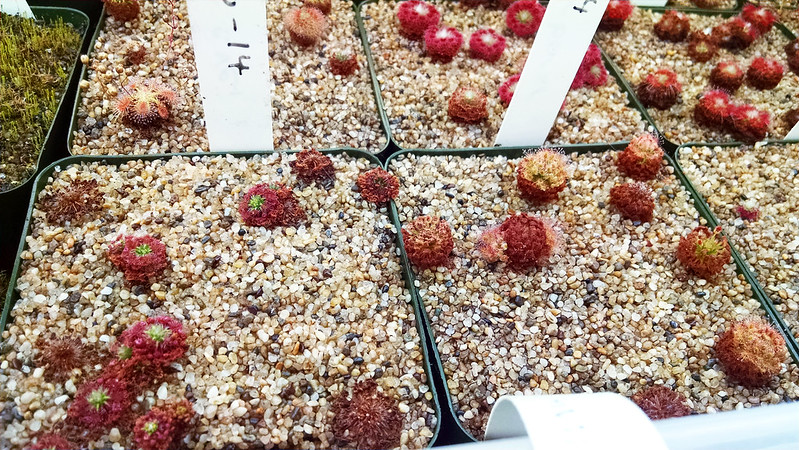
Drosera pygmaea and Drosera roseana.
Looking a bit tired there guys!
The D. roseana on the right were fed recently. I think they just burned a bit too brightly – these were the plants that produced gemmae only 12 weeks after being gemmae. No wonder they look a bit exhausted. As for D. pygmaea, I've always had trouble with this species. A number of people describe it as being one of the easiest pygmies, but I've just never been able to keep them happy. Who knows.

Drosera patens is showing a bit of a stem/skirt of dead leaves.
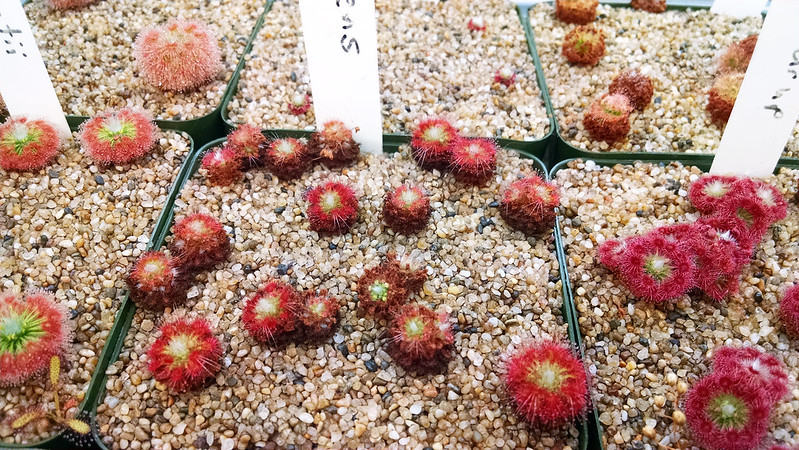
Drosera patens.
They're burning out.
The life cycle of pygmies is so short. This picture from my Instagram is was taken back in mid-May (follow me on Instagram for more plant pictures!). They looked so happy then. D. patens is part of a group of closely-related pygmies including Drosera nitidula and Drosera allantostigma, so I really like them when they're growing well.

My supposedly orange-flowered Drosera pulchella has also shrunk back a bit.
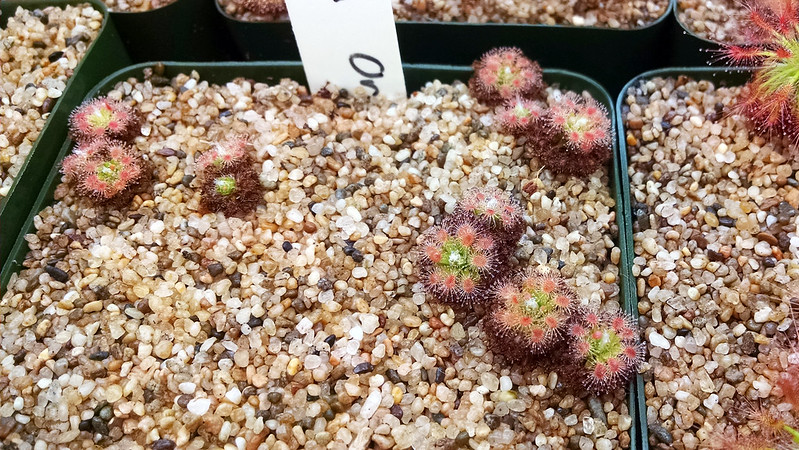
Drosera pulchella.
It would be cool to see the orange flowers.
I say "supposedly" because I've never had any flowers from these guys. I don't seem to flower pygmies very readily. Not sure why! Plants are weird. Maybe my conditions are too consistent from them. After all, they're native to a much more extreme climate than my garage (southwest Australia).

My good old Drosera scorpioides are glad to have been recently fed.
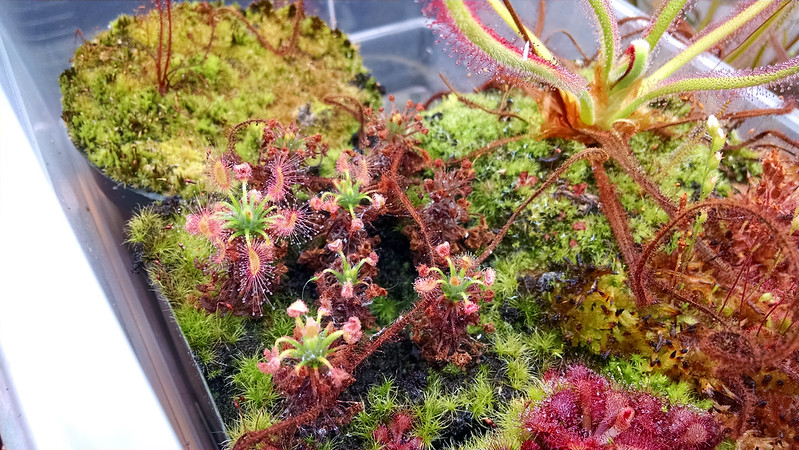
Drosera scorpioides.
Ah, memories. My first pygmies.
I definitely need to re-sow this species this year. Not sure how much longer they'll hold out. Also I've heard from multiple people that their D. scorpioides tend to conk out suddenly sometime during year three. Also I think there's a slug or snail in that tray somewhere. I hate slugs.

Moving on to plants that are doing quite well, check out this Drosera occidentalis ssp. microscapa. It...exists!
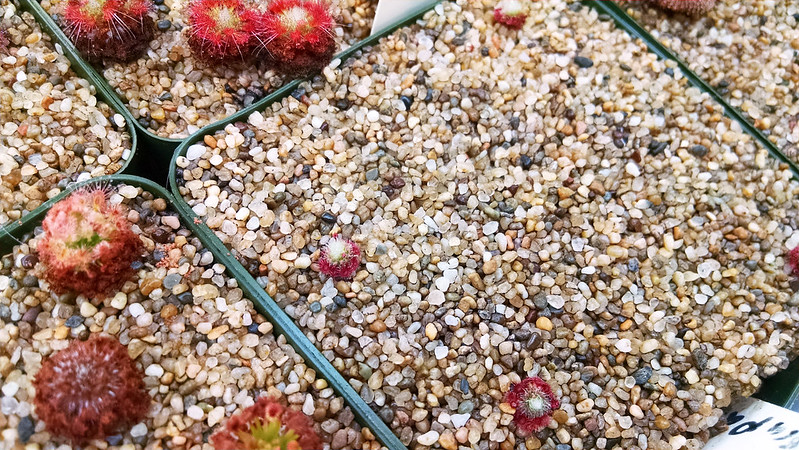
Drosera occidentalis.
These are so hilariously tiny.
Back in February they were nowhere to be found. I'd figured that sowing on the sand had been a bit too extreme for the tiny gemmae – being so small they have less stored energy and moisture, so they wouldn't have time to grow roots into the soil. Guess I was wrong! It still took like 6 months before I could tell they were there though. What a silly plant.

I'm very pleased with how Drosera silvicola and Drosera barbigera are doing.
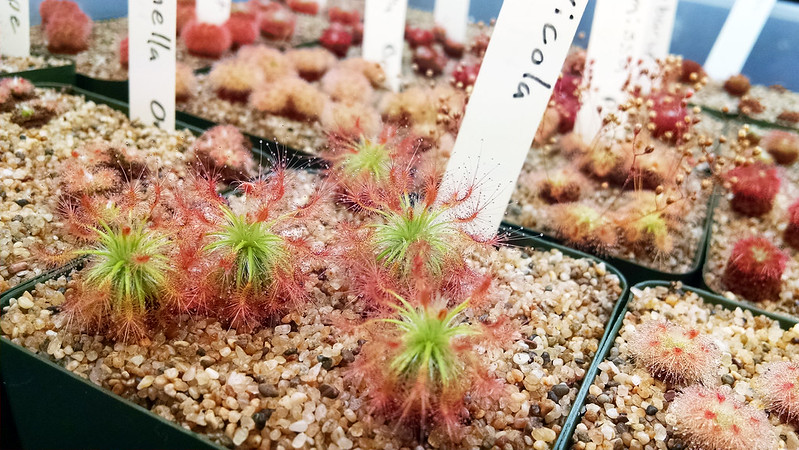
Drosera silvicola.
These have really filled out nicely.
Drosera barbigera.
Four plants per pot seems perfect.
These both seem to have some affinity with D. scorpioides in terms of growth habit, but I like how the stem is less pronounced, leading to this nice dome-like set of traps. Quite handsome plants!

I've gotta post about Drosera ×Dork's Pink. Just look at it.
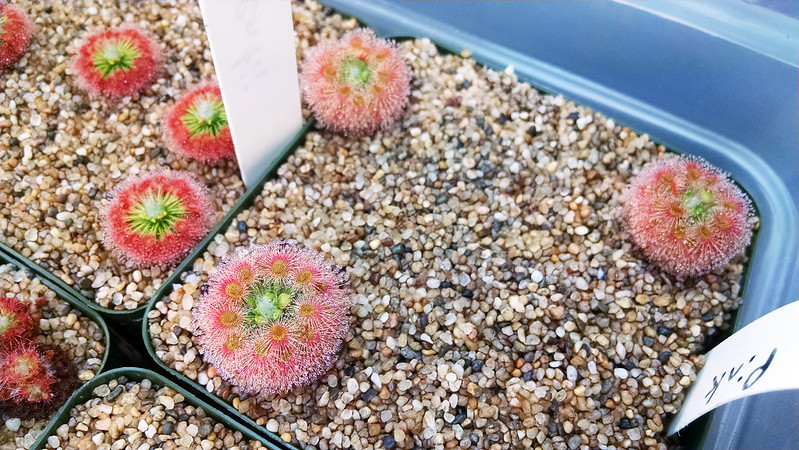
Drosera ×Dork's Pink.
I hope I get a lot of gemmae from these.
D. ×Dork's Pink is D. lasiantha × callistos, an absolutely fabulous man-made hybrid that was formally described in the March 2015 issue of the Carnivorous Plant Newsletter (join the ICPS to download it). I just love the density of the traps and the truly wonderful glowing pink color. It's also quite a large pygmy, so it's very striking.

Finally, Drosera sargentii. Drosera Gemmae is actually calling it Drosera parvula ssp. sargentii now. Whatever you call it, I think it's my new favorite pygmy (sorry D. allantostigma).
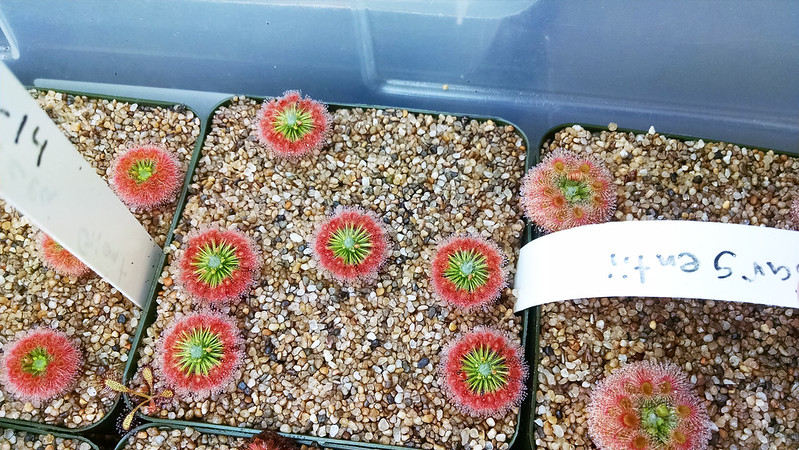
Drosera sargentii.
I could stare at these all day.
Just LOOK at those pygmies. Like perfect little bullseyes. Wonderfully distinct bands of color, almost perfectly circular. I can't even handle how cool this plant is.

If you like sundews you've gotta be growing pygmies. I'm pretty sure they're the coolest.

Thursday, October 8, 2015

Field Trip: Funny stuff at Predatory Plants

Yesterday I decided to go hang out in San Francisco with my friend Josh, owner of Predatory Plants. I thought I'd head home early to beat the commute traffic, but unfortunately the commute traffic got started around 1 pm, so I ended up sitting around his greenhouse checking out all the weird stuff he's got around (and also catching up on all the carnivorous plant gossip).

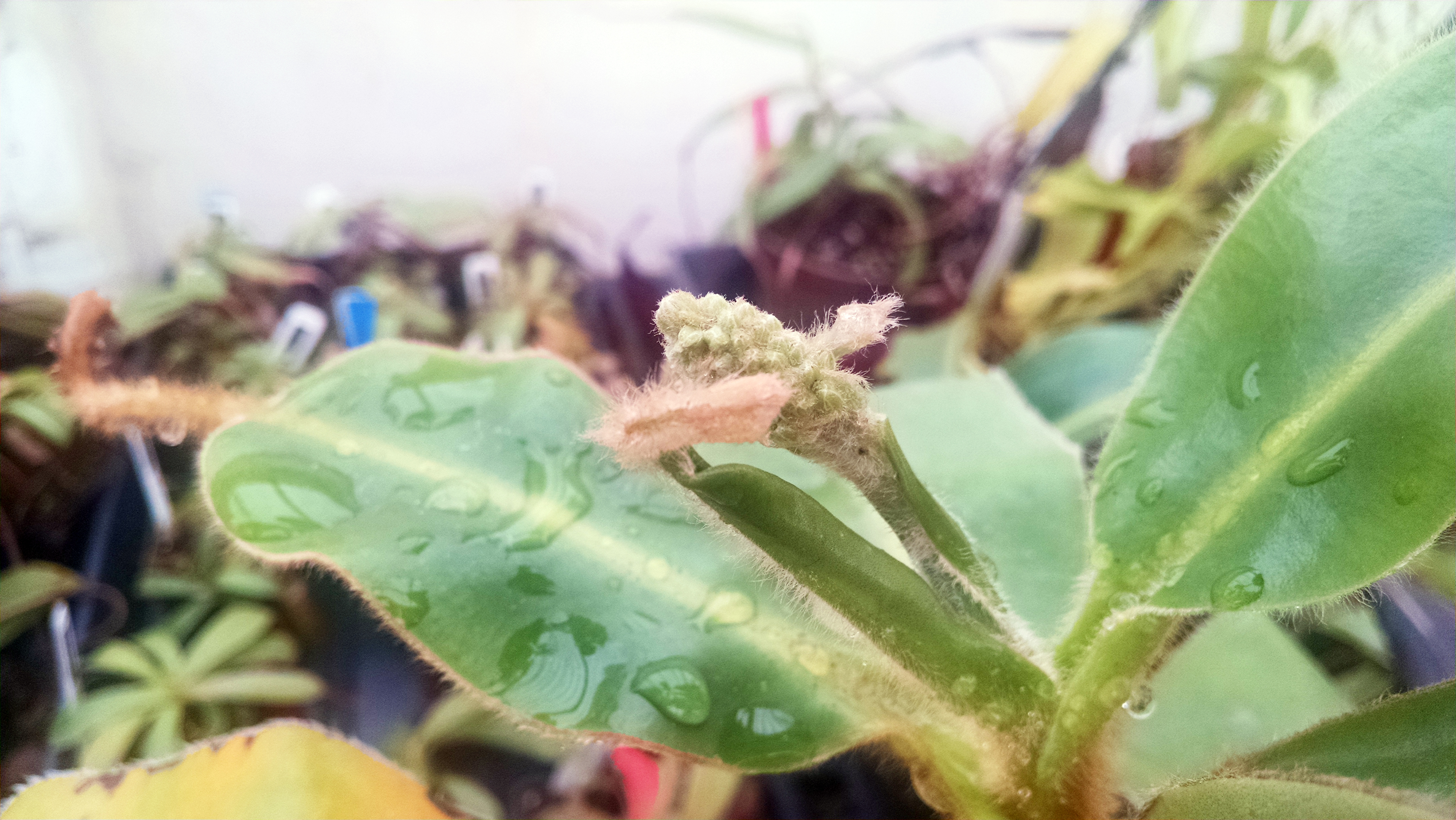
This Nepenthes glandulifera flower stalk looks like a certain other prized inflorescence.

Nepenthes glandulifera inflorescence.
Like a teddy bear.
This plant is so fuzzy it's ridiculous.

The clump of Drosera omissa × pulchella is just about to attain sentience.

Drosera omissa × pulchella.
Be careful of pygmy hybrids.
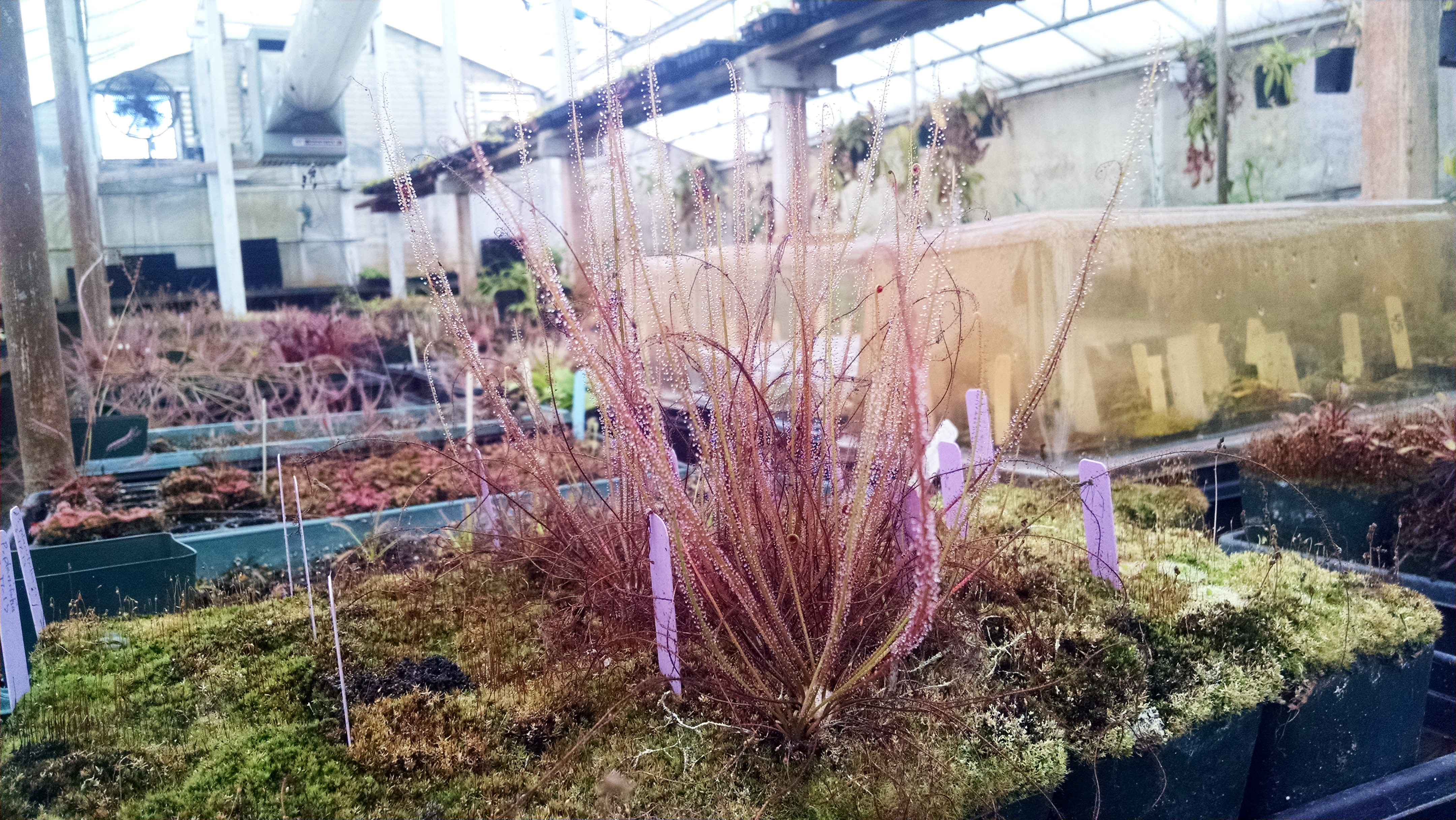
Meanwhile the Drosera scorpioides are looking quite Dr. Seuss-like.

Drosera scorpioides.
They look so fragile.
I correctly guessed that these plants are three years old. It's fun having extremely niche expertise.

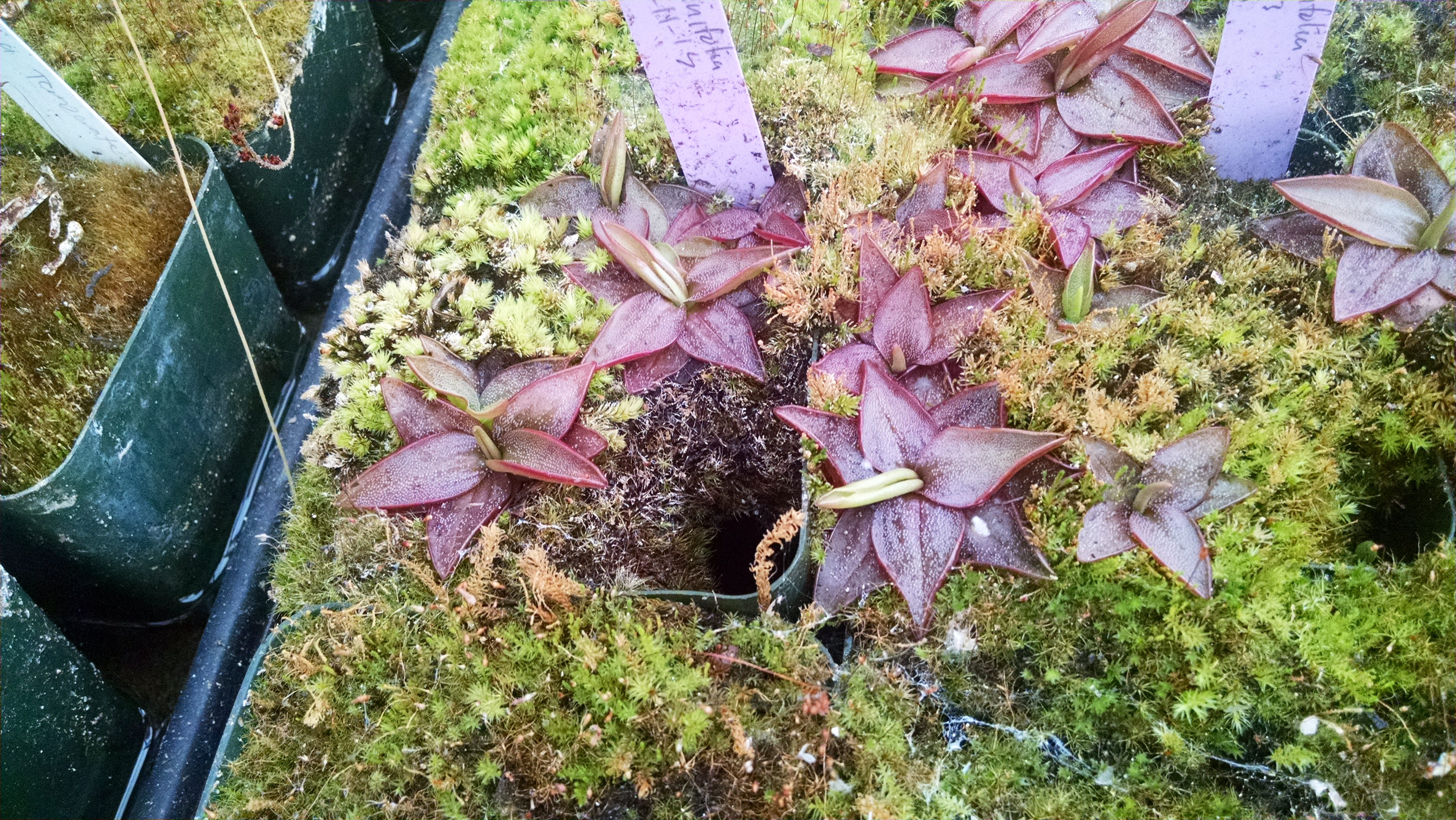
Josh discovered something funny about his pots of Pinguicula planifolia.

Pinguicula planifolia.
They're attractive plants, just baffling.
See that hole in the pot? It's hollow underneath. I guess in the two-plus years these have been growing here the bottom layer of soil has gradually been washed away, while the top is held together by the moss. Josh says he's afraid to mess with it now, since the plants seem to be fine.

I had to stop to admire this fine patch of Drosera filiformis Florida red.

Drosera filiformis Florida red.
I love this plant. Great color.
These are around two years old. Really lovely plants! I wish mine would get a move on and start filling out.

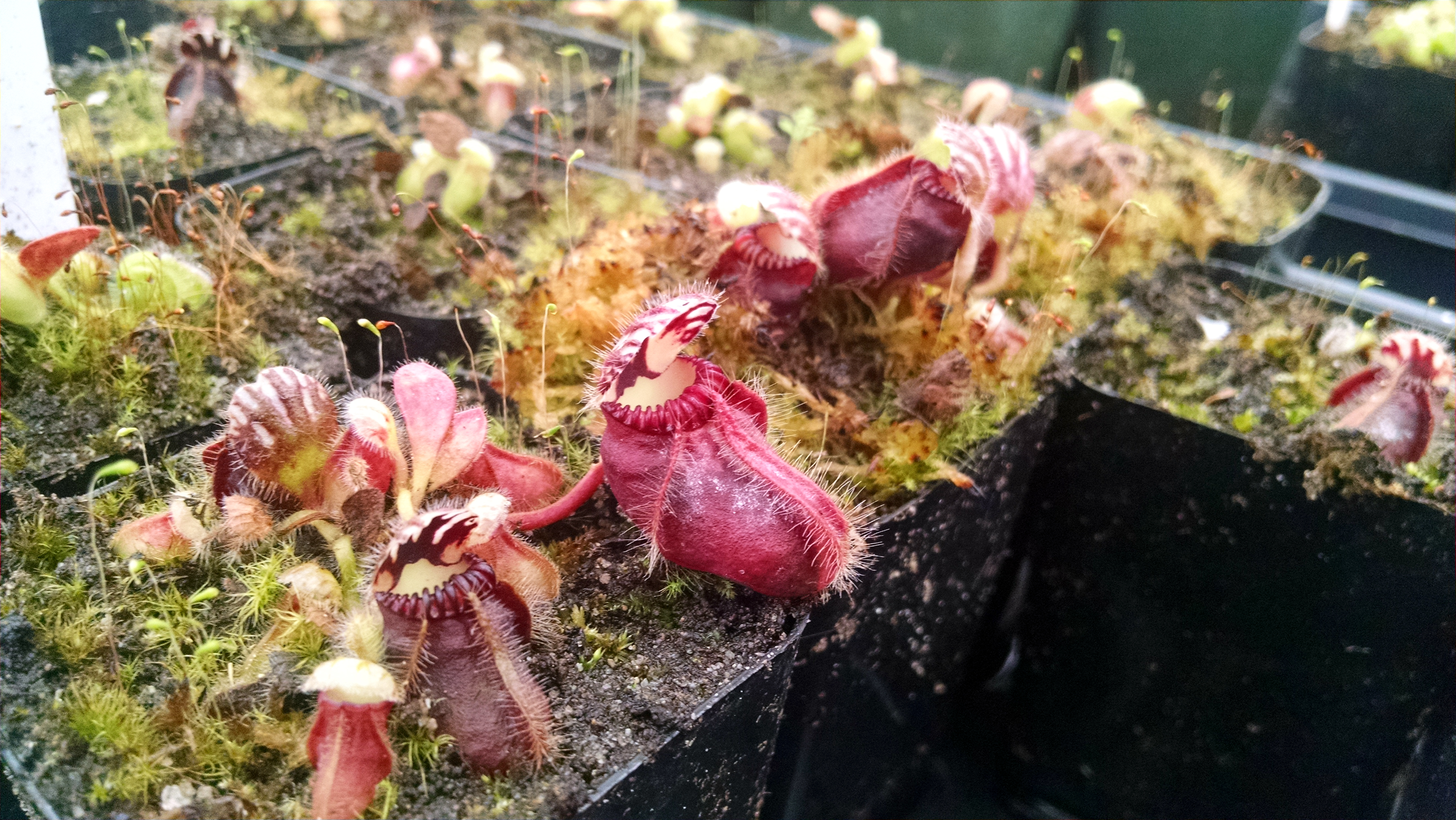
Also, Josh recently got into growing Cephalotus, and the results are looking pretty good!

Cephalotus follicularis.
So squat and hairy!
Everybody loves Cephs. If there was more of a consensus on how to grow them (and an easier way to produce them) I'm sure they'd become one of the most popular plants in cultivation.

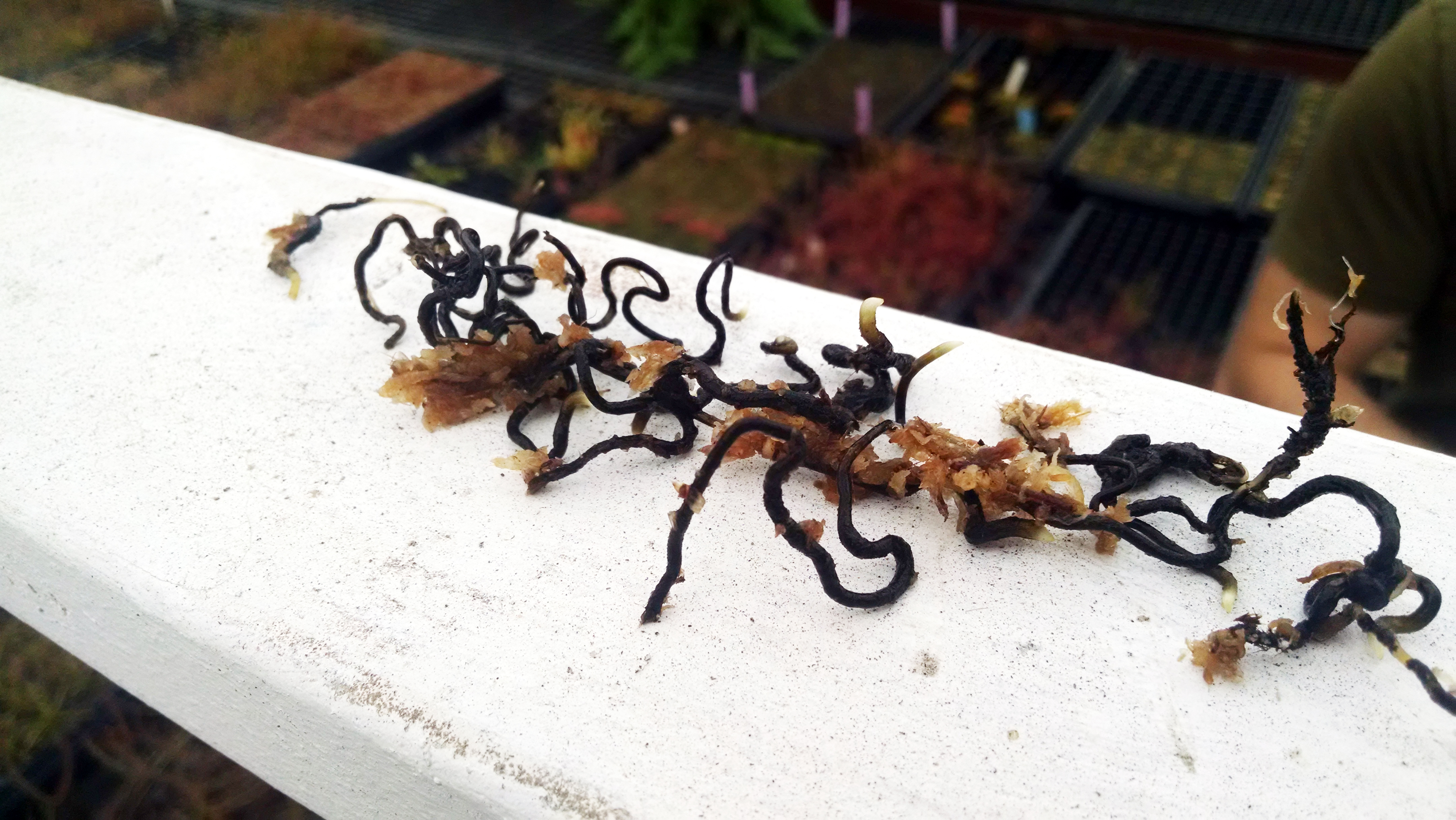
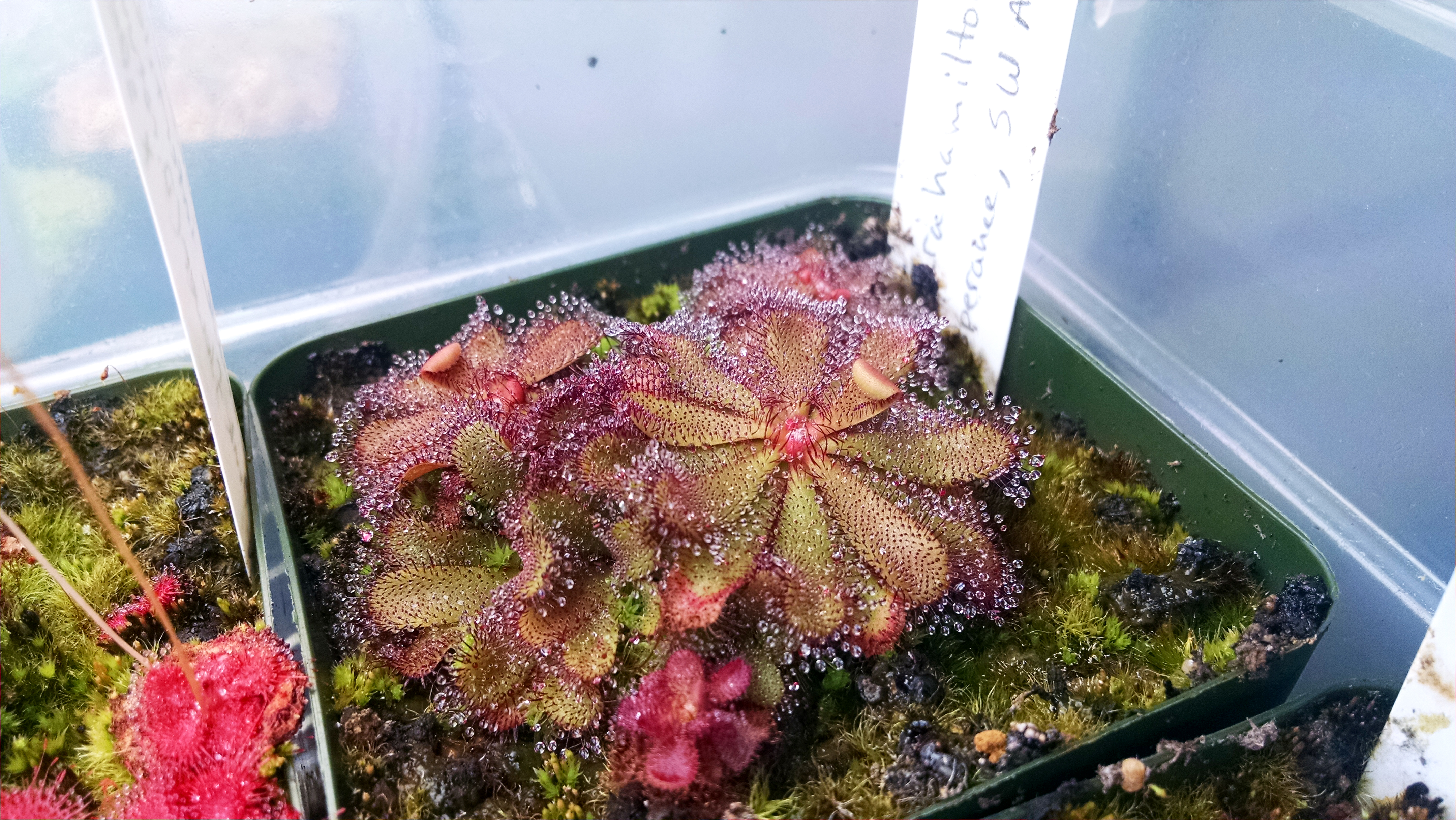
Towards the end of the day Josh was planting up some Drosera hamiltonii to a larger tray. For every plant he repotted he got a root cutting to start a new one. It's a very efficient system.

Drosera hamiltonii root cuttings.
Those are some good-looking roots.
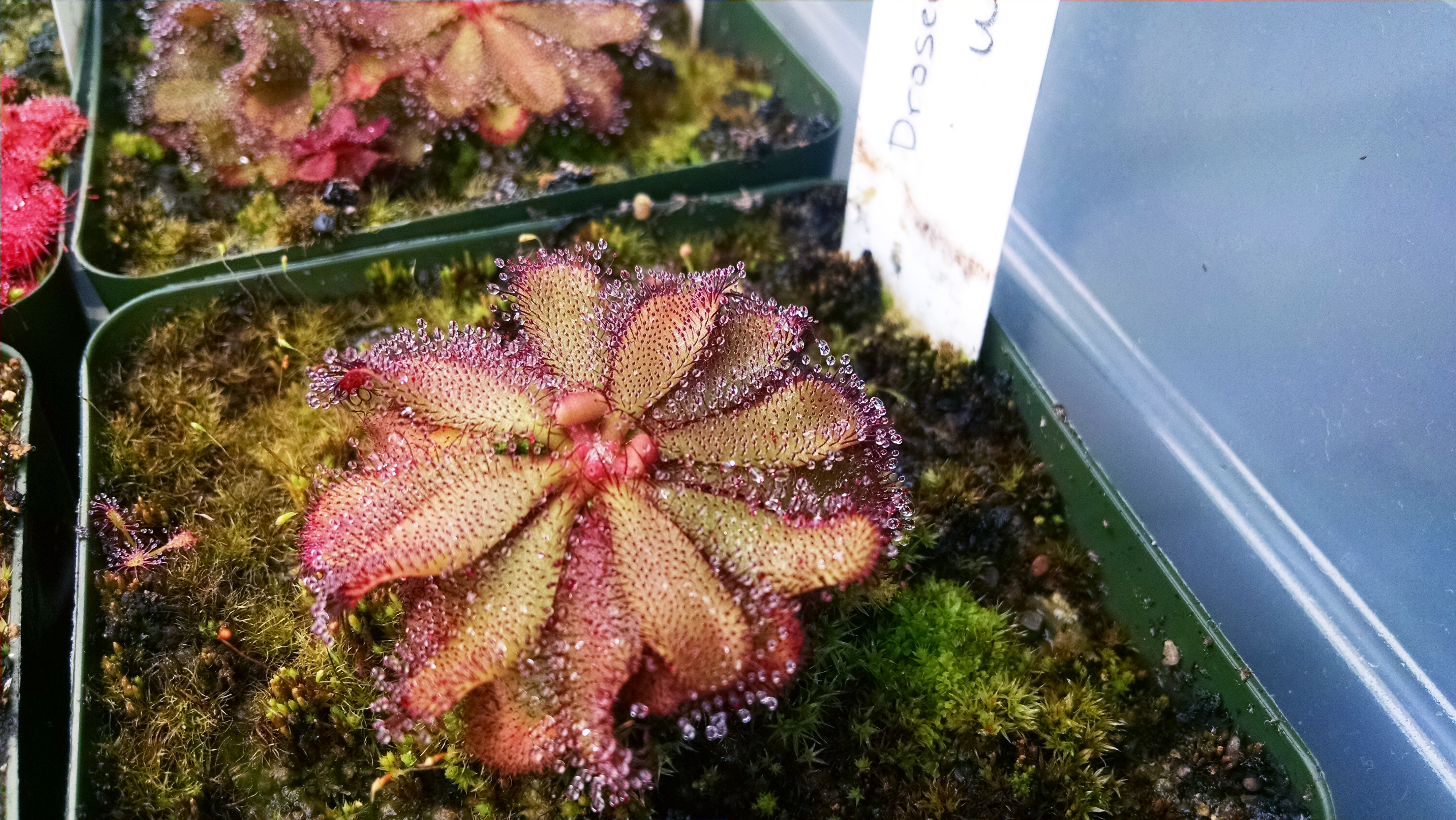
Seeing all those D. hamiltonii made me want to check in on my own when I got home. They're looking great!

Drosera hamiltonii.
Dew like crazy.
Drosera hamiltonii.
I love seeing the new leaves unfurling.
This is definitely one of those species where the less you mess with them the better they look. I think I spotted a root or two creeping into the tray though. I should get some propagation going. Look at those plants!

Saturday, March 7, 2015

Sundews Etc. one year in

One year ago today I made my first post here on the blog, about my blooming Drosera capillaris.

Drosera capillaris.
D. capillaris, 3-7-2014, from Flowers and D. capillaris "Alabama".
Things were so much simpler back then.

Here are some Fun Facts about the Sundews Etc. blog:
  • Around 17% of my traffic comes from Ukraine. Thanks for tuning in, Ukrainian growers!
  • Both of my Grower Interviews are among my top 10 most popular posts. I guess I should do some more.
  • Based on the labels (to the right) I talk about Drosera burmannii more than any other species (big surprise), but pygmy sundews as a group are a close second.
  • There are just shy of 1100 photos of carnivorous plants on this blog for 153 posts, around 7 per post on average.
Now, let's look back at some old posts and see how far we've come.

March

Dionaea muscipula.
Dionaea muscipula, 3-12-2014, from Things are growing!
April 

Drosera scorpioides
Drosera scorpioides, 4-3-2014, from Pygmies and D. adelae.
May

Drosera 'Marston Dragon'
Drosera 'Marston Dragon', 5-26-2014, from The Housefly and the Dragon.
June

Drosera allantostigma.
Drosera allantostigma, 6-20-2014, from I really love Drosera allantostigma.
July

Drosera capensis 'Albino'
Drosera capensis 'Albino', 7-4-2014, from Repotting a few sundews.
August

Drosera helodes and Drosera allantostigma.
Drosera helodes and Drosera allantostigma, 8-26-2014, from Checking in on various plants.
September

Drosera adelae
Drosera adelae. 9-11-2014, from Drosera adelae is offset crazy.
October

Sarracenia leucophylla
Praying mantis and Sarracenia leucophylla, 10-25-2014, from A thief among the Sarracenia.
November

Pinguicula laueana × emarginata
Pinguicula laueana × emarginata. 11-21-2014, from Pinguicula roundup, November 2014.
December

Utricularia calycifida.
Utricularia calycifida flower, 12-6-2014, from A few new blooms.
January

Drosera ultramafica × spatulata
Drosera ultramafica × spatulata, 1-27-2015, from Some progress shots.
February

Drosera venusta
Drosera venusta, 2-9-2015, from Random pictures of pretty sundews.

Finally, here are a few more posts I noticed looking through the archives that might be of interest to newer reader.
And of course, there are Plant Profiles, Cultivation Guides, and Grower Interviews on my Blog Series page.

Thank you all for reading – sharing pictures and talking about my plants with fellow growers makes everything a lot more fun. Here's to another good year!

Friday, March 6, 2015

Various goings-on

The other day I decided to try another of the aphid-busting treatments I've seen mentioned: immersion in water to drown the little bugs. I submerged Drosera burmannii and Drosera ultramafica × spatulata in distilled water for 2 days, and then brought them back out into the quarantine tray.

Drosera burmannii and Drosera ultramafica × spatulata post soak.
Looking messy post-soak.
They look a bit bedraggled, but hopefully that will have killed all the aphids themselves. There may still be eggs in the soil, so I really need to unpot these things and pot them up again fresh. I've heard that Neem oil can be effective against the pests in the soil, but that's another task. Let's give it some time to figure stuff out.

There's also something weird in my Drosera scorpioides pot.

Drosera scorpioides with gemmae.
These plants look hilarious like this.
Besides looking like hilarious aliens from the gemmae, those mounds of peat are very confusing. My friend Anne suggested it might be ants in the pot, and I really hope she's wrong. For the moment, however, I haven't seen any ants walking around, nor have I seen mealies or aphids that they sometimes start farming. I'll have to handle this pot to get at those last few gemmae, and then we'll see.

In more straight-up positive news, my Drosera helodes are flowering, having fully recovered from their gemmae-making.

Drosera helodes with flower bud.
D. helodes is bouncing back quickly.
I sowed some of those gemmae on a sand-topped pot but those plants are still quite young. Looking forward to seeing the flowers on these.

Out back the Sarracenia continue to go crazy. Here's Sarracenia ×formosa (which is S. psittacina × minor) with a flower bud and 2 new pitchers developing.

Sarracenia ×formosa.
The specific epithet is no mistake, this is a beautiful plant.
I got this plant from Meadowview back at the end of August, and it was breathtaking when I unwrapped it and potted it up. It looked a bit dazed in my conditions for a month and then died back, so I'm really excited to see it now that it's all situated.

Finally, the first new growth is coming up on my old Sarracenia minor as well.

Sarracenia minor.
Little baby pitcher.
This is an exceedingly handsome plant when it's in full growth, and the pitchers from last fall are still around looking good. Can't wait to see the new flush!

Wednesday, December 24, 2014

Gemmae explosion

Happy Christmas Eve everyone! It's wintertime and my pygmies going nuts on their gemmae. Pretty much every mature species in my collection is producing gemmae, and some are really going overboard with it. It's like they've caught the Christmas spirit.

My original Drosera allantostigma is crammed full.

Drosera allantostigma with gemmae.
This is definitely too many gemmae to count.
The pot I got from Brie is looking a bit messy since I've been using it to demonstrate what gemmae are to people.

Drosera allantostigma with gemmae.
Getting gemmae everywhere.
The Drosera scorpioides I started from gemmae myself are just getting started.

Drosera scorpioides with gemmae.
These D. scorpioides are so lovely and dewy.
While the ones I got at the spring BACPS meeting are going bananas.

Drosera scorpioides with gemmae.
Packed in like grapeshot.
I believe I see gemmae even on my long-suffering Drosera pygmaea. I need to bring it forward in the tray so I can look at it more easily.

Drosera pygmaea with gemmae, hopefully.
Maybe after this my D. pygmaea will finally settle in.
The Drosera helodes look almost ready to harvest.

Drosera helodes with gemmae.
These D. helodes look like they're about to explode.
There are a couple forming on the stem-forming Drosera dichrosepala.

Drosera dichrosepala with gemmae.
That one in the back is just getting started.
While the closely-related Drosera enodes appears to just barely be getting started. Beautiful plants though!

Drosera enodes with gemmae.
The colors on these plants have been fantastic lately.
And finally, the most festive of them all, Drosera callistos.

Drosera callistos with gemmae.
Little Christmas wreaths!
Happy growing everyone. I hope your pygmies are doing just as well. And if you don't have any pygmies yet, keep an eye out on the blog – I'm going to have lots of gemmae to get rid of soon.