Showing posts with label Drosera admirabilis. Show all posts

Sunday, August 10, 2014

Repotting follow-up, 5 weeks later

A bit over a month ago I decided it was high time to repot a few sundews, specifically the Drosera intermedia 'Cuba' and Drosera capensis 'Albino' seedlings I'd started around Christmas, and the Drosera admirabilis I'd picked up at the 2014 BACPS Show and Sale. I also decided to finally risk splitting my Drosera capillaris which was cycling back and forth between looking gorgeous and ragged in its growing clump.

The biggest challenge, definitely, was the D. intermedia 'Cuba', which were small plants with delicate roots. It didn't help how windy it was the day I decided to do the repotting. Here are my two main pots, which is where I put the 10 largest plants.
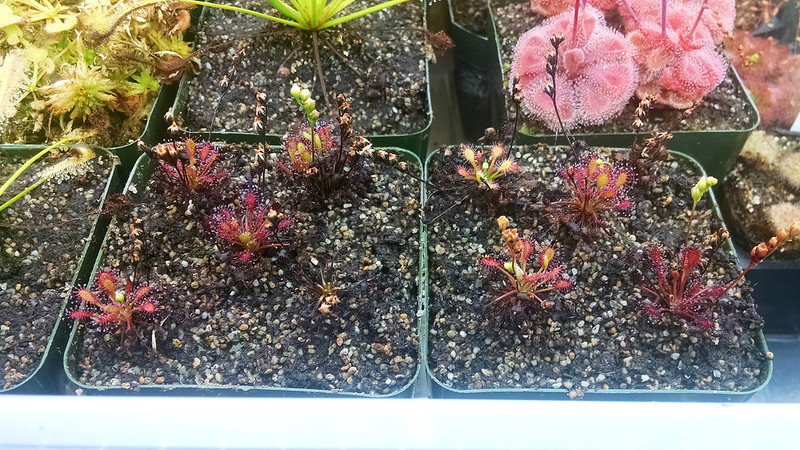
Drosera intermedia 'Cuba', mostly successful.
A couple plants suffered a bit of setback, but over all these were very successful!
Pretty good success rate! I definitely lost the plant in the back right. It's all dead. The one in the bottom right-hand corner of the left pot is a bit more up in the air: there is green at the growth point, and little unopened leaves. It may just be holding back before getting back to decent growth.

The third pot, which is where all the smaller plants ended up, fared much more poorly.
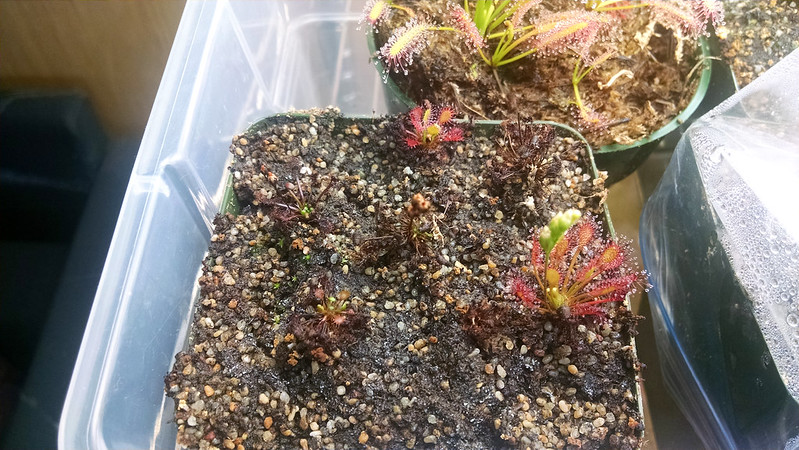
Drosera intermedia 'Cuba', many failures.
The third D. intermedia 'Cuba' pot, with many losses.
As you can see, a couple plants on the left of the pot still have green at the crowns, but overall these were much less successful. That's not surprising though, since they were all on the smaller side to begin with. D. intermedia 'Cuba' has pretty fine roots, and I'm sure some of these plants suffered root damage and died as a result.

The D. capensis 'Albino' on the other hand have large, thick roots, and they didn't really even blink when they got repotted. In fact, the largest plant started to bloom immediately after repotting, and the next 2 down in size have followed suit in the last week.
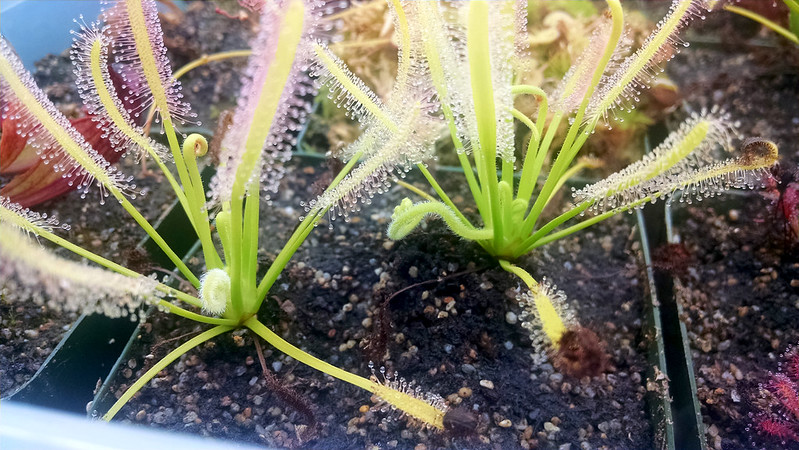
Drosera capensis 'Albino' with new bloom stalks.
Look at the fuzzy little flower stalks.
Large Drosera capensis 'Albino'
What a big nice plant! It's a pleasure to look at.
The smaller plants, which I left in the old pot, didn't even notice any change at all, and they've put on some nice size.
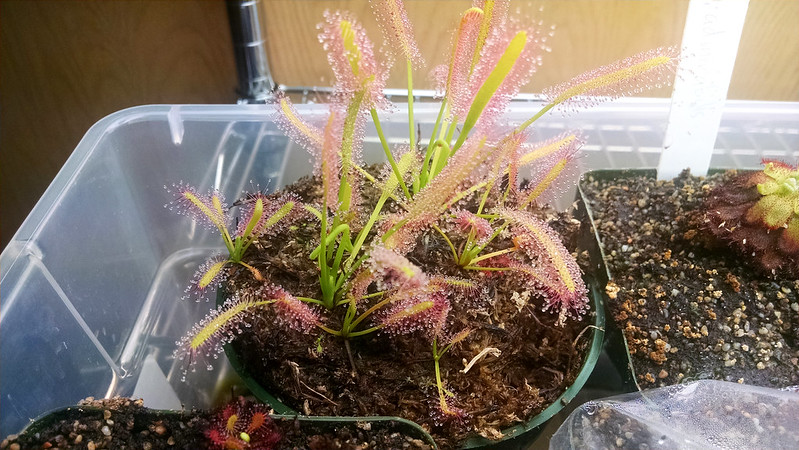
Drosera capensis seedlings ready to be repotted.
You're next little dudes.
It's almost time to pot these guys out themselves! Well, I'm going to be setting up a friend from work with a small growing area, so I'll probably give him one.

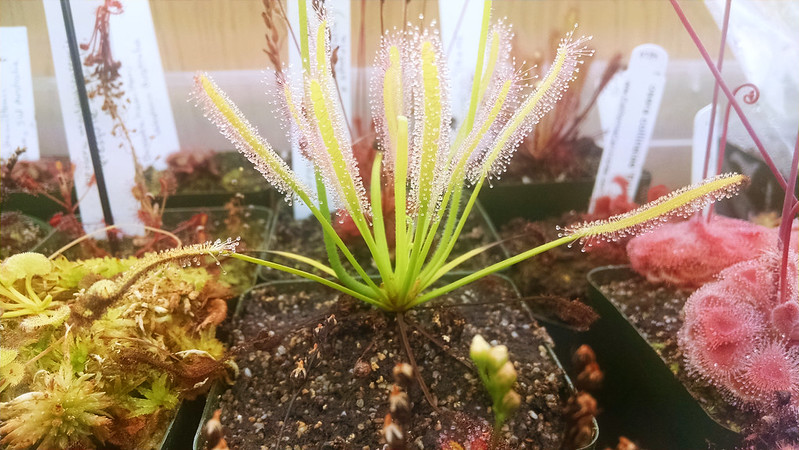
The D. admirabilis also had a pretty solid root, although it was confined to a small pot. I potted it up to give it more room.
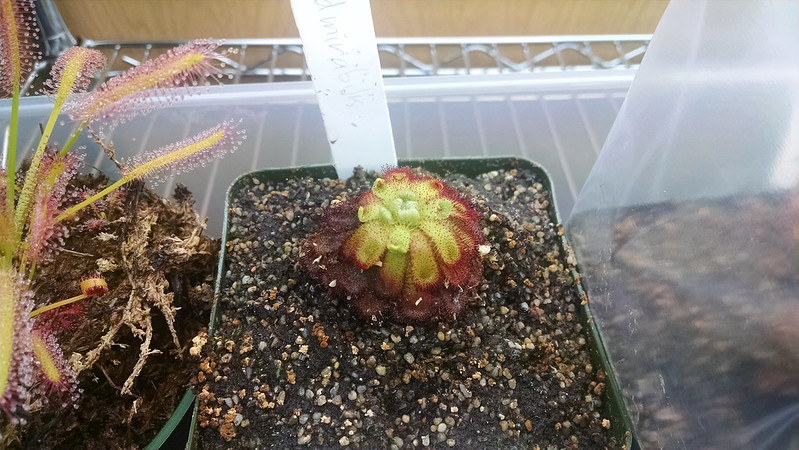
Drosera admirabilis.
Hopefully the plant will settle in and adjust to my conditions well.
Leaf size has diminished significantly. That's almost certainly partly a response to increased light intensity. I also think it's probably suffered a bit of heat stress, since there was a period of fairly warm weather shortly after repotting. I expect it to settle in in the next couple months, much as my Drosera aliciae has done (its leaves shrunk initially as well).

Separating the clump of D. capillaris was almost as hard as repotting a million tiny D. intermedia 'Cuba'. It turns out there were three plants in there, 2 of which were still pretty firmly attached. The largest plant I set out by itself.
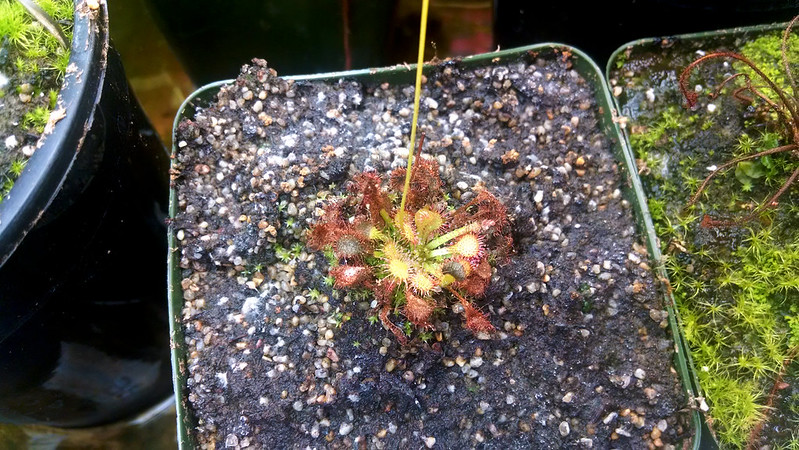
Drosera capillaris, somewhat set back.
I wish I'd used a humidity tent! Still doing okay I guess.
This plant had a good set of roots and separated cleanly, so I just planted it out and didn't do anything special. As you can see, it suffered a pretty big setback from the experience. For a while I thought I might lose it, but it all of those leaves are new growth and I'm pretty sanguine about its future.

The other two plants lost some root and looked ratty in general, so I put them under a bag for boosted humidity. That was definitely the right choice, since now they're doing great! I'm now wishing I'd done the same for the first plant.
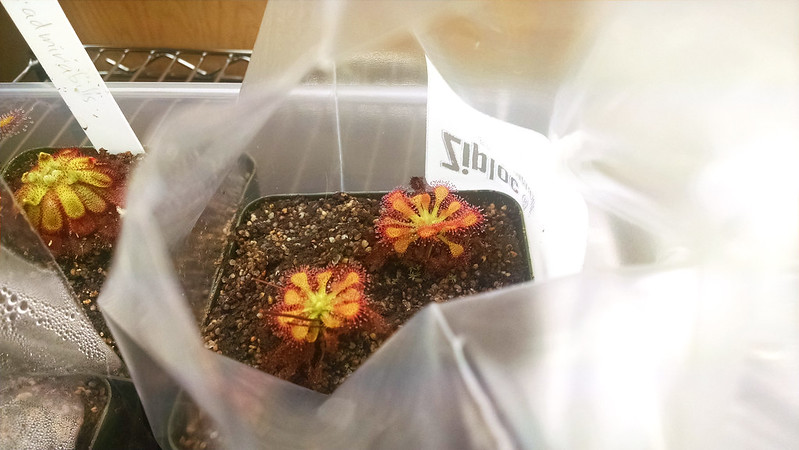
Drosera capillaris in humidity tent.
But these guys are doing great! That's what the tent is for.
It's mostly just a fairly full schedule that keeps me from finishing hardening them off. They're both at a much more advanced stage of recovery than the plant which was simply placed in the tray.

So what have I learned from this round of repotting?
  • First, D. capensis varieties are really vigorous and a pleasure to work with. That almost goes without saying though.
  • Second, humidity tents work really well to boost recovery. I think I could have saved some of the D. intermedia 'Cuba' I lost if I'd used a tent with them. I recently received a small sundew in the mail and used a tent, and it's looking great. 
  • Also, don't repot in the wind. The windiness just made it too unpleasant, and I rushed through things. I also think it stressed the plants more than necessary.
  • Finally, I learned to be much more careful when sowing seed. This was early on in my collection, so I didn't really know how to work with sundew seed or what the germination rate would be. Now I'd be much more careful to space everything out more.

As I said though, I think this was all pretty successful. I certainly learned a lot, and that makes anything better!

Friday, July 4, 2014

Repotting a few sundews

Yesterday I took on one of my big tasks – repotting a couple sundews that desperately needed it. There are still more to work on, of course, but there are always more.

I chose a terrible time to go repotting. It's relatively windy near my house, and I was out around 7 pm, which is right when the wind really kicks up heading toward sundown. The plants didn't like it, my LFS was blowing all over the place, it sucked. I also don't really have a nice repotting area, which is something I've been meaning to put together. In any case, I certainly didn't get any pictures of the process. Suffice to say it was messy and a bit stressful (I'm always worried about damaging the roots, especially since these weren't species with big robust roots), but I'm glad I got it done.

First up were my Drosera capensis 'Albino'. They'd been getting packed pretty tightly in there, especially the largest plant. Looking great though.

Drosera capensis 'Albino'
I love that delicate pink color on the tentacles. And that dew!
Unfortunately these were planted in that terrible Mosser Lee LFS, which made separating the plants out more difficult, since sometimes it was hard to tell the roots from the moss fibers. Still, with a bit of wiggling I was able to separate off the 3 biggest plants and get them into new pots. The remaining plants I left in the old media to size up a bit more before getting transplanted.

Drosera capensis 'Albino' in a fresh pot.
This is definitely a mature, full-sized plant now. Not bad in just under 7 months.
Pair of Drosera capensis 'Albino'
These two are a bit smaller, but still looking good.
Drosera capensis plantlets in cheap terrible moss.
I don't want to have to worry about separating these out until they're a bit bigger.
I can't wait until I'm done with that terrible Mosser Lee stuff.

I also repotted my Drosera intermedia 'Cuba', which was distinctly more difficult than the D. capensis 'Albino'. The D. intermedia 'Cuba' were smaller, with more delicate roots, and packed in more densely. Again, I had to struggle with the moss.

Drosera intermedia 'Cuba', freshly-repotted.
These 10 largest plants look pretty good. Hopefully feeding will be easier now.
Small Drosera intermedia 'Cuba' plantlets after repotting.
The small plants look more ragged. They should bounce back soon though.
I think I lost one of the bigger plants in the top photo, and one of the smaller ones down below, but the rest seem to be doing fine a day later.

Dealing with the roots is the fiddliest part of the process definitely. I clean off as much of the old media as I can, and then poke a hole in the new media with either my finger or a toothpick, depending on how large the root system is, and then work the roots down into the hole. I then pack the media down onto the roots and usually add a bit more at the base of the plant to make it sturdy. It's worked pretty well so far.

The most difficult repotting I had to do was my Drosera capillaris, because that also required separating the clump. One plant came off easily, and was planted up quickly, but the other two were quite closely joined. I had to clip off a lot of dead leaves and do a bit of prying to separate them. One of the resultant plants ended up without much in the way of roots, and the other was small and sort of sickly-looking, so I potted them up together and put them under a humidity tent to give them a head start. I also clipped off their flower stalks so they didn't waste energy making seed instead of setting new roots.

Freshly-separated Drosera capillaris.
I hope the leaves can spread out a bit more now.
Drosera capillaris in post-separation high-humidity recuperation.
Good luck little dudes.
The last plant I repotted was the Drosera admirabilis I bought at the BACPS Show and Sale. I've heard D. admirabilis likes to have lots of room for a big root system, and also likes to be out of the water, so I decided to give it something bigger than the pot it came in. This was an easy job compared to the others.

Drosera admirabilis in a new pot.
I'm happy to finally have a D. admirabilis.
I can't say I really enjoyed repotting, but I'm certainly glad I got it done. I bet my plants are glad too!

Wednesday, July 2, 2014

BACPS 2014 Annual Show and Sale Part Two: Everything Else

In this post I'll share a few more photos from the recent Bay Area Carnivorous Plant Society Show and Sale. In part one I posted about the winners of the juried show.

The event was held at the Lake Merritt Garden Center (I didn't get pictures of the surroundings, so have a GIS). It was a really nice day out, but inside the garden center it was pretty warm and humid, being full of people and plants breathing all over each other. There was a really good turnout!

2014 BACPS Show and Sale sales floor.
Lots of people buying plants! Sometimes it was too crowded to move around, which is great!
Most of the plants on offer were Nepenthes and Sarracenia – there was a decent, though not enormous, selection of sundews, and just a few pings. I think I saw a handful of Utricularia as well. I just ended up getting 3 plants, which I'll share at the end of this post.

Sarracenia for sale at the 2014 BACPS Show and Sale
Sarracenia everywhere.
Nepenthes for sale at the 2014 BACPS Show and Sale.
These were reasonably-priced plants, but some of the rarer offerings were hilariously pricey.
Almost makes me wish to be a Nepenthes grower – but not quite :-p

I also had a few more photos from the Show. Here's the Dish Garden table.

Dish Garden/Terrarium table
Such nice plantings.
My pictures of the ping and sundew tables were ruined by the light from the window. Oh well.

Nepenthes table
I wish I had recorded the identity of that big vining plant.
Nepenthes hamata at the 2014 BACPS Show and Sale.`
Hamatas! I think these were grown by Drew Martinez.
There were also loads of Sarracenia in the show. They took up a whole wall and then some!

Sarracenia at the 2014 BACPS Show and Sale.
I can't imagine having to judge all these Sarracenia.
As I said, I only got three plants at the show –  two pygmies, Drosera callistos and Drosera enodes Scotts River, and Drosera admirabilis.

Drosera callistos
These D. callistos will have big orange flowers. Cute!
Drosera enodes
I like stem-forming pygmies, like these D. enodes.
Drosera admirabilis
Finally a positively-identified D. admirabilis. Charming plant!
So much fun! I can't wait for next year.