Showing posts with label Utricularia livida. Show all posts

Friday, March 20, 2015

Utricularia longifolia putting on a show

It's been almost exactly a month since I first noticed a flower stalk on my Utricularia longifolia. Today is the first day with a fully open flower, and man is it pretty.

Utricularia longifolia flower.
Beautiful U. longifolia flower.
There are two stalks on the plant, and lots of buds forming.

Utricularia longifolia.
The stalk is 18 inches (~45 cm) tall!
Unfortunately, I'm dealing with a pretty serious aphid problem right now, and they keep finding their way onto these flower stalks. I've been spraying Take Down around my collection (on the recommendation of Damon Collingsworth at California Carnivores) and hopefully the aphids will get beaten back before they can do too much damage.

In the mean time though, let's look at other Utrics flowering in my collection, because Utricularia flowers are the coolest.

First up, Utricularia subulata and Utricularia calycifida from a recent post.

Utricularia subulata.
I like these U. subulata flowers more than the cleistogamous ones (obviously).
Utricularia calycifida.
U. calycifida looking elegant as usual.
Then a few from today – Utricularia livida, Utricularia bisquamata, and Utricularia sandersonii blue form.

Utricularia livida.
U. livida still blooming up a storm almost a year later.
Utricularia bisquamata.
U. bisquamata amongst the Drosera capensis red form (with a D. capensis 'Albino' weed as well).
Utricularia sandersonii blue form.
Angry bunnies and cleistogamous U. subulata flowers.
That U. sandersonii pot is a bit messy, but at least the angry bunnies are cute.

Thursday, October 30, 2014

Flower stalk on Utricularia calcyfida

I've got some action over in my Utricularia calycifida pot.

Utricularia calycifida with flower stalk.
U. calycifida is in section Foliosa. They have bigger "leaves".
Utricularia calycifida with flower stalk.
I like the little mound.
I really like this plant. It's been growing pretty solidly and spreading in the pot. Now it looks like I'm going to get a flower stalk!

I've been reading a bit about foliar fertilizing on Utricularia lately, and think maybe I should give it a shot. I feed my Drosera at least once a month, but my Utrics don't get any love. Maybe there would be even more blooming and spreading then.

Things are a little funny over in the Utricularia livida pot.

Utricularia livida.
Getting a little messy over here.
First of all there are those weird leaves that some people have suggested might be Utricularia tricolor. Secondly, the peat is all pushed up and furrowed. I don't really know why. Maybe I have earthworms in here? I don't know where they would have come from. The plants look pretty healthy anyway.

Finally, my Utricularia graminifolia is growing in again after I traded a couple chunks away.

Utricularia gramnifolia.
Sort of growing in. I should experiment with different methods with this plant.
I had this growing in a windowsill earlier, and I feel like it was going a bit faster then. It's under lights right now. I'll leave it for a couple more months and see if it really wants that filtered sunlight instead. I've read that natural light is important to get it to bloom. Who knows.

Utrics are weird.

Thursday, July 31, 2014

Funny leaf in U. livida pot

My Utricularia livida is one of my easiest and cutest plants. It just chills out, and has been blooming away for the last several months, although recently it's slowed down a bit.

Utricularia livida flowers.
The older flower stalks are getting a bit droopy. Still whimsical though!
Recently I noticed a weird leaf down in the pot. It doesn't look like any U. livida leaf I've ever seen before, but it definitely looks like a Utric.

Mystery leaf in Utricularia livida pot.
The mystery leaf!
If you look closely there's a second one near the top of the photo. This pot is one of my cleanest – there's no moss or algae to speak of, and nothing except U. livida growing here. Until now, I guess! I wonder what's up. It almost looks like Utricularia calcyfida, but my U. calcyfida has never gotten anywhere near this pot. Mysterious! Guess we'll see if anything else develops.

In other Utric news, I've got a little baby Utricularia biquamata flower in my Drosera callistos pot.

Utricularia bisquamata flower.
The very tiny and very weedy U. bisquamata.
These are so precious. I should set up a dedicated U. bisquamata pot.

Monday, June 9, 2014

Plant Profile: Utricularia livida

This is part of a series of posts describing my experiences with different species, their culture requirements, and photos of their growth in my collection. The full series can be read here, or by species at the Series page

 Utricularia livida is a perfect example of an easy, delightful plant.

Utricularia livida with several flower scapes.
U. livida blooms, looking adorable on 6-9-2014.
I've had my U. livida for about 3 months, when I bought a little plug from Natch Greyes' Carnivorous Plants. Natch reads the blog, and I think he'll be pleased to hear that he sent along an excellent little plant – it's been growing like gangbusters and the blooms are just as adorable as I could hope.

The humble beginnings of my Utricularia livida.
First new growth once I received the plant, 3-12-2014.
U. livida is a terrestrial Utricularia, and is also widely held to be a weed (though a charming one). For this reason it lives in its own little glass tray/container, with the pot sitting inside. This way I can keep it out of my sundews and other Utricularia, and give it free reign to delight me with little sprays of flowers and cute foliage.

Utricularia livida filling in the pot.
A month of growth, 4-11-2014.

Utricularia livida flower.
A taste of things to come, 4-11-2014.
It's also extremely, extremely easy to care for. I have it under my lights, but I'm sure it would grow just fine on a windowsill (my windowsills are just too narrow for plants, which is too bad). The soil is the standard carnivore peat and sand, and the water is distilled. While I got a couple flowers out of one of the old stalks it had been shipped with, the plant waited to make new flower stalks for about 6 weeks, during which time it focused on spreading throughout the pot.

Flower stalks forming on Utricularia livida.
My first new flower stalks, 4-30-2014.
One trick I read somewhere for terrestrial Utricularia is to periodically saturate the media to sort of simulate a fluctuating water level in a bog. What I do is let the water level drop to about an inch from the bottom of the pot, and then fill it back up to right level with the top of the media. It'll be really soggy for several days after that, and the plants seem to spread nicely afterward. My Utricularia sandersonii and Utricularia calcyfida also get this treatment, and respond well.

Many Utricularia livida flower stalks.
U. livida blooming for real now, 4-29-2014.
Of course, the flowers are the thing when it comes to Utricularia (for the most part). I'm not sure what caused my patch to start flowering – I've heard that different clones behave differently (this one is awesome). It gets a constant photoperiod and hasn't been around long enough to know any seasons here, so it's anyone's guess. I suspect that if you get some U. livida, give it decent light, and flood it periodically, you'll be rewarded with lots of adorable little blooms. I certainly have. Every carnivore grower should consider adding this cute little guy to their collection.

Utricularia livida flower close up.
The flowers are so cute up close. 6-9-2014.

The Breakdown
  • media: Peat and sand or pure peat work fine.
  • light: Doesn't need quite as much as a sundew. Great windowsill plant, or good placed a bit farther from the lights than the rest of the collection.
  • water: U. livida likes it wet. Keep it in a tray and flood it periodically if possible.
  • temperature: It probably shouldn't be allowed to freeze.
  • feeding: I've heard that terrestrial Utricularia can benefit from foliar feeding with something like MaxSea, but I have no experience in this. I've considered seeding my pot with some pond water to introduce little microorganisms but the plants haven't seemed to need it yet.
  • propagation: Once you grow a colony you can dig out patches of it and seed new pots. I've heard that Utricularia like to always be colonizing fresh media, so it might be a good idea to divide your Utrics periodically.

Thursday, May 29, 2014

Weeds

Every plant person deals with weeds. Usually the weeds are very different from the desirable plants – ask any cactus/agave person what they think about Oxalis, or anyone with acreage in the country about mustard. In the CP hobby there are plenty of mosses which give people more or less trouble, depending on the pot they're invading. There are also carnivorous weeds – plants that are either deliberately included in a collection, or which arrive unexpectedly in a trade, and then begin to travel around into other pots. Weeds make great plants for beginning growers, since by definition weeds hard hard to kill and adaptable to lots of different conditions.

Perhaps the classic CP weed is Drosera capensis (although a couple of terrestrial Utricularia give it a run for its money). D. capensis flowers extensively on long scapes, self-fertilizes, and produces thousands of seeds. Heretofore my D. capensis has produced seed and offsets, but I hadn't caught seedlings popping up unexpectedly. Until a week ago or so.

Drosera capensis surprise seedlings.
Lots of little tiny D. capensis (I think – they could be D. aliciae).
Luckily, this is all in the D. capensis pot. I think the seeds fell out when the stalk got knocked by the lights. I don't plan on feeding these seedlings, so we'll see how quickly they'll grow.

Terrestrial Utricularia make for great weeds, which is why I confine them to their own trays for the most part. While U. bisquamata and U. subulata are probably the most famous Utric weeds (check any Sarracenia pot at a nursery and there's a good chance you'll find some), U. livida is the most vigorous terrestrial Utric I currently grow. In the 2 or 3 months I've been growing it (check out this post from March) it has filled its pot and started blooming like crazy.

Utricularia livida filling the pot.
Look at this beautiful profusion of Utricularia. Such a neat-looking pot.
Utricularia livida flowers.
There are even more stalks coming up. Keeps on blooming!
If I put together a mixed bog you better bet I'll throw a couple U. livida chunks in there, but most of the plants in my collection are in single-species pots, so I like to keep things separate for the time being.

I recently acquired a weedy Ping – Pinguicula lusitanica is a small, self-fertile, freely blooming Pinguicula that apparently likes to travel around a greenhouse. I just got a flower stalk on my biggest plant!

Pinguicula lusitanica with flower stalk.
I now have two Pings, on totally different size scales.
That's always how it starts. These are supposed to be short-lived annuals, going from seed to bloom in a matter of months. Sounds fun!

Drosera brevifolia is a not-dissimilar sundew weed – it's tiny, bloomy, potentially annual (although I've gotten the impression they can last a few seasons with consistently favorable conditions), and cute.

Drosera brevifolia blooming.
The frontmost 'dew already has a 3rd stalk coming up. Good job, little plant.
I'm gonna try harvesting some of this seed soon, so I can re-sow and get a big colony going. Sundews look great in colonies.

Are there any weeds in your collection that you're particularly fond of? Do any give you problems?

Friday, May 16, 2014

A couple more flowers

I feel like all I've been posting about lately has been flowers, but I guess that's okay.

First off, my Utricularia sandersonii blue form has fully matured and is a full-on angry bunny.

Utricularia sandersonii blue form flower.
Look at that little bunny glaring at you.
Utricularia sandersonii blue form close up.
Such an elaborate little flower on this Utric.
Utricularia sandersonii blue form flower showing spur.
The spur is even better now.
The Utricularia livida next door is also just getting started with its show, which promises to make for a cheery couple weeks under the lights.

Utricularia livida, starting to bloom.
Those flower scapes are really silly.
Also, excitement of excitements, the Drosera helodes I only recently received from Brie popped its flower open today, and it is lovely.

Drosera helodes in bloom.
I was so delighted when I wandered over to the tray today.
Drosera helodes flower up close.
My roommate was quite taken with the little dots, as am I.
Those little dots are just the sweetest thing, and the plant looks so proud of its little bloom.

I also noticed the first flower stalk on my Drosera burmannii.

Drosera burmannii, beginning to flower.
Surprisingly, the first one to bloom is by no means the largest.
This is quite exciting, as I can sow D. burmannii along with my others once I get my propagation area started. This sundew should be in everyone's collection!

Interestingly, my largest specimen has lost a great deal of its striking red color. I'm not sure exactly why – it still looks fantastic, but I really do wish it was still that brilliant red. I'm going to move it very close to the lights soon, to see if really high light intensity (and somewhat higher temperatures) can stress it nicely. Still looks great though.

Drosera burmannii, almost 6 months old.
I bet this plant could eat a June bug if one happened by.
So dewy!

Wednesday, May 14, 2014

Utricularia sandersonii "blue" flower

It looks like my U. sandersonii from Natch Greyes beat out my U. livida for the privilege of bearing my first (proper) terrestrial Utric flower.

Utricularia sandersonii blue form flower.
I had to take the pot out of its glass bowl for this shot. Such a tiny flower.
It's a tiny little flower, but is super cute up close.

Utricularia sandersonii blue form flower close up.
This flower is looking bashful for its beauty shot.
As you can see, it's not quite mature yet – the distinctive "bunny ears" on top haven't unfolded yet.

Utricularia sandersonii blue form flower close up.
Check out that awesome spur!
It does have this great spur though. Utrics really do have elaborate, orchid-like flowers, just in miniature! At least the terrestrials are miniature.

Just a couple weeks behind, but my U. livida is getting ready for what looks like the first of (hopefully) many mass flowerings.

Utricularia livida ready to bloom.
I'm expecting a big show of blooms any time now.
I'm really excited for the flowers to start popping open – so far I count 6 scapes. Gonna be really cute!

My Drosera 'Marston Dragon' is also blooming rather impressively.

Drosera binata 'Marston Dragon' flower stalk.
I like how this plant supports multiple blooms at once.
It's too bad that the buds are all right at the height of the lights, so I don't get to see them as often as I like. It's still quite cute.

The second flower has also opened on my Pinguicula gigantea.

Two Pinguicula gigantea flowers in the tray.
The Ping flower stalks flex up and down over the course of the day. I wish I could film it.
Pretty sure these are the cheeriest blooms in my whole collection. I believe one can self-pollinate P. gigantea, and if so I should get on that. This is such a cute little butterwort.


I'll keep the blog updated with any new Utric flowers.

Monday, May 5, 2014

A new toy

I got myself something fun this weekend.

My new 30x loupe.
My new loupe – it was actually the display model, which is why the case is scuffed. Still works great!
It's a 30x loupe, which I got for $10 at the Bone Room, a morbid curiosity shop in Berkeley. I decided to use it tonight to take some low-budget macro shots. The results were mixed, but sort of fun. I also got a 65x mini handheld microscope thing as well, but there's no way I'll be able to use that with my phone camera. I think I first saw someone use a loupe this way on Terra Forums, but I can't remember who it was, alas.

Drosera burmannii close up.
Drosera burmannii leaf, which has gotten less intensely red following re-potting.
Drosera pygmaea close up.
Drosera pygmaea, one of my NASC acquisitions.
Utricularia livida scape close up.
Utricularia livida scape. This will probably be more interesting in a couple weeks when the flowers are open.
Sphagnum moss and Drosera brevifolia close up.
Sphagnum moss with Drosera brevifolia. I like the contrasting colors.
The pictures are pretty fun at least

Wednesday, April 30, 2014

Terrestrial Utricularia

Utricularia are the most widespread and diverse of all carnivorous plants, even more so than Drosera. Also known as bladderworts, for their bladder-like traps (which are worth reading about on Wikipedia, though I won't go into it here), they are typically grown in cultivation not for the traps (which are usually hard to see) or their foliage (which ranges from "almost invisible" to "somewhat interesting"), but for their flowers. The most impressive species are from section Orchidioides, which are – alas – among the more difficult to grow. However, even the easy (and sometimes weedy) terrestrial Utricularia can have charming displays of flowers. I like to grow them because they're peculiar and a little offbeat, and I can dream about a nice big bloom show to share with people someday.
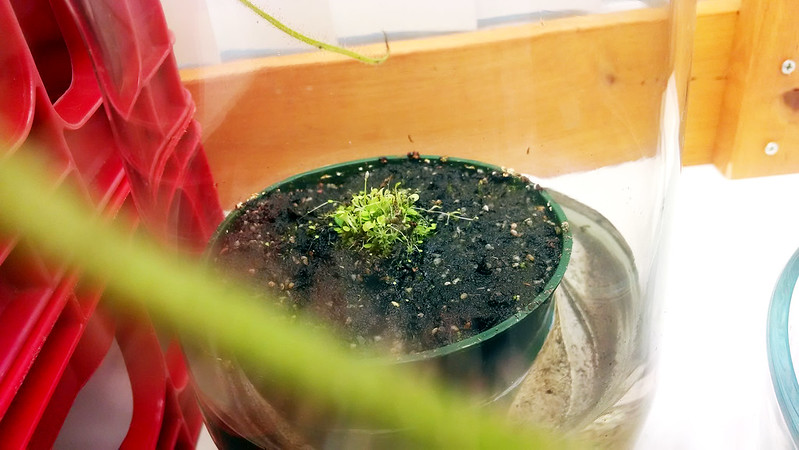
Utricularia sandersonii, blue form
A small but healthy plug of U. sandersonii blue.
This is Utricularia sandersonii, the blue-flowering variety. U. sandersonii are sometimes referred to as "angry bunnies" because of the shape of their flowers. I bought this chunk from Natch Greyes a couple months ago, and it has held steady and shown some slight growth. The U. livida I got at the same time is doing great, but this is just fine. I'm sure it'll take off eventually.
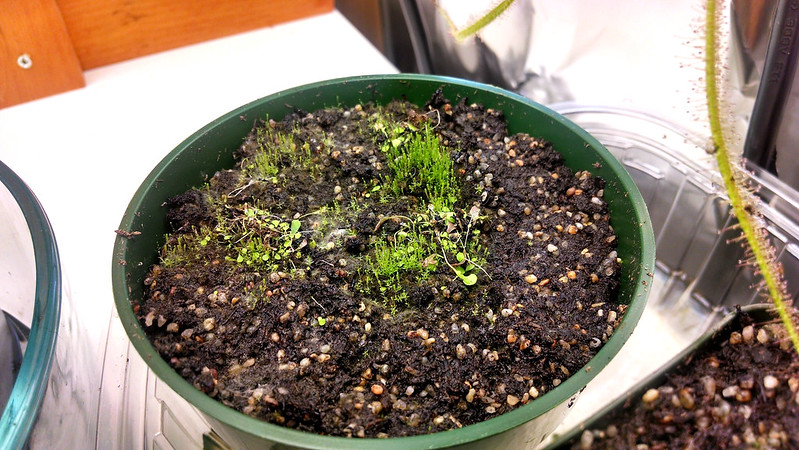
Utricularia sandersonii, typical form
Typical U. sandersonii bouncing back from a rough time in transit.
This typical form of U. sandersonii I got in a giveaway over at Terra Forums. I think it sat in my garage for a day or two because no one told me it had been delivered, so it was a bit more beat up than the blue form. It's got some new growth, and also has plenty of mosses growing to keep it company (heh).
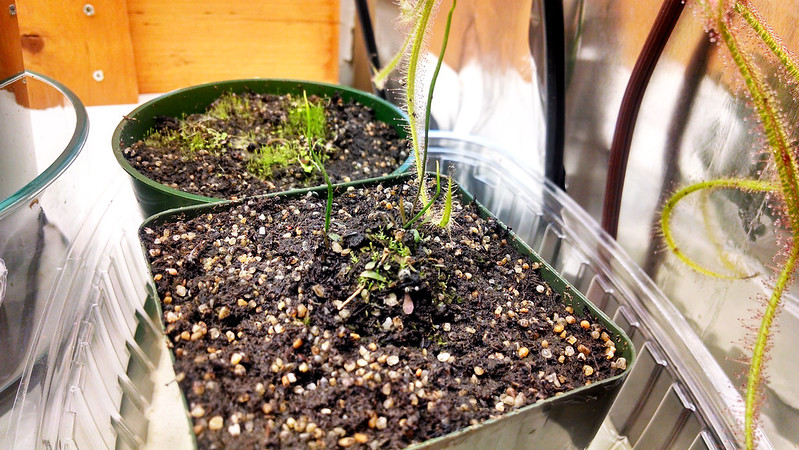
Utricularia praelonga
The peculiar leaves of U. praelonga are cool, although apparently it's difficult to get to flower.
Utricularia praelonga is an odd species that produces two kinds of leaves – the typical terrestrial utric leaves, as seen on the U. sandersonii and U. livida, and also long, grass-like leaves. This one I received in a trade for a couple of my D. burmannii seedlings.
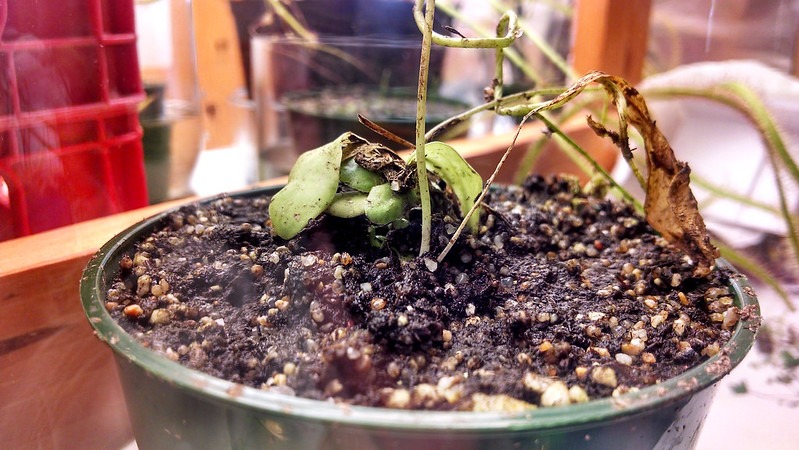
Utricularia calycifida
U. calycifida looking a bit beat up from shipping.
My newest Utric is U. calycifida, which I received in the NASC auction (I still need to make a post about those plants, now that they've all arrived). It's still recovering from shipping, but is a very nice specimen. U. calcyfida has largish leaves and long flower stalks, when you can convince it to bloom. Very much looking forward to it settling in.

My Utricularia livida is the only one I've posted about before, on account of it having popped out a bloom on one of its old stalks. Here's that stalk now, with two tiny flowers.
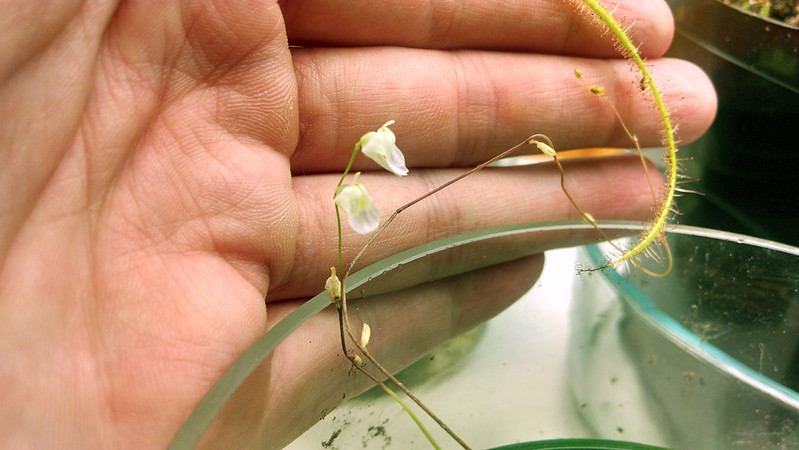
Utricularia livida flowers.
Itty bitty U. livida flowers.
But the really exciting thing is clear when you look much closer.

Utricularia livida with new flower stalks.
Someday I want a healthy carpet of foliage and full stand of flower stalks from this U. livida.
Three new scapes coming up! It's also really filling up the pot, which is great. This is supposed to be a very weedy species, which is fine, since it's in its own container. That just means it will fill out better. Really looking forward to seeing these develop further.

Speaking of containers, here's a shot of where I grow my Utrics.
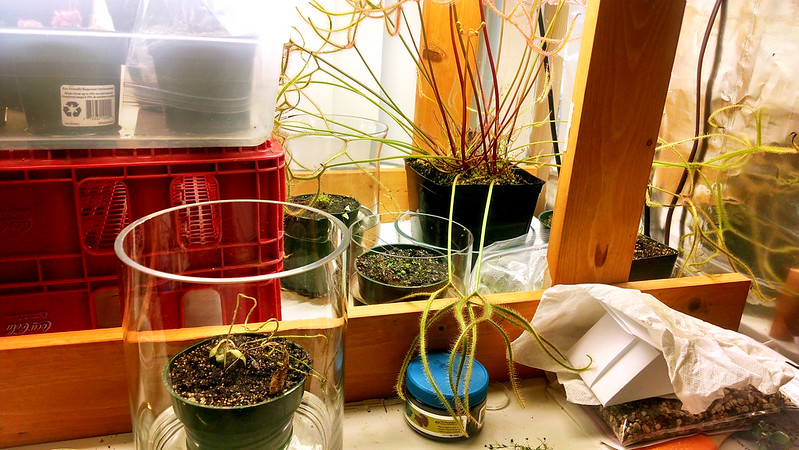
Utricularia growing area.
My (somewhat messy) terrestrial Utricularia area.
As you can see, there are individual glass containers for each specimen (almost – the U. praelonga and U. sandersonii typical are bunking together right now). This is somewhat inefficient in terms of space, but it keeps them from infesting other pots, and will make for handsome displays once they start blooming (it's important to think positive). Also these glass things can be found for cheap if you keep an eye open.

On a final note, my Sarracenia are developing nicely, and originally I'd hoped to post about them today. However, the gods of photography frowned on my attempts to get decent closeup shots (the camera software on my phone is terrible), so all I have is one peek at Sarracenia minor. It's getting there!
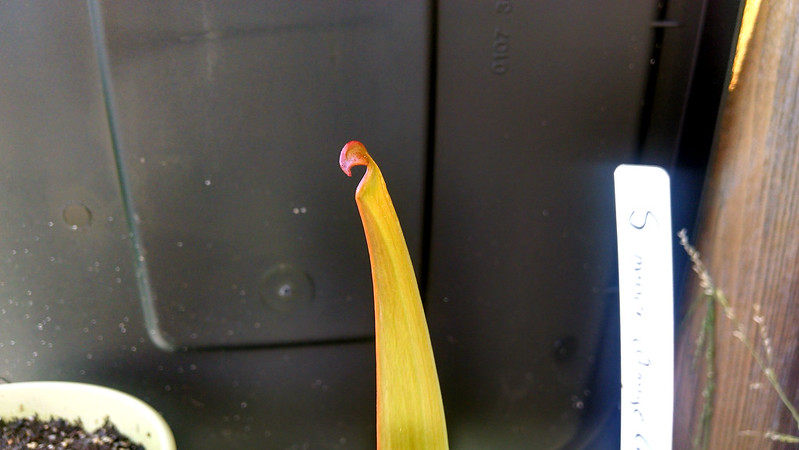
Sarracenia minor pitcher almost developed.
S. minor with some decent coloration going. Looking forward to seeing full pitchers!
The S. flava and S. leucophylla each have pitchers almost 18 inches tall right now, but we'll have to wait for different conditions to get a photo.

Alright. It's extremely hot now, and my bedroom gets afternoon sun. I'm going to retreat to the garage, which stays cool, and read a book. I hope my D. spiralis can handle a couple days of heat before the temperature drop this weekend.