Showing posts with label Drosera burmannii. Show all posts

Sunday, July 31, 2016

Big news at Sundews Etc. HQ

Hi everybody, this post is mostly about me, rather than the plants, which is not what I usually like to post about. Don't worry though, I've got some pictures of some of my plants to spruce things up!

First of all, I'm about to head to the ICPS Conference in London! I'm very excited to go meet other weird obsessives from around the globe.

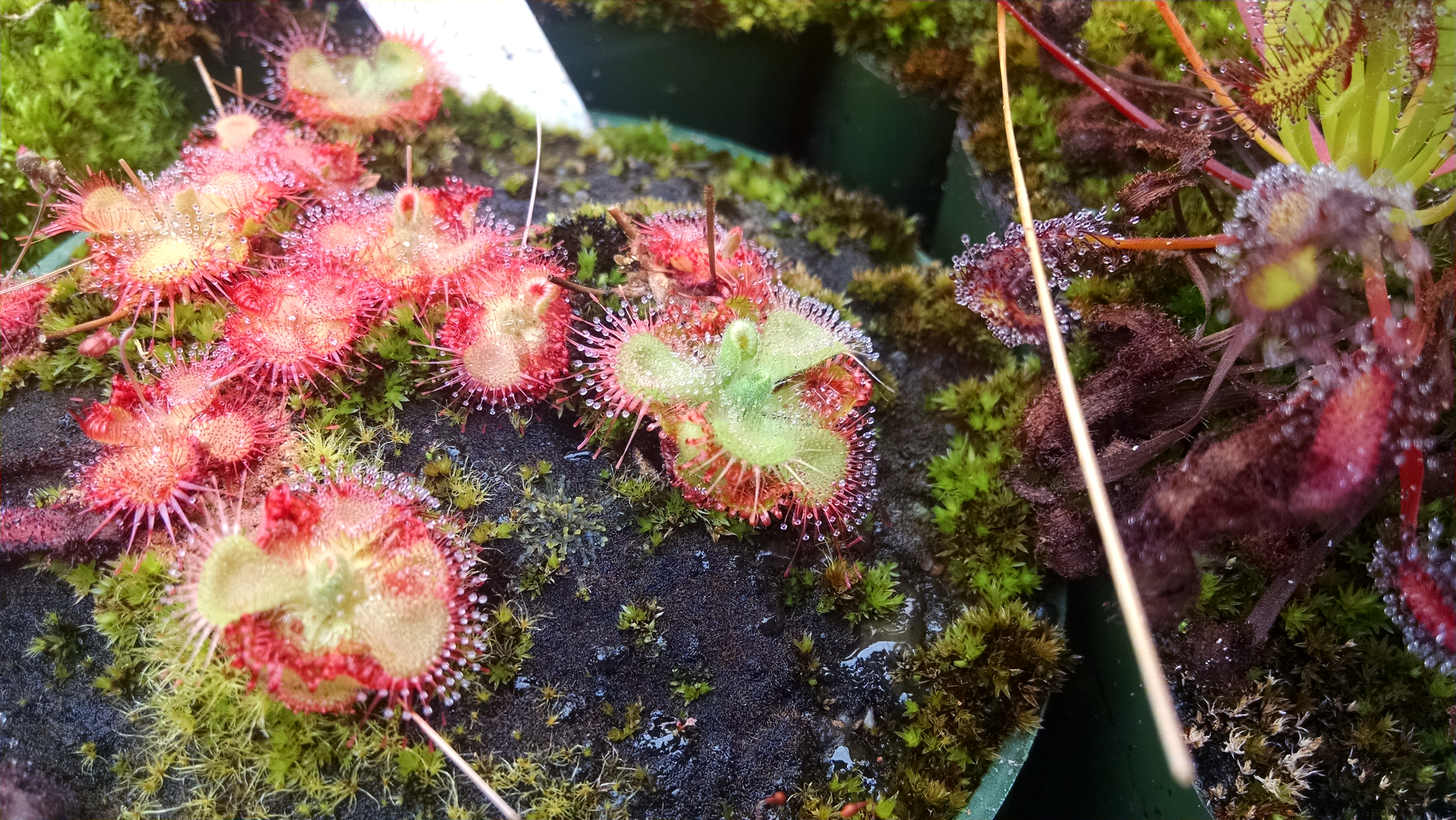
Drosera graomogolensis.
The Drosera graomogolensis look rad as heck right now.
I'll be in London next weekend for the conference, and then my girlfriend and I are going to spend a week in Germany futzing about for the hell of it. I'm quite excited, and will make sure to take pictures/video of the event. My great dream is a selfie with Sir David Attenborough, but we'll have to see.

The second bit of news is a bit bigger, and is part of the reason that I've been posting somewhat less frequently in the last several months. I'm now a carnivorous plant professional working at Predatory Plants!

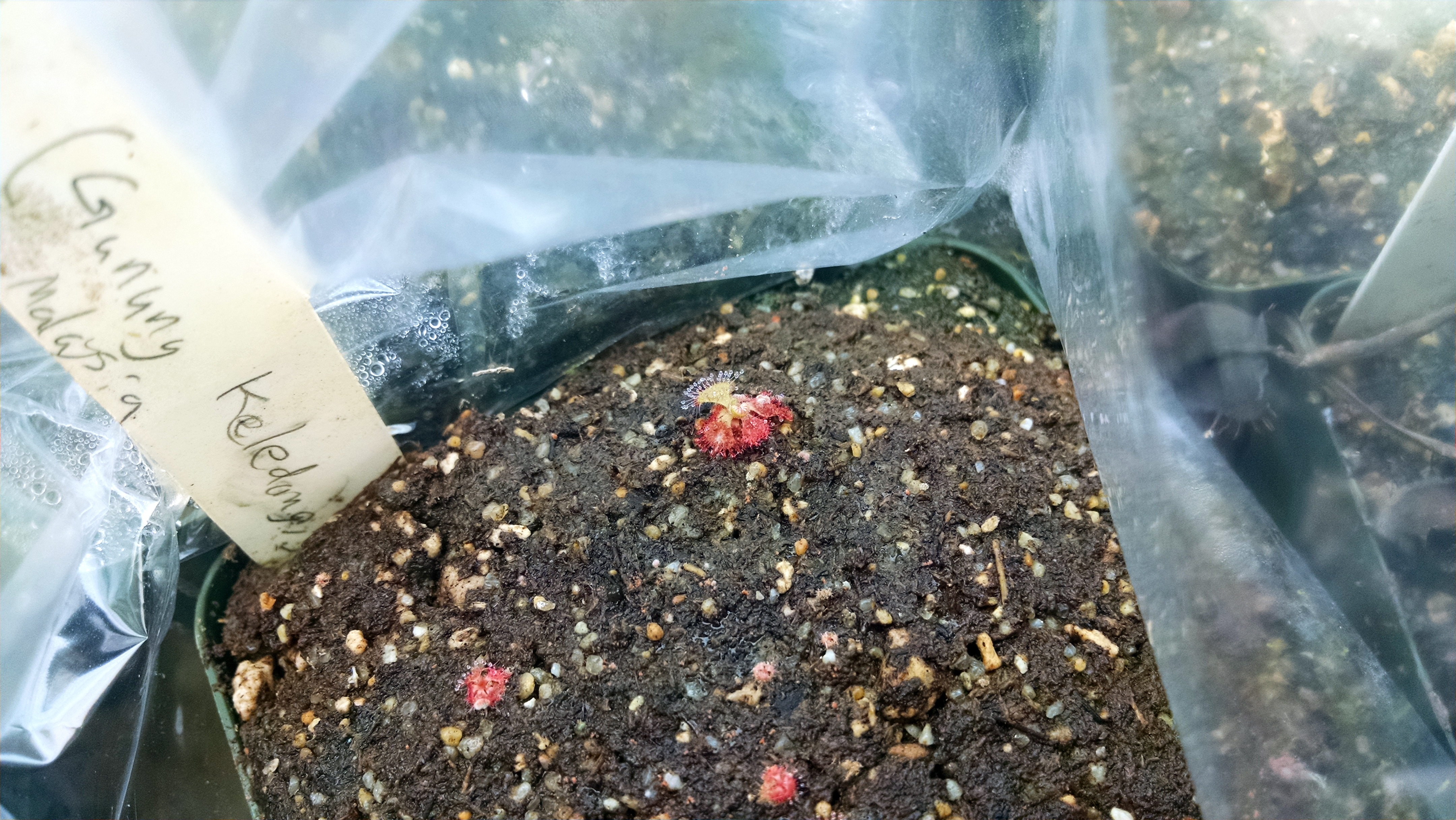
Drosera burmannii Gunung Keledang.
Drosera burmannii Gunung Keledang look very alien and cool.
Specifically, I'm the Director of Retail Operations, which means I do online order fulfillment, work the plant show circuit, and do propagation and greenhouse work whenever I can find a spare second. Basically I now think about plants all day long, almost to the exclusion of other concerns. It's very exciting – and very, very unexpected – to have begun something of a career in carnivorous plants, especially considering I bought my first Drosera capensis less than 3 years ago.

Utricularia praelong flowers.
Utricularia praelonga still blooming up a storm.
In point of fact, I've been working at Predatory Plants since November. At first it was part time (after I left my last job), and then it became full time, but it wasn't clear that it would be a permanent position. Luckily, things have been going quite well in expanding the business, and well here we are. My family is deeply confused about what my life has become.

Drosera adelae giant.
This is Drosera adelae Giant form, and it's actually genuinely giant. Wow!
What does this mean for the blog and Instagram? Well, I might not post quite as often, if only because after a long day in a hot greenhouse I can barely manage to keep my personal plants watered, much less documented and blogged about. However, now that everything's all official I'll be able to post about work stuff as well, some of which is quite cool. I'm still trading and selling my own seeds and gemmae, but I may occasionally post links to fun stuff that we're selling on our website.

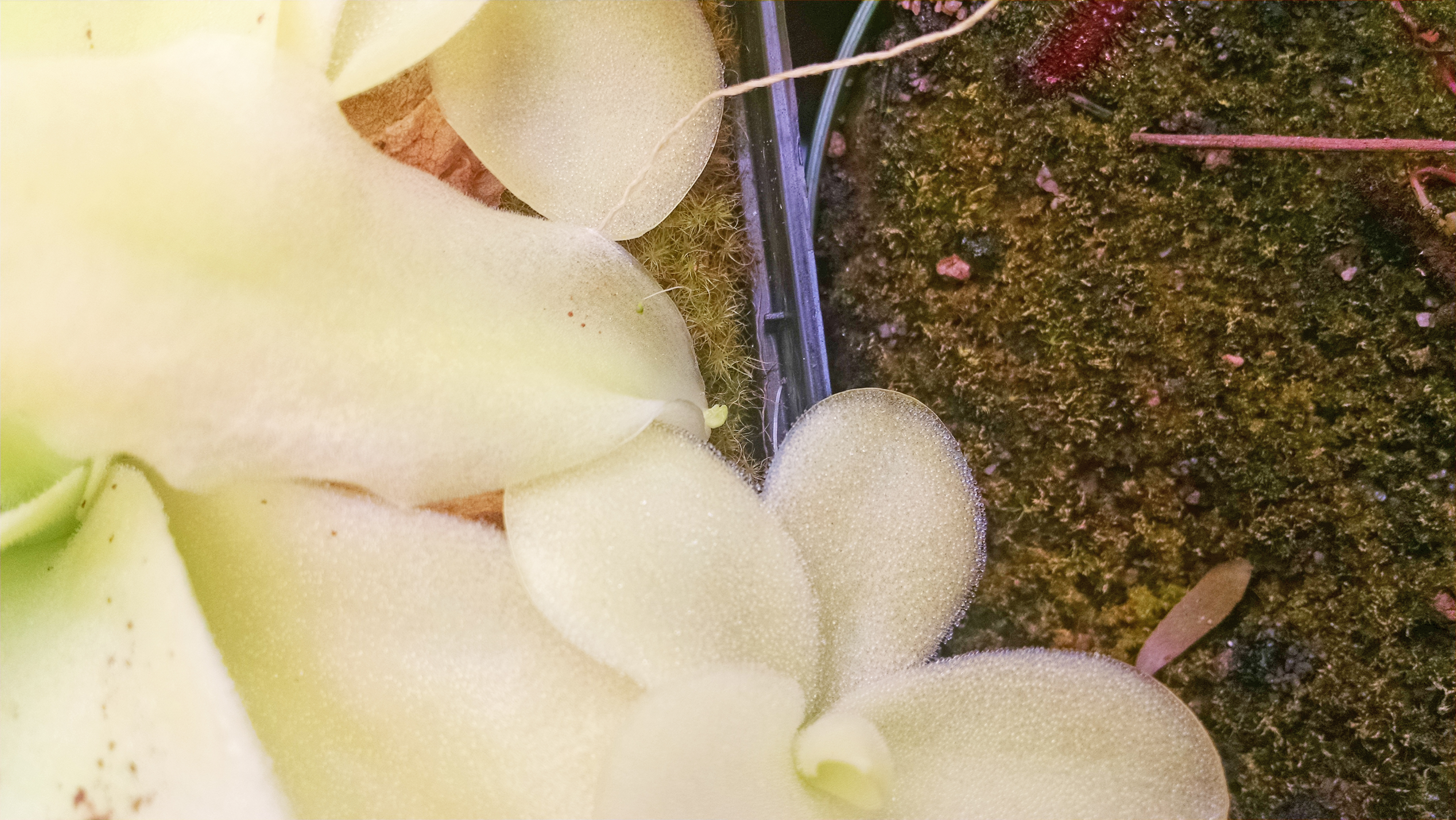
Pinguicula gypsicola × moctezumae in flower.
The unspeakably adorable Pinguicula gypsicola × moctezumae at work.
Thanks to all of you who read the blog, and who have commented and emailed about how much you enjoy it. I had been in a bit of a post-college slump/depression for a bit when I started collecting sundews, and then started blogging about it. It really got me out of my funk, and now it's gotten me a very strange and fun job. Life is very weird and cool! So are carnivorous plants, I guess.

Wednesday, June 22, 2016

Mostly about flowering

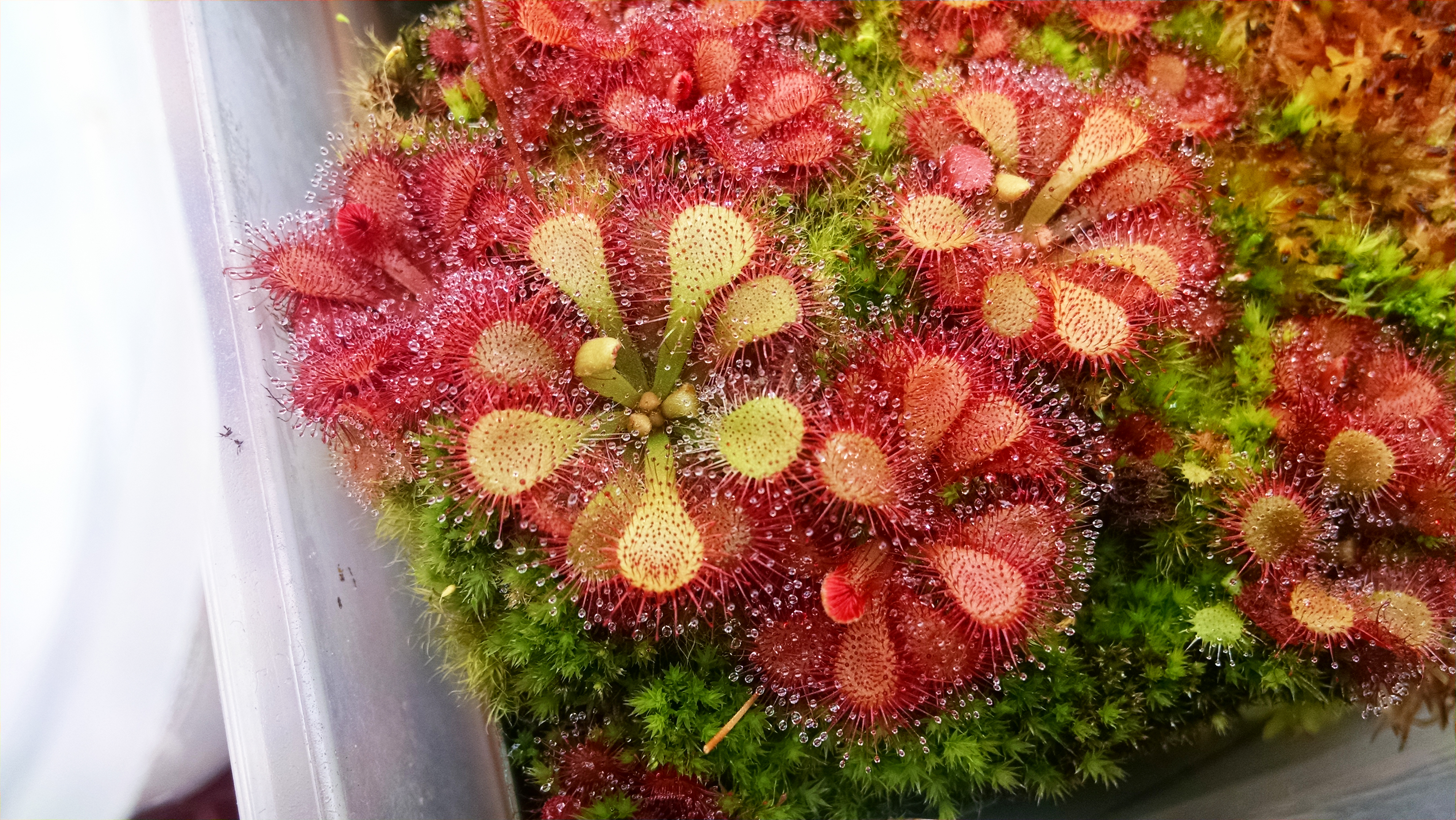
This is what comes of letting your Drosera burmannii flower without concomitant feeding.

Drosera burmannii "Hann River".
This is the "Hann River" form, incidentally.
They're quite fallen off from where they were even in March. I think this phenomenon is why people insist that D. burmannii is an annual even though it demonstrably is not – the effort required to not let it bloom itself to death is tiresome, so it ends up dying. I've got to admire its drive to reproduce I guess.

What it needs to do is what this Drosera scorpioides has done and catch some serious prey.

Drosera scorpioides.
Look at this big shiny fly!
Incidentally, this species has never flowered for me. I love seeing small plants catch large prey though, it's always delightful.

This Pinguicula gypsicola × moctezumae has a really nice color to it.

Pinguicula gypsicola × moctezumae.
So pink and pretty!
This pot is really a mess. You can't really tell in the picture, but there are like 6 species and 3 genera in here. Oof.

I love the look of this flower stalk on Pinguicula rotundiflora × hemiepiphytica.

Pinguicula rotundiflora × hemiepiphytica.
This is much too cute.
New ping flowers always look so bashful. Never flowered this one before, so I'm excited!

Nearby my Drosera aliciae is not doing well.

Drosera aliciae.
Just chill out man.
This is one of my first carnivores, and it's been trying in vain to get off a flower stalk for months and months. They all end up aborting, and the plant looks pretty bad now. I can't figure out why it doesn't just chill out about the whole thing. Oh well.

My first Utricularia praelonga flower petal has dropped and it looks pretty cool.

Utricularia praelonga petal.
It's a pretty good-sized flower for a utric.
This probably happened an hour or two before I took this picture, since it's still very fresh and well-shaped. I like how utric flowers just drop as a mass, it's very funny. I'm really getting into Utricularia lately, which is like the most niche part of an already niche hobby. But check out this flower stalk!

Utricularia praelonga flower stalk.
Growing plants is so much fun.
It's almost 18 inches high, and has these bright yellow flowers. That's pretty cool man! I think so at least.

Wednesday, March 23, 2016

Why does D. burmannii get caterpillars?

My pot of Drosera burmannii (Gunung Keledang) has been looking sketchy lately.

Drosera burmannii (Gunung Keledang)
Pest-chewed plants always look so sad.
In fact, it's sketchy in a way that I remember. It's a lot like what my old competition pot of D. burmannii (Humpty Doo) looked like when it had a caterpillar. I even noticed some things that look like droppings on the plants. When I realized there was probably a caterpillar somewhere I dug around in the dead leaves at the base of the plants but I couldn't find anything. Anne recommended I just use some Bayer 3-in-1 on it, since the plants don't mind, and the bugs definitely do. Hope it works.

It's probably just coincidence that two separate pots of D. burmannii got a caterpillar. Maybe the shape of the plant is attractive for them. It sucks! I don't want to lose this culture before I get seed!

My nearby pot of the Hann River form is looking ridiculous right now.

Drosera burmannii (Hann River)
It's a really shocking red.
This form gets so red that it messes up my camera. I can't really get pictures of it to turn out right when it looks like this. Also I recently trimmed all the flower stalks, so it's looking funny.

My other form of D. burmannii is from Humpty Doo, and these two volunteers are the final remainders of my once-prized culture.

Drosera burmannii (Humpty Doo)
You can do it little guys.
I should start a fresh pot of these. This is all I have left! After aphids, caterpillars, and bloom-out I guess that's what happens. Still, they can be really amazing when grown well.

Drosera burmannii (Humpty Doo)
Lovely pom-pom.
Memories!

Wednesday, January 13, 2016

Assorted plant stuff

One can't always have a nice themed post. This is one of those times.

My Pinguicula laueana × emarginata is blooming again.

Pinguicula laueana × emarginata flower.
Lovely flower of P. laueana × emarginata.
This has got a really pretty flower. It's interesting, I've only ever flowered this plant, my Pinguicula gigantea, and my Pinguicula emarginata. I don't know what triggers flowering in pings. I've got several that I think are big enough to flower, but they just haven't.

In pygmy news, there are finally gemmae forming on my Drosera scorpioides.

Drosera scorpioides with gemmae.
D. scorpioides gemmae is quite the hot item.
I think I'm going to need to start a new pot of these guys or risk losing these to attrition. Should get a good crop though, last year I had a lot.


The Drosera barbigera look funny and squashed with their gemmae.

Drosera barbigera with gemmae.
Funny smooshed plants.
Such nice color this time of year too.

Drosera burmannii (Gunung Keledang) is growing in, and isn't quite as red as it was before.

Drosera burmannii Gunung Keledang.
One can never have enough Drosera burmannii.
I quite like this form, especially if it maintains that green leaf, red tentacle coloration. It's taken well to feeding.

My Byblis liniflora continues to be lovely, and continues to be impossible to photograph.

Byblis liniflora.
This plant is very dream-like.
I feel like this would need to be in a black box with bright diffused light to photograph well. Has anyone out there managed to get a good picture of B. liniflora? I'd love tips.

Finally, I haven't posted about Pinguicula rotundiflora lately, but it is way too cute.

Pinguicula rotundiflora.
Look at those cute little leaf margins!
Now this is a plant that I want to flower. Luckily this one is pretty easy to propagate, as evidenced by all the babies in the pot. Maybe I can have a whole bunch in flower together. That would be adorable.

So I guess that's what's up around here.

Monday, November 23, 2015

Plants pulling through

Here's a silly story:

A few weeks ago I was rearranging my collection and I took my small pot of Pinguicula gigantea × moctezumae out of its tray and set it on top of my shelves. In the dark. In a dry tray. Over two weeks later I was walking to my car, looked in the little window in my garage door, and noticed my plant. I rushed back inside, and put it in a proper tray, in the water, under the lights.

It's totally fine.

Pinguicula moctezumae × gigantea.
There's even a leaf pull that struck in this time.
It's barely even etiolated. This pot was in the dark for over 2 weeks. The soil was bone-dry and rock hard. And a couple days later you can't even tell. This is an offset from a plant that my friend Anne got when she was 11, and is the only carnivore she never managed to kill. Great plant!

Another plant that's getting over a rough patch is my Drosera 'Emerald's Envy'.

Drosera capillaris 'Emerald's Envy.'
One of my favorites! Glad it's coming back.
This plant bloomed hard, sending up two flower stalks in quick succession (from which I was able to harvest a healthy amount of seed). Right then we had our last heat wave of the summer, and I think the combination just stressed it out. It had sat around with no traps, just petioles, for over a month, but now it's getting back to business. I've been feeding the new traps in order to give it a good burst of energy.

I've also begun to re-hydrate my Drosera cistiflora pot.

Drosera cistiflora...hopefully.
Fingers crossed!
We'll see if I'm successful with it. My tuberous pots aren't showing any sign of life so far, but I'm still holding out hope. This one as well – it went to sleep late, so it didn't get a particularly long dormancy. We'll see!

On the other side of things, my Drosera brevifolia have germinated!

Drosera brevifolia seedlings.
There are at least 4 seedlings in this pot. Try and spot them!
I noticed (and took this picture) a few days ago, and given the size of the seedlings I'd say they probably germinated sometime in early November. That means it took something like 18 weeks from when I sowed them back in late July. Don't give up on your seeds too quickly! Now I'm just waiting on those red Drosera filiformis.

The nearby Drosera burmannii (Gunung Keledang) have had a bit of a head start, and one in particular is looking excellent.

Drosera burmannii (Gunung Keledang) seedlings.
Loving that color combination.
I should finish hardening these off and get some serious feeding started.

The last set of seed is the one I'm most excited about, Drosera tomentosa.

Drosera tomentosa seedlings.
Now they just need to out-compete the moss.
I hope this is one of the forms with extravagantly fuzzy flower stalks. They're so cute! I'm trying to find South American sundews right now, btw, and would be happy to trade for plants, roots, leaf cuttings, or seed. Email me at sundews.etc@gmail.com!

Finally, it's that time of year again. I've spotted the first gemmae of the season! These are Drosera leucoblasta.

Drosera leucoblasta showing gemmae.
The first gemmae forming is the real sign of autumn.
Pygmies are my favorite, as I've said before. And since I already mentioned trading earlier in this post, I might as well say that I'd love to do gemmae swaps with all comers this season. Here is my current list of pygmies:

D. allantostigma
D. barbigera
D. callistos
, Brookton large form
D. × Carbarup
D. dichrosepala
D.
× Dork's Pink
D. enodes (Scotts River)
D. grievei
D. helodes
D. leucoblasta
(Brookton)
D. leucostigma
D. mannii
D. nitidula
D. occidentalis
var. microscapa
D. omissa, pink flower
D. oreopodion
D. palacea
, giant form
D. patens
D. pulchella
, orange flower
D. pygmaea
D. roseana
D. sargentii
D. silvicola
D. scorpioides
, pink flower
D. spilos

And these are the plants I'm looking for this season! The ones in bold are the ones I'm most excited about.

D. androsacea
D. citrina
D. closterostigma
D. echinoblastus
D. eneabba

D. gibsonii
D. hyperostigma
D. lasiantha
D. microscapa
D. miniata
D. nivea
D. parvula
D. pedicellaris
D. platystigma
D. pycnoblasta
D. rechingeri
D. sewelliae
D. stelliflora
D. walyunga


I love trading! Feel free to hit me up to trade whenever.

Tuesday, November 3, 2015

It's really good to feed your sundews

I've been very good about feeding my sundews lately. I've been able to give a number of them good solid feedings, and am planning on doing more going forward. One of the good things about feeding is that it really increases seed production. When I really got into growing sundews I wanted to get a decent stock of seed available to sell, since finding seed to buy was difficult when I first started collecting. I should be updating my sales page with additional seeds soon.

One of my favorite species to feed is always Drosera burmannii, since they always respond so dramatically to being fed.

Drosera burmannii Gunung Keledang.
You go little guy!
Check out that brand new leaf on D. burmannii (Gunung Keledang). This is the first feeding for these seedlings. Should be able to do even more feeding soon.

These D. burmannii (Hann River) flowered out a bunch, so they were really in need of a feeding.

Drosera burmannii Hann River.
Nice new growth everywhere.
All the pale leaves are new growth from feeding. That one plant on the left of the picture is what happens if you let D. burmannii flower out without feeding – they sort of melt away by blooming themselves to death. Whoops!

The closely-related Drosera sessilifolia is almost as enthusiastic about feeding as is D. burmannii.

Drosera sessilifolia.
I love me some Drosera Subg. Thelocalyx.
I still need to see if heavy feeding can get these guys to size up. I haven't yet met Fernando's challenge.

Drosera natalensis tan up really well when they're not fed, but it's fun seeing the color contrast after a round of new growth.

Drosera natalensis.
So dewy!
This is a very nice, low-maintenance pot of plants. It just sort of does its thing, which is great.

I've also fed my pings, and been pretty good about taking pullings lately. Look at this brand new baby Pinguicula gigantea.

Pinguicula gigantea.
Soon I'll be propagating pings properly, just you watch.
The other plantlets in the pot are only 6 months old, and they're already pretty big. Pings are really fun to propagate.

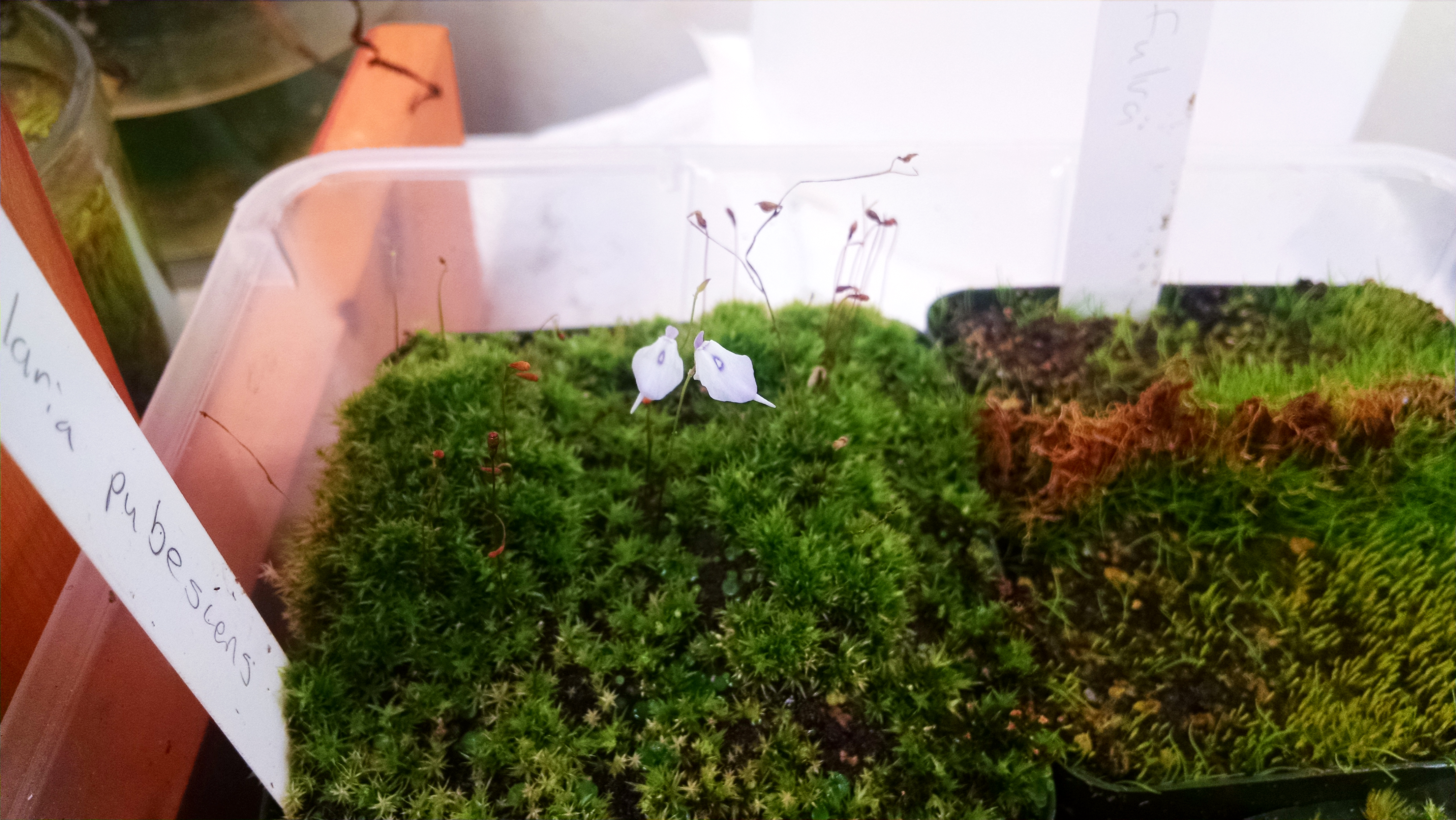
Finally, the one group of plants I never have to think about are my Utricularia, especially the terrestrial species. Generally you just need to leave them alone, keep them wet, and let them colonize the media. Then eventually you should get some flowers.

Utricularia pubescens.
One of my favorite species of Utricularia, easy.
Utricularia pubescens! Funny little flowers and weird "leaves" (utrics don't technically have leaves as such). Unfortunately it's really hard to take a picture of the leaves, but there's a great picture on this page of Barry Rice's Carnivorous Plant FAQ. I wish this pot wasn't quite so mossy, but I certainly don't mind the flowers!

Tuesday, October 27, 2015

Seedlings and more

Back in July or so (I'd have to check the tags to be sure, but that seems right) I started some seed of a few different species. Currently two have germinated – Drosera burmannii (no surprise there) and Drosera tomentosa (that one's a bit surprising). The seedlings are putting on some size.

Drosera burmannii Gunung Keledang seedlings.
It's been a while since I've had D. burmannii seedlings. I like them this size!
Drosera tomentosa seedlings.
New South American species! I want some more SA 'dews.
The D. burmannii is a form from Gunung Keledang in Malaysia. We'll see if it varies at all from the Australian forms I currently grow. At this point I'm most interested in finding a persistently green form of D. burmannii. The D. tomentosa seed I received in a trade forever ago and finally sowed, and I'm pleased I've gotten plants out of it. I've fed both of these sets of seedings, so I'm hoping things start popping off soon. The other two pots I sowed (Drosera filiformis Florida Red and Drosera brevifolia) have, alas, not germinated.

A somewhat older seed-grown plant is this Drosera indica. This is one species that did not appreciate the period of neglect during the summer.

Drosera indica.
Keep strong, lonely little leaves.
A number of plantlets conked out after not having been fed. Just look at what the pot looked like initially. I think that D. indica is one species that absolutely must be fed. These two only made it because I got them a bit of fish food a week or so before this picture was taken. I've fed them again since, and am looking forward to healthy plants going forward.

I've started trying to wake up the tuberous sundews I picked up back in January and which went dormant in April.

Drosera ramellosa and Drosera rupicola.
I still need to remove the moss cap.
I have no clue with tuberous dews. They're really really cool, and I'd love to be able to grow them. There's definitely a finesse to it though, and we'll see if I've got the touch. I really hope they start to re-emerge soon!

One plant that is 100% not coming back out of dormancy is Drosera intermedia 'Cuba'.

Dead Drosera intermedia 'Cuba'.
It was a good run, D. 'Cuba'.
They went dormant last December, and just never came back. They stayed alive for a long time though – as recently as mid-April I was convinced they'd wake up any day. However, that black color is pretty definitive. Oh well, it makes a bit more room in my collection. Maybe I can harvest those last few flower stalks and start a new pot.

I've actually been quite good about feeding my plants lately, and my Drosera capensis red form has decided to reward me with a flower stalk!

Drosera capensis red form flower stalk.
This looks like it could be a really good flower stalk. I'm excited.
When I noticed this I gave it a really heavy feeding, because I'm hoping to get lots more seed from this. Josh has observed that the red form of D. capensis is the least fertile form he grows, and is the only one that will regularly yield no seed at all. I want seed though, so this sucker is getting fed.

Tuesday, July 21, 2015

I've been really busy!

It's been so long since I've made a blog post. I feel bad about it!

Byblis liniflora budding.
Byblis liniflora forming its first bud. Cute!
As I mentioned in my last post, I've started a new job recently. I've also been visiting family, and had family come visit, and helped a friend move. There's been almost no time for plants.

Drosera burmannii from Gunung Keledang.
Little tiny Drosera burmannii from Gunung Keledang.
Luckily my plants pretty much grow by themselves at this point. I've been meaning to make a post about my setup (hopefully soon), but as long as I keep it watered they just chug along. Luckily I started some seeds just before I got all busy.

Nepenthes tobaica × aristolochioides.
Nepenthes tobaica × aristolochioides. Looking forward to this guy growing out.
I've even bought a couple Nepenthes lately, of all things. They're living on my windowsill in the kitchen. It's a good place for Nepenthes.

Nepenthes sanguinea orange form.
Nepenthes sanguinea orange form. I like easy neps.
One never stays this busy forever. I've got all sorts of plant projects that I want to get started with, and I'll make sure to keep the blog abreast of everything. It's not like I'm going to stop getting new plants hahahah.
Wednesday, June 3, 2015

Utricularia graminifolia flower and other cool stuff

Back at the beginning of March – 3 months ago – I first noticed a flower stalk forming on my Utricularia graminifolia. Yesterday it finally popped its first flower.

Utricularia gramnifolia.
Neat little flower. Foliage is looking pretty good too.
So cute! U. graminifolia is considered one of the more fiddly terrestrial/semi-aquatic utrics. I grow mine in an undrained glass container about 18 inches from my lights. I let the water pretty much evaporate all the way before refilling almost to the top of the container (covering the plant entirely). I've heard of several people using this method to successfully grow U. graminifolia to flower. There are several more flower stalks coming up, which is exciting. One thing to note when using this method – when you first plant your plug of U. graminifolia there's nothing holding the peat together, so watering really stirs it all up. The peat settles after a day or so. Once the plant fills in the container watering isn't so much of an issue anymore.

 I've also got a flower coming up on my Drosera collinsiae (Fairyland, RSA).

Drosera collinsiae with flower stalk.
Very nice rosette of leaves on this plant.
This is a really handsome plant that hasn't gotten much attention on the blog. It started to flower once before, but I clipped the stalk when I noticed aphids on it. Now we're flowering again and I'm keeping my fingers crossed that this one won't be similarly afflicted.

These next two photos I recently posted on my Instagram, but I decided to share them here too because not everyone has Instagram. First up, look at this wild picture of my Drosera burmannii (Hann River, Kimberley, Western Australia).

Drosera burmannii Hann River.
Dig that weird splotchy coloring.
I had let them go a while without being fed, which gave them a lovely, luminescent red color. Then, a couple days after a heavy feeding, I noticed that there was this mix of pale pink and deep red leaves as the new growth grew in. Super cool!

I also shared this photo of Drosera enodes, which I took as part of my project to improve the pygmy sundew pages on Wikipedia.

Drosera enodes.
One of the loveliest pygmies, imo.
D. enodes forms this little dome composed almost entirely of dew, and it's really, really cute. I love my little pygmies.

Saturday, April 18, 2015

Aphids: The Aftermath

As I've mentioned a few times in the past, I've had problems with aphids lately. I don't know where they came from, but come they did, first attacking my Drosera anglica CA × HI, then my Drosera aliciae, and then to the rest of my collection. I ended up attacking them with Take Down Garden Spray, which is Pyrethrin and canola oil. Damon over at California Carnivores recommended Take Down, and after a month of repeated applications I think I've got the aphids on the retreat.

That's not without them taking their toll. Apparently one thing that aphids can do is make a plant just divide its growth point like crazy. This D. aliciae is the most dramatic example of the phenomenon. When the aphids struck it was only one plant. Now...

Drosera aliciae with multiple growth points.
Now that's one, two, three...
Drosera aliciae with multiple growth points.
Four, five...six? growth points. Seven?
I think there are seven plants there now? Or at least growth points. I don't really know. I suppose someday I might separate them out, but for now I kind of like how it looks.

The D. anglica CA × HI, which was hit much harder, also split.

Drosera anglica with aphid damage.
This pot is a mess.
It's a bit harder to see, since there are some Drosera ultramafica × spatulata in there, and maybe a couple Drosera burmannii. It's a big mess in the growth point though.

My D. burmannii also had some aphids, but since D. burmannii don't divide they just got to suffer.

Drosera burmannii with aphid damage.
My poor D. burmannii are such troopers.
I'm not sure, but I think I may have noticed some caterpillar droppings in there too. Poor D. burmannii, just getting the one-two punch.

I was very very annoyed to see aphids on my Utricularia longifolia flower stalk. Either because of the aphids, or because of the repeated applications of Take Down, a few of the buds didn't develop, and the older ones faded earlier than I had expected.

Utricularia longifolia flowers with aphid damage.
I'm still very happy to have these flowers.
At least they're gone now. I think. The new flowers still look great.

Whenever I talk about pests in my collection I like to also talk about bugs getting eaten. This is a fly that got trapped by my Dionaea 'B-52' just as my roommate and my dad were out looking at my Sarracenia with me.

Dionaea 'B-52' with fly.
It was a whole mini-drama.
This photo is very ghoulish – the fly is reaching its front legs out in a (futile) attempt to escape.

Before I started growing carnivores I was never the sort of kid to, say, burn an ant hill with a magnifying glass, or pull the wings off of moths. I catch spiders in my house and put them outside instead of smashing them. Carnivorous plants, though, have a certain elegant brutality that allows me to appreciate their particular style of minor violence. Just look that that Dionaea photo. It's grim.

. . .

Btw one of my Byblis liniflora is forming a stem.

Byblis liniflora forming stalk.
Now I'm becoming enamored of Byblis. This could be a problem.
Nice!