Showing posts with label Pinguicula 1717. Show all posts

Friday, November 13, 2015

A bit of trading

I haven't done much trading lately. I've been a bit too busy to deal with receiving bare-root plants, and I don't have any space in my collection anyway. But I've recently started hunting for South America Drosera (if you've got extra and would like to work something out, email me at sundews.etc@gmail.com), so I wound up doing a couple trades.

Drosera felix is getting acclimated to its new home with a bit of boosted humidity.

Drosera felix or kaieteurensis or whatever.
Time to get in shape little guy.
Actually, I just looked it up on Wikipedia and I guess D. felix is now considered synonymous with Drosera kaieteurensis? That's too bad, felix is a cuter specific epithet (it means "happy"). Cute little plant in any case!

I also got some leaf cuttings of Drosera latifolia.

Drosera latifolia starts.
Leaf cuttings always make me a bit anxious.
And a nice big root of Drosera graomogolensis.

Drosera graomogolensis start.
Root cuttings are much less fraught.
I'm looking forward to these guys striking and growing out, but it'll be a few months at the earliest.

One of the people I was trading with wanted some Drosera hamiltonii, so I decided to take some root cuttings. The roots had gone insane and grown into the pot, and I ended up with several extra. So I potted them up too!

Drosera hamiltonii starts.
I'm running out of room still.
Hopefully these grow in pretty quickly, since I oriented the root vertically.

In other propagation news, I finally managed to get a strike on Pinguicula "Yucca Doo 1717".

Pinguicula "Yucca Doo 1717" from leaf pull.
New baby plants!
I've done several pulls of this plant, but this is the first one that didn't wither away immediately. It's just in time too, since it looks like one of my adult plants above it is melting away itself.

Saturday, June 20, 2015

Cute little ping pullings

I think Pinguicula are the most fun carnivorous plants to propagate. You don't need to prepare any pots or get all messy, and if the propagation attempt fails it's really not that big of a deal (unlike, say, dividing Sarracenia rhizomes). Also, the plantlets are so cute! Consider this Pinguicula esseriana:

Pinguicula esseriana leaf pulls.
I can't believe how tiny these are.
All of those little tiny leaves fell off when I was mailing off a plant for the NASC auction. Look at all the babies!

Another ping that has done really well at making babies is the Pinguicula rotundiflora that I won at said auction.

Pinguicula rotundiflora leaf pulls.
One of my favorite pings. Great leaf margins.
These guys have really taken off! That's like 5 or 6 for the price of one.

Let's see how my other recent leaf pulls are doing.

Pinguicula 'Pirouette' leaf pull.
Pinguicula 'Pirouette'. I think the mother plant is thinking about dividing as well.
Pinguicula gigantea leaf pull.
Pinguicula gigantea. This is one of the most popular plants in my collection. It's a charmer!
Pinguicula agnata leaf pull.
Pinguicula agnata looking pretty fine.
Pinguicula laueana leaf pulls.
Pinguicula laueana, another contender for the "leaf pulling champ" title.
That's quite a successful batch of pullings!

One plant that I've never yet successfully propagated is Pinguicula "Yucca Doo 1717".

Pinguicula "Yucca Doo 1717" with failed leaf pull.
I'll have to keep trying with this guy.
The leaves seem to wither very quickly. Maybe I'll just have to wait for the plant to divide itself naturally.

Finally, as I was taking pictures for this post, I decided to yank a leaf from Pinguicula sp. Tehuacán.

Pinguicula sp. Tehuacán with leaf pull.
Carnivorous leaves ahoy! This is gonna be a cute one.
If you do leaf pullings every few weeks you'll always have backup pings to grow and share. And they're so adorable!

Thursday, March 12, 2015

Pinguicula roundup, March 2015

It's been a while since I did a Pinguicula roundup, and I've acquire quite a few new species/hybrids/cultivars since then. Let's have a look!

First up is this tray that houses several little starts I've acquired recently.

Pinguicula start tray.
Pinguicula start tray. Little babies!
In here we have (clockwise from top right): Pinguicula 'Florian', Pinguicula jaumavensis, Pinguicula rotundiflora × hemiepiphytica, Pinguicula 'Sethos', Pinguicula esseriana, and Pinguicula cyclosecta.

Pinguicula 'Florian'.
P. florian, March 2015.
Pinguicula jaumavensis.
P. jaumavensis, March 2015.
Pinguicula rotundiflora × hemiepiphytica.
P. rotundiflora × hemiepiphytica, March 2015.
Pinguicula 'Sethos'
P. 'Sethos', March 2015.
Pinguicula esseriana.
P. esseriana starts, March 2015.
Pinguicula cyclosecta.
P. cyclosecta, March 2015.
Some of these have really nice colors, especially the P. 'Florian' and P. cyclosecta. Also my friend Apache Rose said that the P. rotundiflora × hemiepiphytica is her favorite ping, and she has a very nice collection (four of these starts are from her). One more note – in a couple of months I'm going to have a lot of little P. esseriana floating around hahah.

Now for some old friends. Pinguicula gigantea is in the midst of another flowering burst.

Pinguicula gigantea.
Flowering P. gigantea, March 2015.
Hopefully that means it will start dividing again soon!

My other two tiny little P. esseriana are putting on a bit of size.

Pinguicula esseriana.
Somewhat older P. esseriana, March 2015.
Still pretty small though.

Pinguicula moranensis recently made some leaves that look sort of succulent, so I took a pulling.

Pinguicula moranensis.
P. moranensis, March 2015.
Here's hoping it strikes! I should take another.

Meanwhile there's another flower forming on Pinguicula laueana × emarginata.

Pinguicula laueana × emarginata.
P. laueana × emarginata, March 2015.
It's really filling out that tiny pot.

Still watching the carnivorous leaf unfurl on Pinguicula laueana.

Pinguicula laueana.
P. laueana, March 2015.
I've also got some pullings working on this guy. Fingers crossed!

It's about time I separated these two Pinguicula "Yucca Doo 1717" plants.


Pinguicula "Yucca Doo 1717"
P. "Yucca Doo 1717", March 2015.
They've put on some good size since I traded for them back in August.

Pinguicula 'Pirouette' is looking amazing lately.

Pinguicula 'Pirouette'
P. 'Pirouette', March 2015.
Lots of success from those pullings too.

Finally, Pinguicula agnata, which hasn't gotten much attention on the blog lately, but which just has a delightful leaf shape and color.

Pinguicula agnata.
P. agnata, March 2015.
I love my pings. I feel like I should consolidate them into a tray together so I can appreciate them better. So pretty!

Friday, November 21, 2014

Pinguicula roundup, November 2014

Besides sundews I have a reasonable collection of Sarracenia and Utricularia. I also have a small collection of Pinguicula – one which I'm hoping to expand in the future. Pings are easily the most adorable of carnivorous plants, with a gooey charm all their own.

Pinguicula gigantea was my first ping, and it has been offsetting quite nicely.

Pinguicula gigantea with offset.
The little plantlet has to really stretch to get light.
That little guy off to the left is the newest growth point. I really need to divide and re-pot this plant. This is one of the few Mexican butterworts that doesn't have a non-carnivorous winter dormancy. It's also one of the only ones with mucilage on the bottom of the leaves as well as the top.

On the opposite side of the size spectrum are my Pinguicula "Yucca Doo 1717", a selection from New Mexico that is really cute.

Pinguicula "Yucca Doo 1717".
They're buddies!
Mature plants from this selection are really pretty, with nice scalloped leaf edges. They've grown pretty nicely since I received them several months ago.

Also on the small side are these Pinguicula lusitanica, which are dead.

Pinguicula lusitanica, dead.
This is another one of those "liverwort and moss" pots.
These are supposed to be an annual that will sprout, mature, set seed, and die all within a few months. I received 5 plants, 2 of which bloomed and all of which have since died. I keep holding out for seedlings, but so far all I've got is a sundew in the bottom left of the pot. We'll see.

My newest ping is a hybrid, Pinguicula laureana x emarginata.

Pinguicula laureana x emarginata.
Lovely colors on this hybid.
This guy has great coloration, and is fairly large. It is in a pretty small pot though, and I don't want to end up drowning it with the water level in the tray. Another re-potting job for when I have the time.

Finally, I think my prettiest ping right now is this Pinguicula moranensis GG from California Carnivores.

Pinguicula moranensis GG.
So precious! This is one of my favorite plants.
It's a beautiful greenish pink color, and is developing quite a handsome rosette shape. When I got it it only had 2 leaves, so apparently it likes my conditions. This is definitely one I'll want to propagate once it gets a bit bigger.

Pings are great.

Tuesday, August 19, 2014

Cultivation Guides: Plant Trading

 This is part of a series of posts describing various aspects of cultivation, which will hopefully be useful to new growers trying to solve the challenges of growing carnivores, and experienced growers who are always looking to improve their collection. The full series can be read here, or by topic on the Series page.

Trading is an essential part of the carnivorous plant hobby. There are only a handful (maybe a dozen) sundew species/cultivars that are consistently available to buy anywhere (online or at nurseries). Nepenthes and Sarracenia are a bit easier to find, if significantly more expensive. Pinguicula are difficult and Utricularia extremely difficult to find for sale, outside of one of two beginner varieties.

So basically once you start trying to expand your collection you're going to have to start trading. At first it can be intimidating – beginners don't have much trading stock, shipping plants bare root seems risky, and the plants you receive in the mail usually look all ratty. Luckily, it's much easier than it seems.

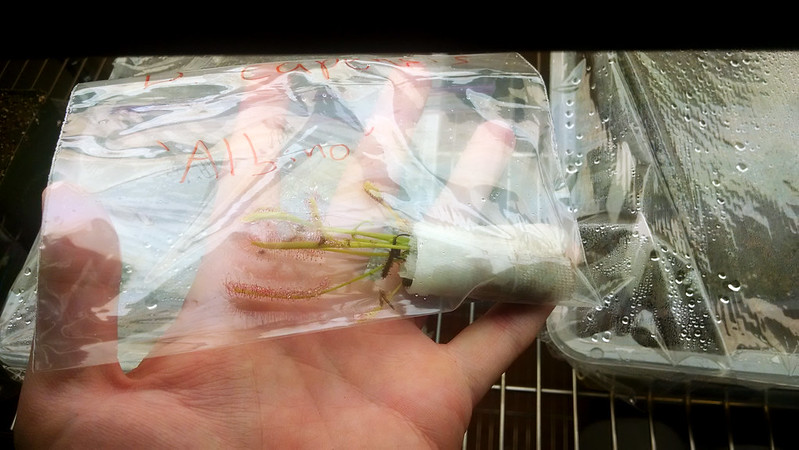
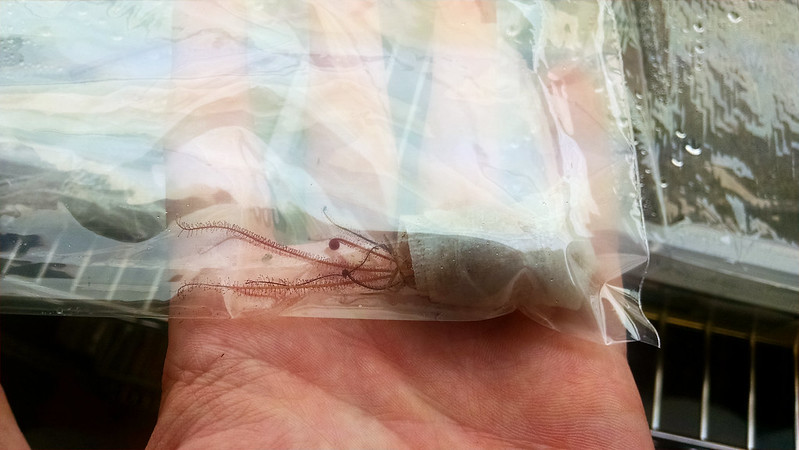
I just completed a trade with a poster on Terra Forums who was initially looking for some Utricularia graminifolia (I've had a pot for a while, though I haven't posted much about it). In order to make everything worthwhile, we wound up with me sending some U. graminifolia, Drosera prolifera, Drosera filiformis Florida Red, and Drosera capensis 'Albino' and receiving Drosera affinis, Pinguicula 1717, Drosera capensis Bainskloof leaf cuttings, and seeds of Drosera sessilifolia and Drosera burmannii Giant Red (Hann River, Kimberley, WA, Australia). This was a very exciting trade for me, since I've been looking for D. capensis Bainskloof and D. sessilifolia for some time.

First up, sending plants. Sundews should be shipped bare root, with as much media rinsed off the roots as possible (this helps prevent accidentally spreading weeds or pests). These should then be wrapped in a portion of wet long-fiber sphagnum, and wrapped again in a damp paper towel. This can be placed in a plastic baggie. See below
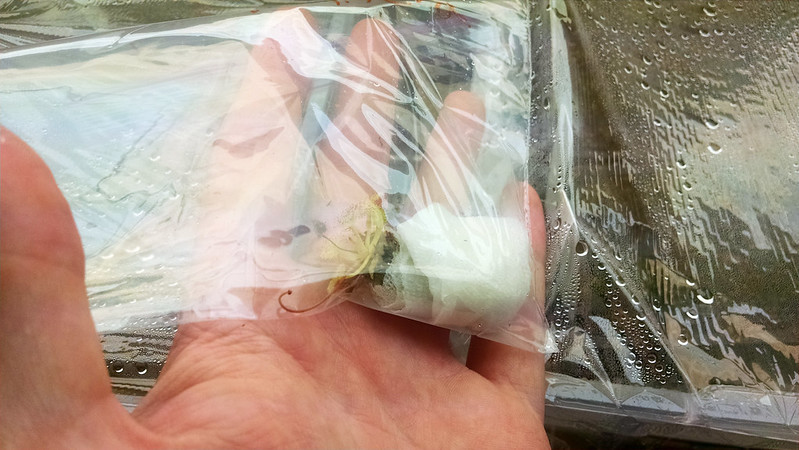
Drosera prolifera ready to be shipped
D. prolifera plantlet, off to a new home.
Drosera capensis 'Albino' ready to be shipped
D. capensis 'Albino' is the largest plant I shipped today.
Drosera filiformis Flordia Red, ready to be shipped
Once again, D. filiformis Florida Red proves to be popular trading material.
For terrestrial Utricularia it's a little different. In their case, just dig out a plug of plants and media from your pot, and wrap it in a damp paper towel to hold it together. Then, into the baggie.
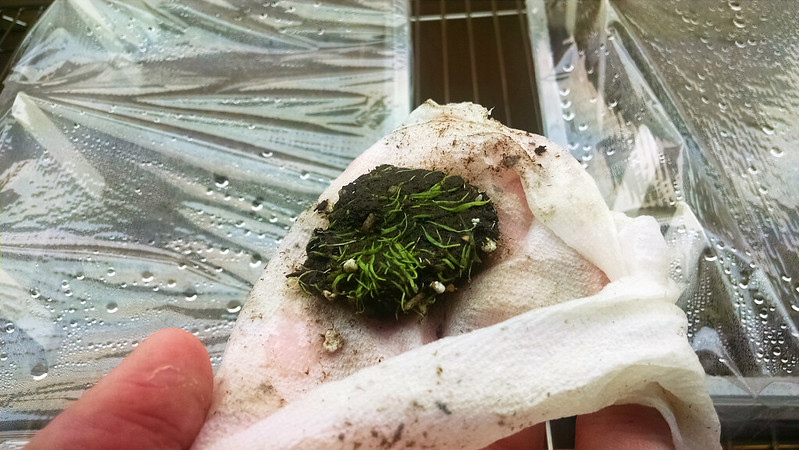
Utricularia gramnifolia plug
This is about the size of the plug of U. graminifolia that I started with.
Utricularia gramnifolia ready to ship
All wrapped up safe.
Make sure to label all your plants clearly with as much information as possible. Species, cultivar, location data, etc. are all important pieces of information for the future owner. Once you've done that, it's time to pack up and ship.

I use the USPS small flat-rate Priority mail boxes.
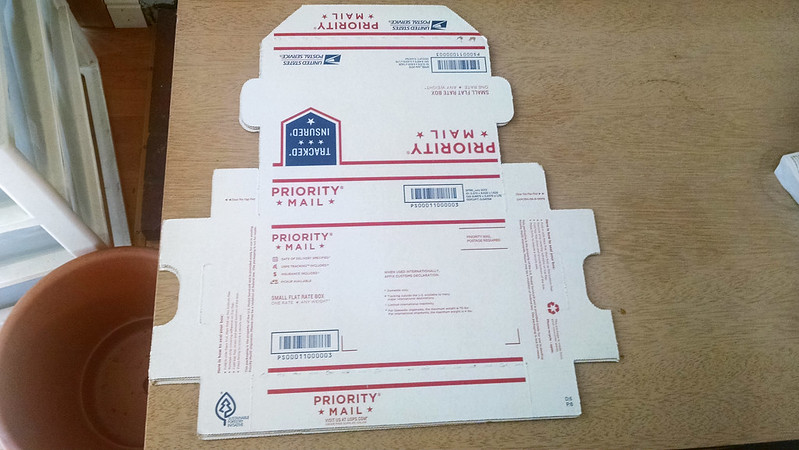
Small flat rate box
Non-flat rate boxes can be affordable, but they're less predictable.
The boxes themselves are free, and shipping is only $5.80 for guaranteed 3-day delivery. That's about the sweet spot for shipping plants – anything quicker is exorbitantly expensive, and going cheaper puts the plants at risk with long shipping times. I find I can usually fit 3-4 smaller-sized plants in one box. If I were shipping mature specimens of larger species I'd have to use a different container.
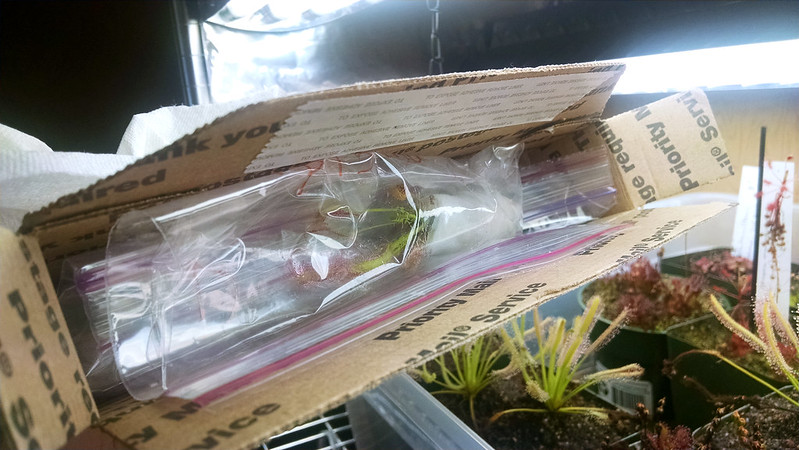
Flat rate box all packed.
I like to cushion my boxes with dry paper towels if I don't have other packing materials.
It's always best to ship at the beginning of the week, so that plants don't sit around in a post office over the weekend. Also keep the temperatures in mind – plants can be lost to freezing or baking hot weather on the receiving party's end.

When you receive plants in the mail, it's important to pot them up right away. They're probably stressed out from shipping, and getting them settled in quickly will make a big difference in how quickly they bounce back. It's good to have some media prepared in advance.
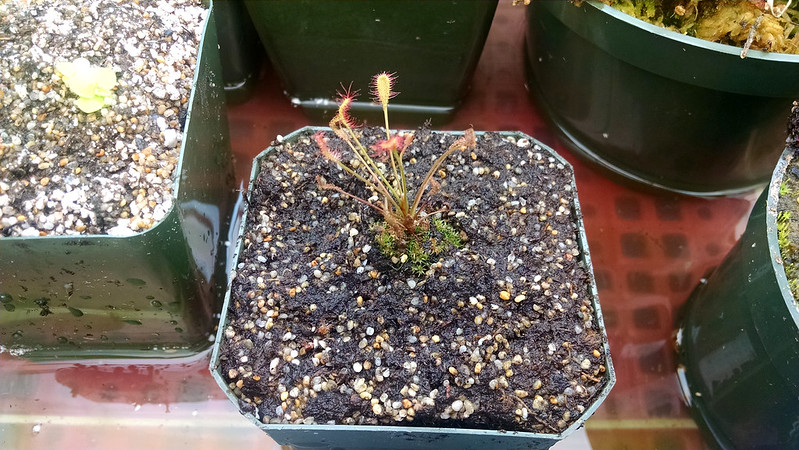
Drosera affinis
Looking forward to seeing this D. affinis get bigger.
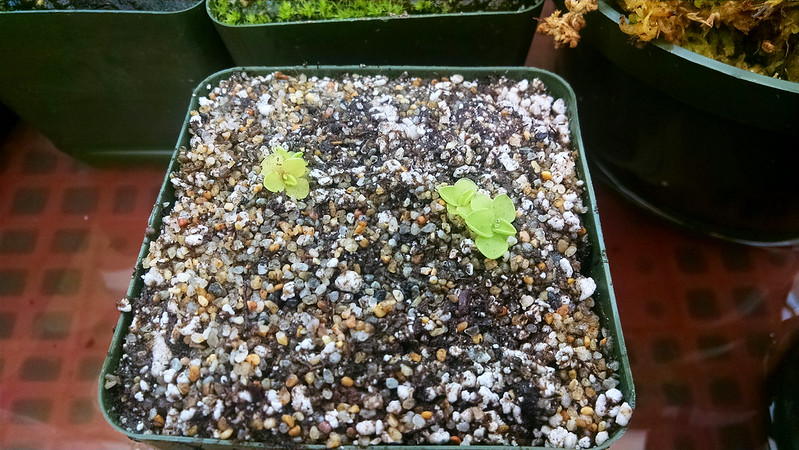
Pinguicula 1717
This media has a lot of perlite in it for these pings.
One thing that I've come to find really helps my plants recover from any stressful situation, be it shipping or repotting or whatever, is much higher humidity. Therefore I now put a plastic baggie over the pots of my new acquisitions. This is also useful as insurance in case the plants you receive were accustomed to much higher humidity than your setup provides – the humidity tent allows them to be hardened off slowly, rather than potentially shocked to death.
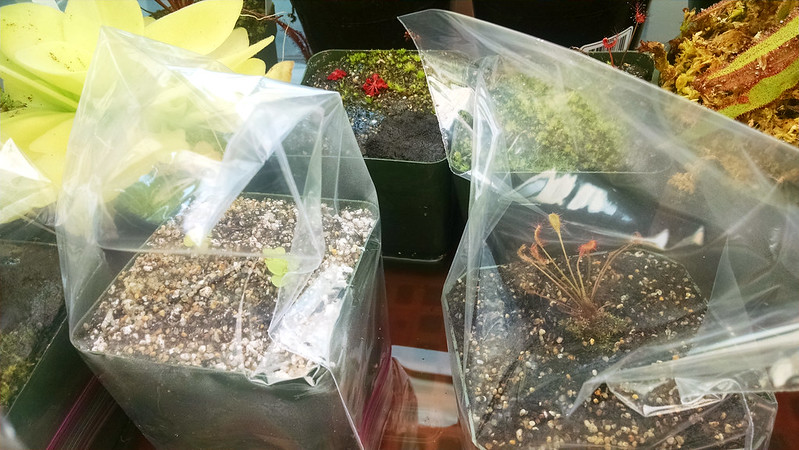
Drosera affinis and Pinguicula 1717 in humidity tents.
I really like using humidity tents.
Since I received 2 leaf cuttings of D. capensis Bainskloof I decided to start one in water, and one on the media. This provides a bit of insurance in case one technique fails utterly.
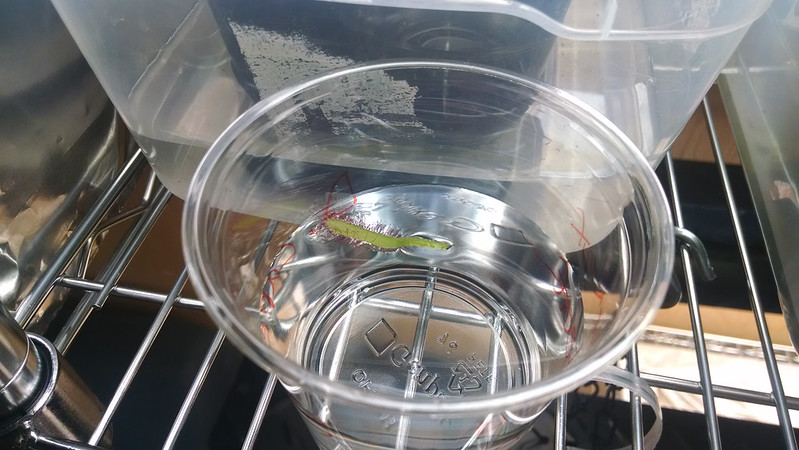
Drosera capensis Bainskloof leaf cutting in water
I've not had much success with the water-float method and D. capensis previously, but maybe this time will be different.
Drosera capensis Bainskloof leaf cutting on media
My fingers are seriously crossed for this leaf cutting.
Finally, shipping seeds. Sundew seeds are tiny, sometimes hilariously tiny, which means shipping them safely can be a challenge. My personal favorite method is to make seed packets out of parchment paper, and envelopes out of printer paper. That way there is no tape or glue to catch the seeds, and the tension of multiple folds keeps the seeds well-contained. The fellow I traded with used pieces of rolled and then folded paper and tape that actually worked pretty well, but I still think the above method is the best I've seen.
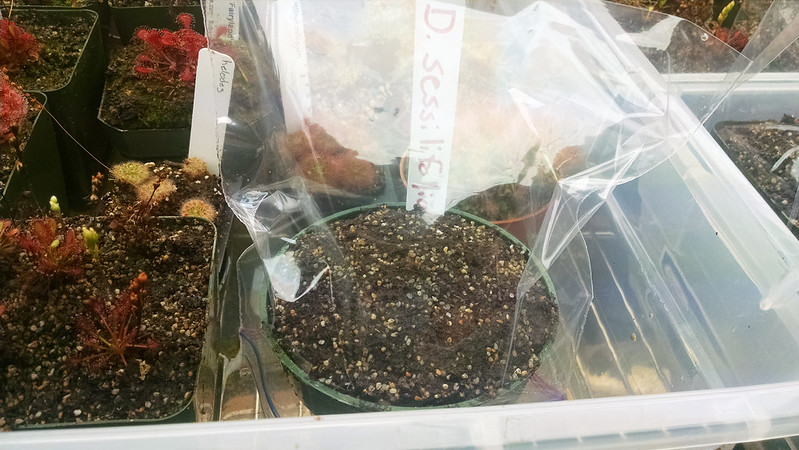
Drosera sessilifolia seed starts
Super pumped to be growing D. sessilifolia. Ever since I learned about its relationship with D. burmannii I've wanted some.
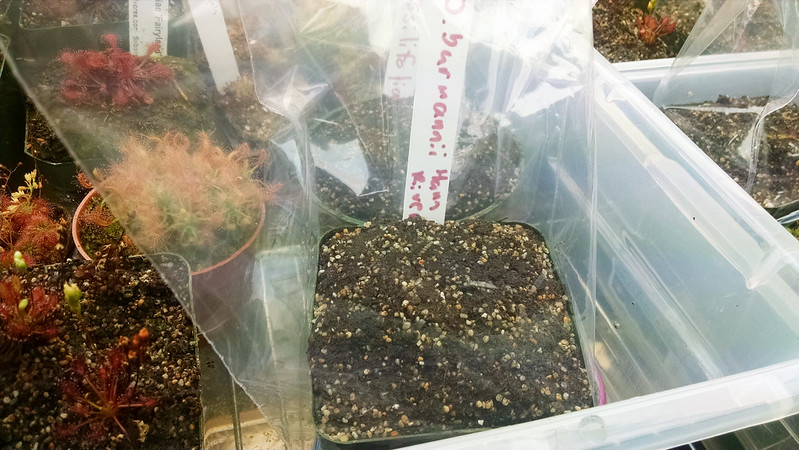
Drosera burmannii Giant Red (Hann River) seed starts
This is a different locality than my D. burmannii Humpty Doo, but I suspect it will look fairly similar.
Finally, remember to label your plants! Eventually you're going to reach a point where you no longer remember what's in each pot. Labeling will help you stay organized and make it much easier to trade in the future (nobody wants an unidentifiable mystery plant).

Happy trading.